Monday, April 25, 2011

Spring Wildflowers

First, a warning: the evil has leafed.  The evil is Poison Ivy (Toxicodendron radicans), enemy of hikers, campers, dog owners, and backyard brush clearers.  Poison Ivy thrives anywhere there is an ecological edge which, in this vastly human-disturbed landscape, is just about everywhere – along roads, along creeks, along trails, along fences, at the edge of the woods, at the edge of the lawn, or at the edge of a clearing.  In other words, it grows just about everywhere you might go looking for wildflowers.

Poison Ivy always has trifoliate leaves, or leaves composed of three leaflets.  The terminal leaflet is symmetrical and has a longer petiole (leaf stem) than the side leaflets, which tend to be slightly asymmetric, with deeper notches on the bottom side of the leaf.  The overall size of the leaves, and how deeply lobed or notched the leaflets are, varies greatly, as does the overall habit of the plant.  Poison Ivy grows as a shrub, ranging in size from a single twig to a thicket in the forest understory, or as a vine that climbs up the trunks of trees or the sides of rocks.  The most successful Poison Ivy plants that I have seen are in east Austin, along Boggy Creek, where they have attained "tree" status.  At first glance, a tree grows along the creek, but on closer inspection, the "tree" is actually a massive explosion of lush Poison Ivy vines being supported by the trunk of a long-dead tree.  Think Medusa's hair, the plant version. 

In the spring, when the trees are leafing and the wildflowers are blooming, the leaves of Poison Ivy are shiny green and especially appealing, but be forewarned that the shininess of the leaves is in part due to the oils that the plant produces, which contain urushiol, a compound that causes mild to extreme skin irritation in most people.  Hence the "poison" part of the name.  The best defense against Poison Ivy is to learn to identify its leaves and to avoid them.  And, despite the variability of the plant, knowing it, as in being able to spot a single leaf in a forest, is quite possible because the plant has a very strong presence.  Even in winter, its twigs have a certain curl to them, and its hairy, older vines hum with warning, seeming to simultaneously draw attention while saying, Stay away from me.  So, learn its leaves, because they literally are everywhere, even leaping, looking friendly and pretty and all spring green, across the well-used Homestead Trail at McKinney Falls.

Poison Ivy (Toxicodendron radicans) leaping into the trail

It's been a couple of weeks since Lee and I hiked the Homestead Trail – a couple of long, hot, rainless weeks for April – so, while I thought I was capturing the start of the wildflower season, I was actually lucky to capture a variety of wildflowers in their short moment this spring, before the especially-early summer began.  One of the first flowers that I spotted along the trail was Blue-Eyed Grass, a perennial herb that blooms only in the spring.  Many varieties of Blue-Eyed Grass (Sisyrinchium spp.), which is related to the iris flower, grow in open woods and grassy areas throughout central Texas.  It is difficult to distinguish between species because they hybridize with each other, producing many variants.

Blue-Eyed Grass (Sisyrinchium sp.)

Blue flowers, more of a rarity in the yellow-dominated fall, are well represented among the spring wildflowers.  Baby Blue Eyes (Nemophilia phacelioides) is a blue-flowered spring ephemeral, meaning that it blooms briefly in the spring and disappears by summer.  Like other spring ephemerals, such as Missouri Violet, Baby Blue Eyes grows in moist, shady woodlands, where it does most of its quiet growing in the winter, after the leaves have fallen from the trees overhead, allowing more sunlight to reach the forest floor.  The plants bloom in the early spring, just before the trees leaf out and, in blooming, become visible to us, signaling that spring has arrived.  But just as quickly as they are visible, the spring ephemeral herbs die back under the leaf litter until next year, earning their ephemeral reputation.  The blue flowers of Baby Blue Eyes attract butterflies, moths, and bees during their brief bloom period in March and April.

Baby Blue Eyes (Nemophilia phacelioides)

Another spring-blooming blue flower is Giant Spiderwort, which is common throughout my east Austin neighborhood, where it blooms in shady spots and abandoned lots in March and early April.  Like many early bloomers, Giant Spiderwort (Tradescantia gigantea) is a perennial herb that emerges from its roots in the fall, grows up to three feet tall during the winter, blooms in early spring, and dies back in the hotter weeks of late spring.  The color of the flowers varies from deep blue, when the plant grows in acid soils, to purple, to pinkish purple, when the plant grows in alkaline soils.  Though I did see a few of the plants blooming along the Homestead Trail, this picture is from my backyard in east Austin, where Spiderwort blooms purple.

Giant Spiderwort (Tradescantia gigantea)

Among spring wildflowers, in contrast to fall wildflowers, there are also many monocots, including Blue-Eyed Grass and Spiderwort.  This is because many monocots, like irises, tulips, and crocuses, regrow from bulbs or corms in the soil, growing and blooming in the cooler, moister winter and spring, then dying back in the hotter summer.  Onions and garlic are examples of monocots in the Lily Family that grow from underground bulbs.  Wild Garlic (Allium drummondii) is native to Texas and the Plains states to the north, forming large colonies in fields, pastures, and other grassy areas.  Wild Garlic blooms March through May in flowers that range from white to purple-red.

Wild Garlic (Allium drummondii)

Another Lily Family plant that blooms in the spring is the Rain Lily, a striking white-flowered herb that also regrows yearly from an underground bulb.  The blooming of the Rain Lily (Cooperia pedunculata) is triggered by rainfall, so in years when we have ground-soaking rains in April and May, fields and open woodlands seem to sprout an abundance of the white flowers overnight.  In drier years, like this one, the Rain Lilies are fewer and are restricted to moister, shadier spots.

Rain Lily (Cooperia pedunculata)

Southern Dewberry is a common plant in our area, growing as thorny vine that forms thickets along fences and roadsides.  Its bloom period is brief though, in March and April, and, in that, it joins the ranks of the spring wildflowers.  Southern Dewberry (Rubus trivialis) has flowers characteristic of the Rose Family, with five non-fused petals, lots of stamens, and many carpels.  The flowers, if pollinated, develop into summer blackberries, which provide food for wildlife.

Southern Dewberry (Rubus trivialis)

Another common wildflower that begins blooming in spring and continues throughout the summer and into the fall, rainfall permitting, is Yellow Wood-Sorrel, a perennial herb that is a common garden and greenhouse weed throughout North America.  Yellow Wood-Sorrel (Oxalis stricta) has trifoliate leaves that resemble three-leafed clover leaves and five-petaled yellow flowers.

Yellow Wood-Sorrel (Oxalis stricta)

The Homestead Trail is mostly shaded as it winds through a woodland of Cedar Elm, Hackberry, Ashe Juniper, and Mesquite trees, but it also passes through more exposed areas.  On one such rocky hillside, I found a Two-Leaved Senna, a Prairie Larkspur, and Pink Mimosa flowering side by side amidst last fall's dead grasses.  Pink Mimosa is a shrub of rocky hillsides, canyons, and limestone soils that blooms in pink to white puffballs in the spring.  The leaves of Pink Mimosa (Mimosa borealis) are twice pinnately compound, meaning each leaflet is composed of many tiny sub-leaflets, giving the leaves a feathery appearance.  Puffy mimosa flowers provide nectar for bees and butterflies.

Pink Mimosa (Mimosa borealis)

Prairie Larkspur (Delphinium carolinianum), a spring wildflower that prefers sandy soils, also grows in open woods, fields, and roadsides.  Prairie Larkspur blooms from April to June and its flowers range in color from white to pale blue to blue violet.

Prairie Larkspur (Delphinium carolinianum)

Two-Leaved Senna (Senna roemeriana) is a perennial Pea Family shrub that grows in fields or dry, open hillsides with limestone soils.  Two-Leaved Senna gets its name from its leaves, each of which is a symmetric pair of leaflets resembling one, divided leaf.  From April through October, Two-Leaved Senna produces yellow, five-petaled flowers that attract birds and butterflies.  The shrub is a larval host to sulfur butterflies, and its seeds are an important food source for central Texas birds.

Two-Leaved Senna (Senna roemeriana)

At the northern end of the Homestead Trail, the trail passes by a Texas Parks Department building, which is surrounded by a field of wildflowers.  The mix of wildflowers in that field resembles the mix of colors along many of our major roadways, leading me to believe that, just as the highway department seeds the wildflowers along the right-of-way, the parks department probably seeded the Texas Bluebonnets, Indian Paintbrush, and Antelope Horns decorating the field behind its building.

Texas bluebonnet, state flower of Texas, is the classic spring wildflower.  Bluebonnets are winter annuals that germinate after the fall rains, grow as rosettes through the winter, and bloom in the spring.  Texas Bluebonnets (Lupinus texenis) have palmately-compound (fan-shaped) leaves and white-tipped, blue flower spikes.  Up close, the flowers are blue with white centers and resemble sweet pea flowers.  Within a flowering spike, some of the older flowers have maroon or purple centers instead of white centers; the maroon-centered flowers have already been pollinated and, lacking the white accent, are now less attractive to bees, butterflies, and other pollinators.  Texas Bluebonnets grow in abandoned fields and pastures and thrive in the alkaline, limestone soils of central Texas.  The seeds of bluebonnets have been spread throughout the state by the highway department, making the blue flowers common along major Texas roadways in the spring.

Texas Bluebonnets (Lupinus texenis)

Indian Paintbrush (Castilleja indivisa) was originally native to the Llano Uplift region of the Edwards Plateau, where it thrived in sandy soils.  Like the Texas Bluebonnet, however, the Indian Paintbrush has been distributed throughout the state by the highway department, so now it is common to see the bright red flowers of the Indian Paintbrush in the same pasture or roadside as the striking blues of the Texas Bluebonnet.  Indian Paintbrush is hemi-parasitic, or partly parasitic, in that it grows its roots into the roots of other plants, such as grasses, and steals their nutrients.  The flowers of the Indian Paintbrush attract butterflies, and the nectar of flowers is a food source for hummingbirds and insects.

Indian Paintbrush (Castilleja indivisa)

My current favorite spring wildflower looks to me more like an alien life form than a wildflower.  A member of the Milkweed Family, Antelope Horns (Asclepias asperula) is an important food source and larval host for monarch and queen butterflies.  Antelope Horns grows in open fields and along roadsides, thriving where the soil is rocky or sandy.  The large, round inflorescences of Antelope Horns appear otherworldly, improbably large and solid for such low-growing plants, but to many pollinators, including a bees, flies, butterflies, and birds, each globe of flowers offers a buffet of nectar in a otherwise hot and dry spring.

Antelope Horns (Asclepias asperula)

Along the trail, as it wound into and out of the woodlands, crossing and recrossing the mowed park road, I also saw some of the less famous, but just as steady and reliable, of the wildflowers that decorate our roadways in the spring.  Engelmann's Daisy is one such common roadside wildflower that grows in open fields and dry, upland soils.  Engelmann's Daisy (Engelmannia peristenia, formerly E. pinnatifida) can be distinguished from other yellow sunflowers by its spring blooming time and long leaves with deeply wavy borders.  A drought-tolerant perennial, Engelmann's Daisy is abundant and ecologically important in central Texas, providing nectar for insects, seeds for birds, and forage for livestock.

Engelmann's Daisy (Engelmannia peristenia)

Another roadside wildflower, the Evening Primrose, put on a good show this year, decorating roadsides throughout Austin in pink for most of late March and early April.  Pink Evening Primrose (Oenthera speciosa) is a perennial herb that spreads from rhizomes, or underground root runners, forming extensive colonies in fields and along roadsides.  Evening Primrose is drought tolerant and thrives in full sun, making it a reliable ground cover and wildflower even in dry years such as this one.  The flowers are distinctive, with long, four-branched stigmas and pink-white petals, and the seeds are food for native finches.

Pink Evening Primrose (Oenthera speciosa)

Prairie Verbena is a perennial herb that grows in open, grassy areas.  Prairie Verbena (Glandularia bipinnatifida) is very common throughout the state, where it blooms from spring through fall, rainfall permitting.  I've noticed that this month, as the heat and drought have progressed, Prairie Verbena has held its place along the roadsides as other spring-only wildflowers have faded.  Prairie Verbena has highly dissected leaves (or highly pinnatifid leaves, hence its Latin name) and nectar-rich flowers that attract birds and pollinating insects.

Prairie Verbena (Glandularia bipinnatifida)

After walking the Homestead Trail, we looped around from the Lower Falls to the Upper Falls then back to the parking lot along the shadier, rockier Rock Shelter Trail, where the red flowers of Cedar Sage decorated the ledges above Onion Creek.  Cedar Sage (Salvia roemeriana) is adapted to growing in the shade and leaf mulch of Ashe Juniper, known locally as Cedar trees, which is how this native sage got its name.  Cedar Sage grows on limestone ledges and rocky canyons throughout the Hill Country, attracting hummingbirds and butterflies with its flowers in spring and early summer.

Cedar Sage (Salvia roemeriana)

Tuesday, April 5, 2011

The Tomato-Growing Habit

Every year I forget about the smell of tomato plants.  I remember, or think I remember, in the way that memories are never quite accurate, the sweet-tart taste of homegrown, vine-ripened tomatoes, I tell stories about that rainy summer when tomatoes covered every kitchen surface for the month of June, and I look forward to the tomato-basil-eggplant meals of late June and early July.  But I also remember what a pain tomato plants are, with their narrow planting window, tendency to overgrow themselves, incessant water needs, and inability to set fruit once nighttime lows creep past the mid-80's.

In fact it's something of a mystery why gardeners are so loyal to tomato plants, especially here in Austin.  In the same season that homegrown tomatoes ripen, excellent, locally-grown tomatoes are cheap and plentiful at the farmer's markets, at the food co-op, or, recently, even at the big grocery stores.  Tomato plants are demanding, requiring extra space, fertile soil, and regular watering, especially in the heat.  They grow so fast that even the cutest, healthiest tomato plant will quickly grow into mess of under-supported vines that definitely doesn't hide within a decorative or front-yard garden.  And, despite the fact that they are hot-season plants from the tropics, tomato plants, unlike their long-season, workhorse relatives, the peppers, can't actually make tomatoes in the heat of summer.


When I first had a garden here, I made the beginner's mistake of thinking that I had the whole, long summer to grow tomatoes.  After all, in Oregon, where I grew up and first smelled a tomato plant, tomatoes needed every minute of summer sun that they could get, rarely producing much fruit before late August or September.  In some years, when the rains extended into July, or when partly-cloudy conditions ruled the so-called summer, the tomatoes didn't ripen until October, or didn't ripen at all.  So when I began gardening in Texas, I was shocked to find out that our tomato-growing season was actually quite short, limited on the spring-side by the last killing freeze, which usually occurred in early March, and limited on the summer side by the nighttime low temperatures.  In a cool, wet year, tomatoes produce well into July, but in a hot, dry year, when daytime temperatures climb into the 100's early in the summer, dragging the nighttime lows up into the mid-80's, tomatoes stop setting fruit as early as mid-June.  The summer before last – remember when it was 107˚ F in June? – my tomato plants stopped producing almost as soon as they had started.

Despite the challenges, tomato growing is central to vegetable gardening in Texas.  No other time of year is more crowded or crazy at the local nurseries than the last few weeks of March, the official tomato-planting window.  When the trees are leafing, the wildflowers are blooming, and the smell of nectar is in the air, even the most occasional of gardeners is pulled outside, to dig up a square of yard and plant something.  But why tomatoes?  Why not peppers, which are more drought-tolerant and produce throughout the summer and fall?  Why not basil, which doesn't keep for long, even fresh from the farmer's market, but is easy to grow and loved by the bees?

I think that tomatoes have us hooked on their smell.  Not the smell of the tomato fruits, but the smell of the tomato plants, that sticky, gummy, viscous smell of hairy vines.  Plants are masters of biochemistry – some, like poison ivy, make toxins that repel us, some, like poppies, make opiates, both real and figurative, that intoxicate us, and some, like apple trees, make the sugars that we crave.  My theory is that somewhere within the sticky, green, summery smell of the tomato vine is a chemical that stimulates a combination of home-comfort-warmth-of-summer receptors in my brain.  The first year that I learned to grow tomatoes properly, Texas style, at the community gardens, the smell of those plants transported me to childhood, to my mother's garden, to that feeling of warmth and perfectness and peace that comes only at the height of summer in Oregon.  I couldn't believe that I had forgotten about the smell of those plants, the essence of summer garden, and realized at that moment that, while fall gardening may make more sense in Texas, I had to grow summer garden, even if it did mean taking my chances with the summer itself.


So I grew tomatoes at community garden plots for several years, and I learned, by copying the most-successful of my neighboring gardeners, how to work within the rushed season – to plant transplants, not seeds, in mid-March, to protect the baby plants using clear plastic sheeting, to give each plant plenty of space and an industrial-strength tomato cage, not one of those flimsy things from the garden-supply store, to mulch heavily, and to expect the season to be over by mid-July.  And I had some successful years, especially the rainy-June summers of 2003 and 2004, when I harvested so many tomatoes that I had to learn how to do water-bath canning.

Then I moved into this house, with its yard, and gave up my community garden plot because I wanted to direct my gardening energies into this property.  Which was a lovely idea, but, given the slope of the property, the shade in the backyard, how overgrown the yard was, and my limited time, I spent the first few years here simply keeping the weeds down and planting a few annuals in the garden by the driveway.  Three falls ago, I located, cleared, and mulched a small, almost-level patch of sunny ground to make a vegetable garden, and the following spring I over-planted the space with tomatoes, peppers, and basil.  The tiny garden was overcrowded, and the season ended early because of the heat.  But, once again, as I squeezed myself between the tomato plants and the wall of the house to water, I smelled those plants, and was struck with how I had forgotten about that smell, and began making plans for next year, for a bigger tomato garden.

Next year turned to the year after, which brings me to the present.  I almost bailed on the project a few times, but I kept telling myself, I want a tomato garden along the south wall.  So I cut down the last of the remaining weedy shrubs along the house and built a retaining wall to tame the double slope, away from the house and toward the back of the house. 


Then I amended the soil with compost and peat moss and set out my tomato cages to see how many baby tomato plants I could buy. 


The plants established quickly and, by the end of March, doubled in size. 


Recently, after watering, I pinched a few sucker stems off the tomato plants.  Once again, I was struck by that tomato plant smell, sticky and hairy and green, transporting me back to my garden two years ago, to the rainy summers at the community gardens, and to my mom's garden so many years ago.  I guess, in a way, I grow tomatoes not just for this summer's garden but also to remember all to the gardens of summers past, and to remember how good it feels to be immersed in summer.

Tuesday, March 22, 2011

Red Buckeye

I have a fondness for Red Buckeyes.  They were one of the first wildflowers that I learned to identify in Texas.  They are one of the earliest bloomers along Barton Creek, and they have bright red, tubular flowers that they hold right at eye level, like a trail-side banner announcing the arrival of spring.  Buckeyes also have distinctive, palmately-compound leaves shaped like five-sided stars.  Their leaves emerge even earlier than their flowers, all bright green and shiny and so stiffly-creased that they remind me of newborn horses struggling to stand on all four legs.

Red Buckeye (Aesculus pavia) new spring leaves

I first met the buckeyes, the Aesculus genus, in northern Ohio.  I was an undergrad doing a research project and my mission was to survey the understory plants of floodplain forests.  The problem was that it was winter, and winter in northern Ohio was no joke – biting cold, lots of snow, and not a leaf to be found on any of the young trees that I was trying to identify.  I had to learn to distinguish between the mess of sticks that was the winter forest understory using branching patterns and overwintering buds, and I quickly found that, among temperate trees, alternate branching was more common than opposite branching.  If mycologists had their "LBM's," or little brown mushrooms, so many average-looking, average-size mushrooms, that winter I struggled with the "ABB's," or alternate brown buds, so many alternate-branched trees with frustratingly average-looking brown buds.

What saved me were the opposite-branched trees – the maples, the ashes, and the buckeyes – and their uncomplicated branches.  The Ohio Buckeyes (Aesculus glabra) were particularly easy to spot, with thick, opposite branches and fat, shiny, many-scaled buds that stood out even in the stark Ohio winter.  I am a buckeye, they shouted, and they were common in the most disturbed and saddest floodplain sites that I visited.  They became early friends, lending me a sense of competence long before I could tell an elm twig from a cherry twig just by the angles and lines, and inspired me to keep on with my baggies of twigs and identification keys.

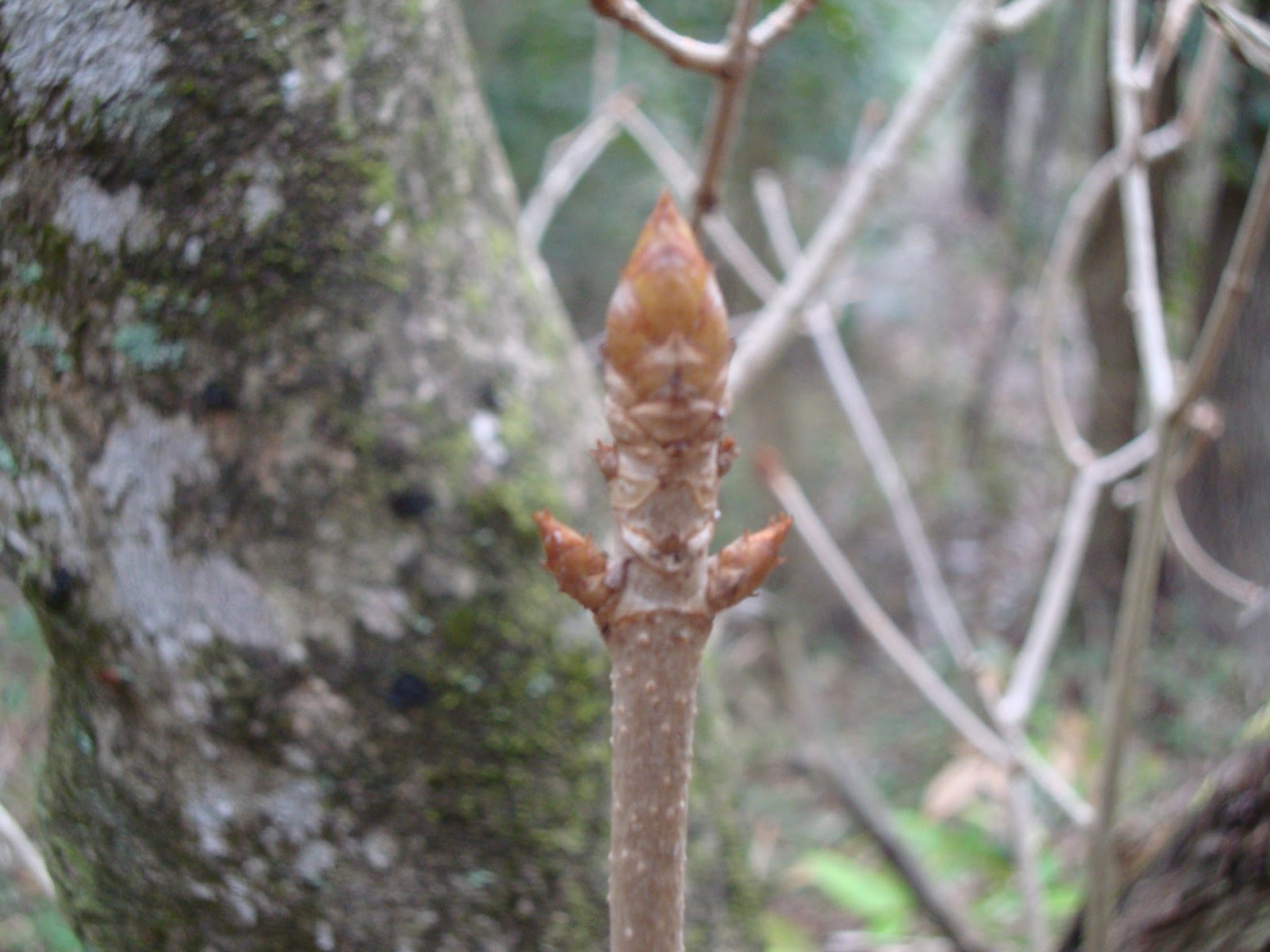
Red Buckeye (Aesculus pavia) overwintering buds

A couple of years later, when I moved to Austin, discovering the Red Buckeyes (Aesculus pavia) along the Greenbelt was a reunion of sorts.  Just as their relatives had in Ohio, the Red Buckeyes stood out in contrast to the late winter landscape, with fat terminal buds that swelled and turned red as the new spring leaves began to emerge.  Even more amazing, these familiar shrubs produced amazingly showy tubular flowers in clusters of red to pink to peach, flowers that I would expect to see on display in a botanical garden, not in flower in early spring in the xeric woodlands of central Texas.  I had trouble believing that these beauties were native wildflowers.

Red Buckeye (Aesculus pavia) flowers

Two varieties of Red Buckeye are native to central Texas – the common, red-flowered variety (Aesculus pavia var. pavia), which grows throughout the southeastern US as a small tree or large shrub, and a yellow-flowered shrub (Aesculus pavia var. flavescens) that is endemic to the western Edwards Plateau.  West of Austin, in the midst of the Hill Country, the two varieties hybridize and form peach- to pink- to orange-flowered varieties.  The showy flowers of both varieties appear in early spring, February to April, attracting hummingbirds, butterflies, and bees.  For me, spring has officially sprung when the buckeyes along the Greenbelt begin to bloom.

This year, the buckeyes began blooming later than usual due to the cold weather of early February, and it took three trips to the Greenbelt over the course of four weeks to document the shift from fat buds to open flowers. In mid-February, when the buckeyes begin blooming in some mild years, the overwintering buds were fattening and becoming more visible against the backdrop of late-winter browns but were showing no signs of opening into leaves yet.

Buckeye buds not yet open (February 19)

By late February, the buds on many buckeye shrubs had begun to open, turning pink as the leaves within began to expand.  On a few of the buckeyes, spring leaves were beginning to emerge, looking newborn, perfectly green, and not yet worn, torn, or faded by the rigors of the upcoming season.

Buckeye buds opening (February 26)

By mid-March, most of the buckeye shrubs had leafed out but were not yet flowering, still waiting for warmer, longer days and a stronger guarantee that the cold of winter was gone for good.

Buckeye after leaf out with flower stalk (March 13)

But a few buckeyes had begun to flower, officially beginning spring at the Greenbelt.  With the start of the central Texas summer less than two months away, that means that this spring, as with most springs, promises to be our shortest, fastest season.

Red Buckeyes begin flowering (March 13)

Thursday, March 3, 2011

First of Spring

Spring is the season of acceleration.  The sun shines warmer, closer, and longer, and the plants respond by growing faster and faster.  If we lived in a more temperate climate, I might have an easier time accepting this speeding up, but in central Texas the first warm day of spring reminds me of the many hot days of summer that are coming, and I can't help but feel a bit of dread as I watch the green of spring quickly overtaking the yellow of my winter-dormant front lawn.

In actuality, my lawn is really more of a mowed weed patch, and only part of the recent green glow is due to spring annuals, like Bedstraw, which looks innocuous now but which will easily take over the shadier parts of my yard in the next month or two.  Also germinating, or sprouting from last year's roots, are hardy perennial weeds like Straggler Daisy, which, once I have pulled or mowed the taller spring weeds, will have regained control of the shady sections of my yard by summertime.  But, while the Bermuda grass smartly waits a few more weeks to break its winter dormancy (if only it were so easy to kill the stuff), the real players in the sunnier parts of my yard are the winter annuals, those quiet, small weeds that germinated between the freezes and waited patiently for this, their moment of sunshine before the big weeds of spring take over.

Shepherd's Purse, a winter annual in the Mustard Family, is a reliable early season weed in my yard and it is easily recognizable by its flowering stalks holding heart-shaped fruits.  (Unfortunately I pulled a patch of them yesterday before thinking to take a picture.)  Henbit, a winter annual from Europe that has made itself at home in yards and disturbed areas throughout the US, also flowers in early spring, covering many lawns in east Austin with its tiny purple flowers.  Up close, Henbit (Lamium amplexicaule) has the attractive, tubular flowers and upright, square stems characteristic of the Mint Family.  Henbit grows close to the ground, making it a nice early-spring ground cover for those of us who aren't concerned about lawn purity, but, for serious lawn growers, I imagine that it is the first enemy of the season.

Henbit (Lamium amplexicaule) in a lawn

The real announcement that spring is here, though, doesn't come from the weeds in the lawn but from the trees above.  The American Elm (Ulmus americana) trees are always the first to bloom, usually in the first week of February.  This year, with our two coldest weeks at the start of February, the elms waited until later in the month.  Their tiny flowers were hardly noticeable except for the faint, green glow on the trees and the first of the spring pollen levels.  After flowering, the elm trees produced loads of light green, wafer-like fruits called samaras.

American Elm (Ulmus americana) samaras

Once they have matured and dried, the elm samaras will carry the seeds of the tree on the wind, much as maple-tree flyers (also a type of samara) do.  But for now, while the elm trees are covered in the young, green samaras of early spring, they are the most visible trees in the neighborhood, highlighted in the green glow of spring long before the surrounding trees have begun to leaf out.

American Elm (Ulmus americana) covered in samaras

While the elm trees are lit up in green, the cherry and plum trees of the area are covered in white flowers that are sweet-smelling as well as attractive, much to the delight of many nectar-starved bees, flies, butterflies, and wasps.  In the weeks right after the late-season freezes, the honeybees were so desperate for food that I was regularly finding them in my kitchen, drinking from the dish sponge, so it is a relief to see them employed again, happily buzzing from one spring blossom to another.

Cherry or plum tree (Prunus sp.) in flower

Two native species of plums, Mexican Plum (Prunus mexicana), a small tree common along waterways, and Creek Plum (Prunus rivularis), a thicket-forming shrub, contribute to the early-spring show of white flowers in and around Austin, but in town many ornamental species of plum and cherry also bloom at the start of spring, making identification difficult.  Plum and cherry trees bloom in clusters of white flowers that appear before the leaves or just as the leaves are opening.  Their flowers are five-petaled, with the many stamens and the radial symmetry characteristic of Rose Family flowers.

Cherry or plum (Prunus sp.) flowers

Texas Redbud (Cercis canandensis var. texensis) is a small, Pea Family tree that also blooms in the early spring, before its heart-shaped leaves expand.  Its rose-purple flowers decorate yards, parks, and wild spaces throughout Austin from late February and to early April, attracting bees, butterflies, and moths.  Texas Redbud is a drought-tolerant variety of the Eastern Redbud (Cercis canadensis) that is adapted to the limestone soils of the Edwards Plateau. 

Texas Redbud (Cercis canandensis var. texensis) flowers

The beauty of spring is in the stark contrast, of spring green in an otherwise brown landscape, or of bright white or purple against a deep blue sky.  To appreciate it, I had to get out in it, to feel the warmth of the sun and to smell the plum blossoms.  Then I got my shovel and gardening gloves and did some digging and weeding on the south side of my house, where the afternoon sun is concentrated.  Out in it, with my hands in the soil, my sense of dread, that spring and summer and all the planting deadlines in between are looming, finally faded away.  Because spring, short and fast as it is in central Texas, is a season of doing, not of worrying about the summer to come.

Sunday, February 27, 2011

The Greenbelt in February

I go to the Greenbelt to get away – away from my house and yard and all the work that needs to be done, away from all the distractions embedded in my daily routine, and away from my day job, which is "easy" and hourly yet still manages to come home with me.  The physical act of walking releases the catch in my brain that holds all those spinning thoughts, allowing the smells and sights and sounds of the woods along the creek to grab my attention and pull me out of my head and onto the damp trail under my feet.  So maybe it would be more accurate to say that I go to the Greenbelt in order to return, or to reset, to close all those windows that are open in the computer screen of my mind and to restart with just one focus, the plants of the forest along the creek.

Which is a huge expectation to have on the creek, and the trail, and all the plants that grow along it.  In that state of mind, distracted and restless and not sure whether I was ready to embrace the late start of spring, the season of acceleration, I went to the Greenbelt expecting to be dazzled by bright, fat Buckeye flowers and vibrant spring ephemerals.  Instead I found quiet.  The creek was still running, though barely so and only along the upstream half of the Greenbelt, the trees were still leafless, and the browned, crispy, long-dead grasses and herbs of last summer and fall still lined the trail and the creek.  Even the once-purple berries of the Beautyberry shrubs had shriveled and turned black.  The obvious landscape of greys and browns certainly wasn't about to grab my attention.


But the creek, even when it's barely running, and the experience of being out in the woods, even when the branches are bare, still has the effect of slowing me down, and, despite my impatience, I began to appreciate the damp smell of the woods and the misty, almost-raining morning that was contributing to the quiet.  Then I noticed the plants that thrive in the cool humidity and quiet between winter and spring.  The mosses seemed especially happy with the misty, damp conditions.


The ferns growing from the rock walls along the creek showed signs of freeze damage, with browned leaves and partially dead fronds.  But the ferns or parts of ferns that had survived the freezes of early February were growing as happily as the mosses, enjoying the non-stressful, humid weather.

Cliff Brake Fern (Pellaea ovata)

Once I began noticing some green, I realized that, actually, at the ground level, green was overtaking the brown.  New blades of grass were emerging from the leaf layer and green rosettes of annual herbs were establishing themselves, gathering strength to become the wildflowers of spring.


In the understory, native winter berries – red Yaupon and blue-black Silktassel – added color to the branches of evergreen shrubs.  Berries also hung on the branches of non-native shrubs, escaped from cultivation, including the small, blue-black fruits on Japanese Privet trees (Ligustrum japonicum) and Chinese Privet shrubs (Ligustrum sinese).  Nandina shrubs held huge clusters of red-orange fruits.  Nandina (Nandina domestica), like Japanese and Chinese privet, is a native of Asia that was brought to the US for use in gardens and has escaped from cultivation.  Unfortuantely, Nandina, Japanese Privet, and Chinese Privet are invasive and are spreading into streamside habitats around Austin.

Nandina (Nandina domestica) berries

And, though small and subtle, not yet grabbing my attention in numbers but there to be noticed as individual dots of color in the underbrush along the trail, the earliest wildflowers of the season were just starting to bloom.  The first wildflower that I spotted this season was Golden Grounsel (Packera obovata), a sunflower-family herb with bright-yellow flowers.  Golden Grounsel grows as a rosette of almost-round to oval leaves that become deeply lobed when the plant makes a flowering stalk.  Golden Groundsel prefers to grow in moist, calcareous soils and blooms February through April, making it one of the first wildflowers of the spring in central Texas.  Its yellow flowers attract bees and butterflies.

Golden Groundsel (Packera obovata) leaves

Golden Groundsel (Packera obovata) flowers

Roemer's Spurge, an annual herb of moist, shaded woodlands, was also beginning to bloom.  Roemer's Spruge (Euphorbia roemeriana) has unique leaves and branching.  The lower leaves on a stalk are alternate and elogated, then a whorl of three leaves gives rise to three stems, each holding an inflorescence (cluster of flowers).  The bract at the base of the inflorescence is almost circular, made of two fused leaves.  The flowers are tiny and bright yellow, appearing on the plants late February through May.

Roemer's Spruge (Euphorbia roemeriana)

Missouri Violet, a perennial herb that is a common spring ephemeral in moist, streamside woodlands throughout the central United States, was also blooming.  Missouri Violet (Viola missouriensis) is a perennial herb that grows as a rosette of heart-shaped leaves and blooms early in the spring, in February through April in central Texas.  Flowers on the wild violets signal that spring, though delayed by the cold weather and slow to get started this year, is on the way.

Missouri Violet (Viola missouriensis)

Saturday, February 19, 2011

Growing Mushrooms

Ah, the fungus – beautiful, magical, mysterious, dangerous, and, most of all, misunderstood.  To most people, a fungus is a mushroom, but really the kingdom of Fungi includes yeast, molds, and a variety of other lesser-known fungi as well as the famous mushrooms.  Even the mushrooms themselves are only the tip of the iceberg of what they really are.  A mushroom is to a fungus as a flower is to a plant – simply a reproductive structure.  Just as the flower on a plant is supported by the roots and stems and leaves that make up the body of the plant, the mushroom that we see growing above ground is supported by the "body" of the fungus underground, a vast network of mycelium, or branching, thread-like hyphae that absorb nutrients from the environment.

Cool fungus on a tree in western Oregon

Fungi are decomposers who get their nutrition from breaking down dead and decaying animals, plants, and organic matter.  In this, their need for nutrition from outside themselves, they are more like animals than plants, and DNA comparisons have revealed that, indeed, fungi are more closely related to animals (yes, that includes humans) than they are to plants.  Needless to say that, after centuries of not seeing most fungi and viewing mushrooms as non-green plants, we are only beginning to understand how they operate.  In particular, figuring out how and when and under what conditions fungi reproduce has proven to be challenging for many species.  Until recently, an entire phylum, the Fungi Imperfecti, was reserved for those fungi who never appeared to reproduce sexually.  We don't know if or how they reproduce so we call them imperfect – talk about projection.

Yet not all fungi have proven to be so mysterious or difficult, and one species in particular, Agaricus bisporus, by virtue of its easy-to-initiate mushroom formation and reliable productivity, has become the mushroom that Americans grow, and buy, and eat, the most.  Agaricus bisporus, a native mushroom that can be found growing wild in parts of California, often in association with Monterrey Cypress trees, now accounts for 90% of mushroom production in the US.  There are two common strains of Agaricus bisporus – a white strain known as the button mushroom and a brown strain called the crimini mushroom (or baby 'bella) when harvested small, with closed caps, or the portabella mushroom when it is allowed to mature and harvested once the cap begins to open.

A few years ago, recognizing that I was a mushroom lover with grow-it-yourself tendencies, my mom sent me a button-mushroom-growing kit for Christmas.  The coldest months of the year turned out to be the best months of the year to grow mushrooms in central Texas, and I successfully harvested many mushrooms.  I also discovered that, just as a store-bought tomato can't match the flavor of a homegrown heirloom tomato, the ubiquitous button mushroom of the grocery store lacks the flavor and texture of a homegrown, freshly-picked mushroom of the same, humble variety.  Eaten raw in salads, fresh button mushrooms are sweet and juicy, with a texture just this side of crunchy.  Cooked in olive oil or butter, homegrown button mushrooms have the texture and meatiness of portabellas and are just as good with pesto.  Since that first year, the mushroom kit became something of a yearly tradition.

Homegrown mushroom pizza

This year, I received my mushroom-growing kit (from Pulpit Rock Mushrooms in southeastern Pennsylvania, the epicenter of US mushroom production) in mid December.  Inside the box was a large bag of compost with Agaricus bisporus mycelium growing throughout.  Agaricus bisporus is a secondary decomposer, meaning that it lives on compost that has already been broken down by bacteria and other fungi.  The compost in my mushroom kit was made from horse manure, with small amounts of nitrogen, gypsum, and water added.  The manure was composted for three weeks then spent a week in a high-temperature (140˚ F) room for sterilization.  Following sterilization, the compost was inoculated with mycelium from a white strain of the Agaricus bisporus mushroom, which was allowed to grow throughout the compost.

Also included in the mushroom kit were instructions for growing mushrooms and a small bag of peat moss.  Per the instructions, I poured the peat moss into a large bowl, added four cups of filtered water, and mixed until the peat moss was uniformly moist.  I spread the moistened peat moss over the surface of the compost.  This step, of adding a surface layer of peat moss to the compost, is called "casing" and is what stimulates mushroom production.  Throughout mushroom production, the casing layer, which must be misted regularly, will also provide necessary moisture to mushroom mycelium.  After casing, I carefully re-closed the box and stored it in a cool closet for about 15 days.

In late December, I retrieved the mushroom box from the closet and opened it to check its progress.  White, strand-like, mold-like mycelium had grown throughout the casing layer, so it was time to set the box up for mushroom production.  I placed the box on an old Chronicle (it felt appropriate to use the "12th & Nowhere" edition) in an out-of-the-way spot that receives indirect, southern light.  I folded the plastic flaps of the compost bag over the box ends, which effectively held the flaps of the box upright.  I thoroughly misted the top layer of peat moss.

Ready for mushroom production (December 28)

At this point, mushroom production is stimulated by three things: temperature, sufficient moisture, and sufficient air exchange.  The ideal temperature range for button mushrooms is 55˚ to 65˚ F, but luckily button mushrooms are among the least-fussy of the fungus when it comes to making mushrooms.  In my experience, button mushrooms will produce in my warm, central Texas house in the winter months, when the household temperatures are in the 65˚ to 75˚ F range, but tend to give up once the sun-heated days of spring regularly warm the house over 80˚ F.

The other two requirements for mushroom production, moisture and fresh air, are in tension with each other.  The best way to maintain humidity above the compost and moisture in the casing layer is to cover the whole mushroom-kit box, which prevents water from escaping.  The problem is that covering the box also stops air flow, which causes the carbon dioxide levels in the air above the mushroom compost to increase, which then inhibits mushroom formation.  So the mushroom grower has to find the best compromise between moisture and air flow, and for every species that best balance is different.  Again, luckily, button mushrooms are forgiving relative to other mushrooms, but they will fail to produce mushrooms if the casing gets dry or air flow is too limited.

I have found that the best compromise for button mushrooms is to leave the box uncovered but to mist regularly, two or three times a day, to keep the surface of the casing moist.  Watering occasionally is not an option – the surface of the casing has to stay moist.  Over watering will damage the mushroom kit as well, but can be prevented by misting the casing layer rather than pouring water into the kit as if it were a plant.  I use a clean (absolutely no chemicals in it ever because the fungus are sensitive) spray bottle with a non-drippy fine mist setting, filled with filtered or spring water, to mist the kit a few times a day.  This method requires regular attention to the mushroom kit, but each misting takes only a few seconds and gives me a chance to check on the mushrooms.

That said, I tried doing things a bit differently this year because the instructions that came with my kit told me to cover the box with cardboard and to occasionally mist the surface with water.  Being a good direction follower, I covered the box, even though I had not done so with kits in the past.  At first, mushroom production seemed to get going as usual but only one, albeit large, mushroom grew in the corner of the box, where the cardboard cover didn't quite overlap with the box flaps, while the other mushrooms that had begun to form as "pins" turned brown and failed to mature.

First mushroom (January 17)

After the first, big mushroom, all was quiet in the casing layer.  No more pins, or bright-white knots of mycelium that develop into mushrooms, formed in the next few days.  I suspected that the cardboard cover over the mushroom kit was the problem, either because my few airings-out a day were not generating enough air flow, or because the cover was blocking the indirect, natural light of the nearby window.  (Though mushrooms will produce in darkness, indirect sunlight is helpful.)  So I uncovered the box and went back to the tried-and-true method of misting a few times a day.  After a few days without the cover, new, bright-white pins formed and began growing into large mushrooms.

Second harvest (January 30)

The first week of February brought four days of freezing temperatures, and, even with the heat on 24/7 that week, out-of-the-way corners of the house dropped into the mid sixties as the cold wind blew through the fifties-built, insulation-free framing of this house.  While the freezing temperatures outside were life-threatening for the garden, the cooler temperatures inside the house initiated a new flush in the mushroom kit.  The flush began in the "pinning" stage, as bright-white balls appeared in the casing layer.

The third flush "pinning" (February 3)

Each "flush," or group of mushrooms produced at one time, varies.  Some flushes include only one or two mushrooms, which are often quite large.  Other flushes produce several mid-sized mushrooms or many small-sized mushrooms.  The third flush produced by my kit this year included many, smaller mushrooms.

The third flush ready to harvest (February 10)

Thanks to a cooler-than-usual February in central Texas, my mushroom kit continued to be productive.  As soon as I harvested the third flush, pins for a fourth flush were already forming.  Today I harvested the fourth batch of mushrooms and, once again, more are on the way.  I'm looking forward to a fifth harvest and a couple more weeks of mushroom pizzas, salads, and quesadillas.

The fourth harvest (February 19)