Showing posts with label McKinney Falls State Park. Show all posts

Tuesday, April 24, 2012

April Wildflowers

The longer I live in Texas, the shorter the springs seem to get.  One moment the trees are bare and I'm appreciating the shapes of their branches against the blue skies of early February, noticing with alarm that the elms and ashes are already glowing in yellow-green, getting ready to flower, and, seemingly, the next moment I'm worried about keeping the back door closed between trips to the garden because the air conditioner is running and summer is here.  Already.  Again.

Luckily, for some sense of perspective, I take pictures.  Recently I uploaded a huge batch of photos onto the computer and then watched the "last import" as a slide show on super slow, ten seconds per picture, while listening to Fleetwood Mac's Over My Head on repeat on the headphones, because ever since catching a clip of that song on a late-night infomercial for the Midnight Special DVD collection, I can't get it out of my head.  Not to mention that Over My Head, the sentiments of it, of falling for a guy that's wrong for you but doing it anyway, because it sure feels nice, well, that about summarizes my feelings for the Austin summer after fifteen years of living here.  I know it's going to hurt me yet I am still hopeful that this year will be the one, the rainy summer when June is defined by thunderstorms, the tomatoes produce into July, the creeks run into August, and the Greenbelt is the seven-mile water park that it can be.  You can take me to that paradise anytime.

So, anyway, as I was watching those pictures, one at a time, all 134 of them, I realized that spring, though quick, was actually a process, not the overnight event that it felt like.  Even more amazingly, I was there.  I was hiking at the Greenbelt with Lee in late January when the red buckeyes leafed out even earlier that usual, and I was there again in February to notice the creep of green into the ground-level of the landscape, as the winter annuals and grasses emerged through the leaf layer.  I was there in March when the backyard colony of Spiderworts bloomed in purple and blue, I was out on the trail in the midst of this year's bluebonnet season, and I was back at the Greenbelt to see the green leap upward as the grasses flowered in blue and the vines and shrubs and trees leafed out.

Spiderworts (Tradescantia sp.) in the backyard

Then April arrived and, with it, the transition to summer.  Days got hot, nights got humid, and the end loomed near.  I realized that I ought to get outside into the last days of spring, to record the diversity of this year's wildflowers, before the ovens turned on.  Last April I found the best trail-side wildflower viewing at McKinney Falls State Park, where Lee and I hiked the Homestead Trail and saw many spring wildflowers.  So this April we returned to McKinney Falls, this time to check out the wildflowers along the Onion Creek Trail.

We walked counterclockwise from the parking lot by the Upper Falls.  The first section of the trail followed the floodplain of Onion Creek, where a mix of tall trees, mostly pecan, cedar elm, hackberry, and, adjacent to the creek, bald cypress and sycamore, shaded the trail.  Because of the shade, the understory was patchy, a mix of leafy, open forest floor and shade-tolerant perennials and shrubs.  The most common wildflower along that section of trail was Blue Curls.  In my thinking, Blue Curls is the shady-places wildflower of April in the Austin area, but I may be biased by so many hours spent on the Greenbelt Trail, where Blue Curls is a major player each spring.
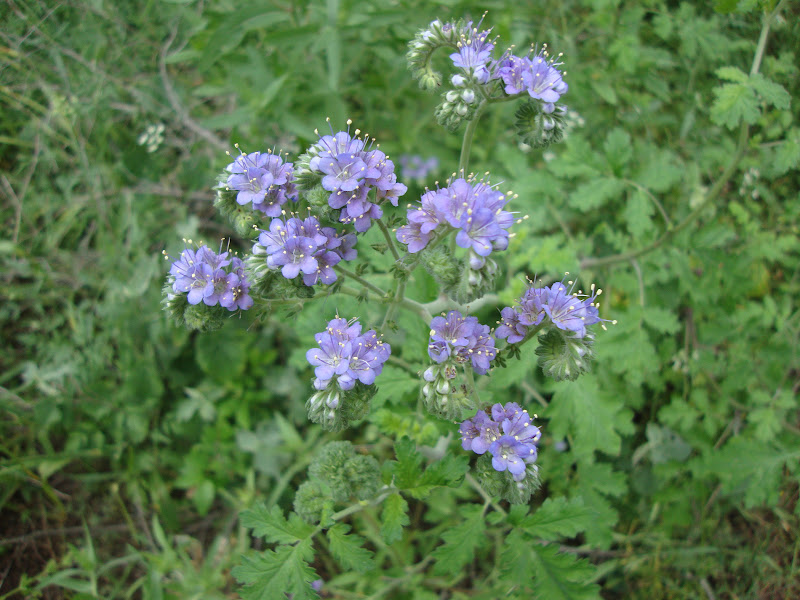
Blue Curls (Phacelia congesta)

Blue Curls is easily recognized by its curling inflorescences of many blue, five-petal flowers accented by long, yellow-tipped stamens.  The inflorescence of Blue Curls is known as a "scorpioid cyme" – scorpioid for the curling, scorpion's-tail shape and cyme for the type of inflorescence (group of flowers) where the terminal, or end, flower blooms first.  Blue Curls (Phacelia congesta) is in the Hydrophyllaceae Family, a surprise to me given that the scorpioid cyme is a hallmark of the Boraginaceae, or Borage Family.  But my botanical instincts proved to be correct when I looked up the Hydrophyllaceae and discovered that it is one of those contested plant families that is thought to be either a subfamily of or closely related to the Boraginaceae.  Blue Curls, borage or not, is a striking wildflower that is common throughout the Hill Country, blooming blue from March to May.

A relative of Blue Curls, which also blooms blue in the spring in shady spots in central Texas, is Baby Blue Eyes.  The single flowers of Baby Blue Eyes are light blue to purple with white centers, and each of the five petals is has a rounded notch.  Baby Blue Eyes (Nemophilia phacelioides) is a winter annual that grows in shady woodlands, canyons, and streamsides, blooming March to May.

Baby Blue Eyes (Nemophilia phacelioides)

Soft-Hair Marbleseed, a Borage Family plant that also has a scorpioid cyme, was blooming in a couple of the sunnier places along the first stretch of trail.  Each flower of Soft-Hair Marbleseed (Onosmodium bejariense) is white and tubular, with a spire-like tip.  Soft-Hair Marbleseed grows in open woodlands and on roadsides in the southeastern part of the Hill Country and blooms in March and April.

Soft-Hair Marbleseed (Onosmodium bejariense)

Another of the wildflowers that I noticed along the Onion Creek section of the trail was a rare treat, the Scarlet Leatherflower.  The unique, vase-shaped pink flowers of the Scarlet Leatherflower grow on a vine with asymmetric leaves that, if not for the lobe on one side that makes each leaf asymmetric, would be heart-shaped.  Scarlet Leatherflower (Clematis texensis) is a uncommon vine that grows over cliffs and shrubs in shady areas near streams in our area.   In fact, as a Hill Country endemic, ours is the only area in the world where it grows, blooming in its striking flowers April through June.

Scarlet Leatherflower (Clematis texensis)

One of the understory shrubs, Wafer Ash, was also in bloom, nearing the end of its flowering season.  Wafer Ash (Ptelea trifoliata) grows as a shrub to small tree in shady, woodland areas in central Texas.  It is commonly found growing underneath the mix of pecan, cedar elm, hackberry, and Spanish oak trees that grow along our waterways.  Its Latin species name, trifoliata, refers to its leaves-of-three, which often lead hikers to fear that it is Poison Ivy.  The leaves of Wafer Ash can be distinguished from those of Poison Ivy by the lack of notches in the leaflets.  While Poison Ivy has notched leaflets, the three leaflets that make up a Wafer Ash leaf are smooth, non-notched ovals.  The common name of the shrub refers to the thin, wafer-like fruits (actually samaras, like those of elm trees) that form after the flowers fade in late spring.

Wafer Ash (Ptelea trifoliata)

Filling out the ground layer of the understory were colonies of False Day Flower.  When I mentioned earlier that, in March, I was there to see the green leap upward as the grasses flowered in blue what I really meant is that I was there to see the huge colonies of False Day Flower form flowering shoots and bloom.  If Blue Curls is my shady-places wildflower of April, then False Day Flower is my shady-places wildflower of March, because, though it is botanically inaccurate to say that the grasses flowered in blue, that is what it feels like in March along the streams of the Hill Country.   False Day Flower (Tinantia anomala) is a monocot, which is why it has grass-like leaves, but it is not a grass; instead it is a relative of the spiderworts that grow in my backyard.  Its flowers are blue, with two petals and three tufted upper stamens that look like two eyes and a nose.  False Day Flower is a winter annual that germinates in the fall, grows through the winter, and leaps into flower in the early spring, forming large colonies of what look like blue-flowered grasses along waterways and on moist, shaded slopes.  False Day Flower blooms from March to May.

Colony of False Day Flowers (Tinantia anomala)

False Day Flower (Tinantia anomala)

About a third of the way around the loop, the trail climbed away from Onion Creek onto higher land above the floodplain and the taller, eastern-forest trees of the bottomland gave way to live oak, mesquite, and cedar (Ashe juniper).  Along this dryer section of trail, woodland was interspersed with open fields populated by grasses, wildflowers, and cacti.

The abundant cactus in the grassy breaks was the Texas Prickly Pear, which was blooming in showy yellow flowers, some of which had orange-tinted centers.  Texas Prickly Pear (Optunia engelmannii var. linheimeri) is common in fields and pastures of central and south Texas, where it grows aggressively, forming wide and tall thickets of spiny cactus pads.  To ranchers, it is a pest, but to wildlife, it is a food source.  The flowers are especially important to native bees, but they must also be a great nectar source for a variety of insects because whenever I find a Prickly Pear in bloom and look into the flowers, I find an array of flies, bees, and beetles feverishly chomping away.  Birds and animals eat the red fruit, called tunas, that form in the late summer.  Humans can eat the tunas as well, but be forewarned that the fruit, just like the cactus pads of the Texas Prickly Pear, have tufts of miniature, barbed spines, called glochids, that are hard to see and even harder to remove from your skin once attached.  Texas Prickly Pear blooms in the spring.

Texas Prickly Pear (Optunia engelmannii var. linheimeri)

The open, sunny fields between the woodlands were filled with wildflowers, some that I've written about recently, like Prairie Verbena (Verbena bipinnatifida) and Texas Star (Lindheimera texana), some that I saw last year on the Homestead Trail, like Prairie Larkspur (Delphinium carolinianum) and Engelmann's Daisy (Engelmannia peristenia), and some that I haven't yet had the chance to document, like Standing Winecup.  Of all the wildflowers in bloom, Standing Winecup was the stand out, blooming in bright magenta with tall flowers elevated above the sea of green grasses, cacti, and shrubs.

Prickly Pear, False Day Flower, Winecup, and Indian Blanket

Standing Winecap (Callirhoe digitata) is one of the poppy mallows of our area, a relative of hibiscus and Turk's Cap.  Standing Winecap is a drought-tolerant perennial that grows in fields and open woods, preferring rocky, dry soils, and blooms from April to June.  Like other Mallow Family plants, the stamens and pistil of Standing Winecap are fused into a single column in the center of the flower, the petals of which can be reddish-purple, dark purple, or white.

Standing Winecap (Callirhoe digitata)

The flowers of Indian Blanket, red and yellow in co-centric circles like a floral bull's eye, also stood out in the green landscape.  Indian Blanket (Gaillardia pulchella) is one of the famous and popular wildflowers of central Texas because it grows happily along our highways and in open grassy areas throughout central and western Texas.  Indian Blanket is heat- and drought-tolerant and reseeds easily, established large, dense colonies in areas with limestone soils and good drainage.  The flowers of Indian Blanket, on the plants from April through June, are important to native bees.

Indian Blanket (Gaillardia pulchella)

Brown-Eyed Susan, like Indian Blanket, is a Sunflower Family plant that also establishes large, showy colonies in open fields or woodland breaks with sandy or well-draining soil.  The ray flowers (the part of the sunflower inflorescence that looks like the petals) of Brown-Eyed Susan are yellow with a red-brown spot at the base and tend to droop downward.  The disc flowers at the center of the inflorescence are packed tightly together to form a purple-brown cone.  The flowers of Brown-Eyed Susan (Rudbeckia hirta) provide nectar for butterflies and bees, and the seeds are food for birds.  Brown-Eyed Susan is an annual to short-lived perennial that blooms April to June.

Brown-Eyed Susan (Rudbeckia hirta)

Yarrow, a wildflower that is common throughout North America, is a perennial with ferny, lacy leaves that grows as a rosette in the early spring before producing tall flowering stalks in the spring.  Each flowering stalk holds many white clusters of flowers that bloom from March to June.  Yarrow (Achillea millefolium) is common where soils are disturbed, preferring partial shade such as at the edge of a woodland.  Yarrow flowers provide nectar to native bees.

Yarrow (Achillea millefolium)

The blue-purple with white flowers of Mealy Sage were also starting to bloom along the trail.  Mealy Sage (Salvia farinacea) gets its name from the white-hairy sepals that cover the flowers before they bloom, giving the flower stalks a fuzzy (or mealy?) look.  Mealy Sage is a drought-tolerant perennial that prefers sunny locations with limestone soils, making it a good match for central Texas.  Mealy Sage blooms in April and May, or after summer rains, providing nectar for butterflies, bees, and hummingbirds.

Mealy Sage (Salvia farinacea)

A few huge pink-violet blooms of Texas Thistle stood on tall stems above the mass of grasses and spring wildflowers.  Texas Thistle, a drought-tolerant biennial, grows in dry fields and roadsides throughout the state.  Though often viewed as a weed, Texas Thistle (Cirsium texanum) is an important nectar source, providing food for butterflies, bees, and bumblebees, and its seeds are eaten by birds.  Texas Thistle blooms from April to July.

Texas Thistle (Cirsium texanum)

Bull Nettle is another wildflower that stands out in a crowd.  With large, hairy, lobed leaves and spiny stems, Bull Nettle (Cnidoscolus texanus) looks intimidating, as it should, given that the whole plant is covered in stinging hairs that cause a burning rash when touched.  The bright white, star-shaped flowers only make the plant more noticeable in the spring.  Bull Nettle is a common perennial that tolerates the heat and drought of central Texas, blooming into the summer.

Bull Nettle (Cnidoscolus texanus)

The last section of the trail looped back to the Upper Falls.  For Lee and me, the best part of visiting the park is walking between the falls, enjoying the huge Bald Cypress trees along the creek and scrambling across the volcanic rock on either side of the Lower Falls.  In between the falls, growing out of a rocky outcrop, I found another lovely wildflower blooming.  Greenthread, a Sunflower Family annual that is named for its narrow-leaved foliage, blooms in bright yellow from April to June.  Greenthread (Thelesperma filifolium) prefers dry, sandy or gravely soils and provides nectar for butterflies.  I think this was my best picture of the day.

Greenthread (Thelesperma filifolium)

In the canyon along Onion Creek, in between the falls, a population of Rough-Leaf Dogwood trees grows.  Dogwood trees are rare in central Texas, limited to shady bottomlands where water is year-round and taller trees, like the old Bald Cypress along Onion Creek, provide shade.  In other words, the dogwoods in Texas are a relic of a wetter time, southern outliers of trees that, in these times, are found mainly in eastern or western forests, not in the dry middle of the continent.  Yet we have a population of Rough-Leaf Dogwood (Cornus drummondii) right here at McKinney Falls, so I am always happy to see them.  I was especially pleased on this visit because the small trees were blooming.  The leaves of Rough-Leaf Dogwood are oval-shaped and rough to the touch, with wavy edges and parallel veins.  Their white flowers are cross-shaped, with four petals, and are clustered together into large inflorescences.  The Rough-Leaf Dogwoods bloom in April and May.

Rough-Leaf Dogwood (Cornus drummondii)

We ended our hike at the field across from the parking lot, where the April wildflowers had turned the open space into a sea of yellow sunflowers punctuated by the red of Indian Blanket, the blue of Texas Bluebonnet, and a few tall, white flowers.  The white flowers that stood above the rest on prickly, blue-green foliage belonged to White Prickly Poppy (Argemone albiflora), a drought-tolerant wildflower that is common in abandoned fields and roadsides in central Texas.  With its prickly growth habit and seeds that are toxic, White Prickly Poppy is regarded as weed, but its flowers are as beautiful as those of any domestic poppy and provide nectar for bees and beetles.

White Prickly Poppy (Argemone albiflora)

Spring came early this year and, with it, the sense that summer was never far behind.  Yet by mid-April, it felt like we were granted an extension, a few more weeks of the glorious, summer-up-north weather that we call spring.  I know that the real heat is just around the corner, but I also know that, counter to my instincts, this is not the time of year to think ahead.  These are the sunny days to enjoy.  But, still, I am hopeful that this will be the year that the rains continue, the year that the drought is lifted, the year that I get to write about summer wildflowers.  I know that it is foolish to place my hopes on the Texas summer.  But it sure feels nice.

Monday, April 25, 2011

Spring Wildflowers

First, a warning: the evil has leafed.  The evil is Poison Ivy (Toxicodendron radicans), enemy of hikers, campers, dog owners, and backyard brush clearers.  Poison Ivy thrives anywhere there is an ecological edge which, in this vastly human-disturbed landscape, is just about everywhere – along roads, along creeks, along trails, along fences, at the edge of the woods, at the edge of the lawn, or at the edge of a clearing.  In other words, it grows just about everywhere you might go looking for wildflowers.

Poison Ivy always has trifoliate leaves, or leaves composed of three leaflets.  The terminal leaflet is symmetrical and has a longer petiole (leaf stem) than the side leaflets, which tend to be slightly asymmetric, with deeper notches on the bottom side of the leaf.  The overall size of the leaves, and how deeply lobed or notched the leaflets are, varies greatly, as does the overall habit of the plant.  Poison Ivy grows as a shrub, ranging in size from a single twig to a thicket in the forest understory, or as a vine that climbs up the trunks of trees or the sides of rocks.  The most successful Poison Ivy plants that I have seen are in east Austin, along Boggy Creek, where they have attained "tree" status.  At first glance, a tree grows along the creek, but on closer inspection, the "tree" is actually a massive explosion of lush Poison Ivy vines being supported by the trunk of a long-dead tree.  Think Medusa's hair, the plant version. 

In the spring, when the trees are leafing and the wildflowers are blooming, the leaves of Poison Ivy are shiny green and especially appealing, but be forewarned that the shininess of the leaves is in part due to the oils that the plant produces, which contain urushiol, a compound that causes mild to extreme skin irritation in most people.  Hence the "poison" part of the name.  The best defense against Poison Ivy is to learn to identify its leaves and to avoid them.  And, despite the variability of the plant, knowing it, as in being able to spot a single leaf in a forest, is quite possible because the plant has a very strong presence.  Even in winter, its twigs have a certain curl to them, and its hairy, older vines hum with warning, seeming to simultaneously draw attention while saying, Stay away from me.  So, learn its leaves, because they literally are everywhere, even leaping, looking friendly and pretty and all spring green, across the well-used Homestead Trail at McKinney Falls.

Poison Ivy (Toxicodendron radicans) leaping into the trail

It's been a couple of weeks since Lee and I hiked the Homestead Trail – a couple of long, hot, rainless weeks for April – so, while I thought I was capturing the start of the wildflower season, I was actually lucky to capture a variety of wildflowers in their short moment this spring, before the especially-early summer began.  One of the first flowers that I spotted along the trail was Blue-Eyed Grass, a perennial herb that blooms only in the spring.  Many varieties of Blue-Eyed Grass (Sisyrinchium spp.), which is related to the iris flower, grow in open woods and grassy areas throughout central Texas.  It is difficult to distinguish between species because they hybridize with each other, producing many variants.

Blue-Eyed Grass (Sisyrinchium sp.)

Blue flowers, more of a rarity in the yellow-dominated fall, are well represented among the spring wildflowers.  Baby Blue Eyes (Nemophilia phacelioides) is a blue-flowered spring ephemeral, meaning that it blooms briefly in the spring and disappears by summer.  Like other spring ephemerals, such as Missouri Violet, Baby Blue Eyes grows in moist, shady woodlands, where it does most of its quiet growing in the winter, after the leaves have fallen from the trees overhead, allowing more sunlight to reach the forest floor.  The plants bloom in the early spring, just before the trees leaf out and, in blooming, become visible to us, signaling that spring has arrived.  But just as quickly as they are visible, the spring ephemeral herbs die back under the leaf litter until next year, earning their ephemeral reputation.  The blue flowers of Baby Blue Eyes attract butterflies, moths, and bees during their brief bloom period in March and April.

Baby Blue Eyes (Nemophilia phacelioides)

Another spring-blooming blue flower is Giant Spiderwort, which is common throughout my east Austin neighborhood, where it blooms in shady spots and abandoned lots in March and early April.  Like many early bloomers, Giant Spiderwort (Tradescantia gigantea) is a perennial herb that emerges from its roots in the fall, grows up to three feet tall during the winter, blooms in early spring, and dies back in the hotter weeks of late spring.  The color of the flowers varies from deep blue, when the plant grows in acid soils, to purple, to pinkish purple, when the plant grows in alkaline soils.  Though I did see a few of the plants blooming along the Homestead Trail, this picture is from my backyard in east Austin, where Spiderwort blooms purple.

Giant Spiderwort (Tradescantia gigantea)

Among spring wildflowers, in contrast to fall wildflowers, there are also many monocots, including Blue-Eyed Grass and Spiderwort.  This is because many monocots, like irises, tulips, and crocuses, regrow from bulbs or corms in the soil, growing and blooming in the cooler, moister winter and spring, then dying back in the hotter summer.  Onions and garlic are examples of monocots in the Lily Family that grow from underground bulbs.  Wild Garlic (Allium drummondii) is native to Texas and the Plains states to the north, forming large colonies in fields, pastures, and other grassy areas.  Wild Garlic blooms March through May in flowers that range from white to purple-red.

Wild Garlic (Allium drummondii)

Another Lily Family plant that blooms in the spring is the Rain Lily, a striking white-flowered herb that also regrows yearly from an underground bulb.  The blooming of the Rain Lily (Cooperia pedunculata) is triggered by rainfall, so in years when we have ground-soaking rains in April and May, fields and open woodlands seem to sprout an abundance of the white flowers overnight.  In drier years, like this one, the Rain Lilies are fewer and are restricted to moister, shadier spots.

Rain Lily (Cooperia pedunculata)

Southern Dewberry is a common plant in our area, growing as thorny vine that forms thickets along fences and roadsides.  Its bloom period is brief though, in March and April, and, in that, it joins the ranks of the spring wildflowers.  Southern Dewberry (Rubus trivialis) has flowers characteristic of the Rose Family, with five non-fused petals, lots of stamens, and many carpels.  The flowers, if pollinated, develop into summer blackberries, which provide food for wildlife.

Southern Dewberry (Rubus trivialis)

Another common wildflower that begins blooming in spring and continues throughout the summer and into the fall, rainfall permitting, is Yellow Wood-Sorrel, a perennial herb that is a common garden and greenhouse weed throughout North America.  Yellow Wood-Sorrel (Oxalis stricta) has trifoliate leaves that resemble three-leafed clover leaves and five-petaled yellow flowers.

Yellow Wood-Sorrel (Oxalis stricta)

The Homestead Trail is mostly shaded as it winds through a woodland of Cedar Elm, Hackberry, Ashe Juniper, and Mesquite trees, but it also passes through more exposed areas.  On one such rocky hillside, I found a Two-Leaved Senna, a Prairie Larkspur, and Pink Mimosa flowering side by side amidst last fall's dead grasses.  Pink Mimosa is a shrub of rocky hillsides, canyons, and limestone soils that blooms in pink to white puffballs in the spring.  The leaves of Pink Mimosa (Mimosa borealis) are twice pinnately compound, meaning each leaflet is composed of many tiny sub-leaflets, giving the leaves a feathery appearance.  Puffy mimosa flowers provide nectar for bees and butterflies.

Pink Mimosa (Mimosa borealis)

Prairie Larkspur (Delphinium carolinianum), a spring wildflower that prefers sandy soils, also grows in open woods, fields, and roadsides.  Prairie Larkspur blooms from April to June and its flowers range in color from white to pale blue to blue violet.

Prairie Larkspur (Delphinium carolinianum)

Two-Leaved Senna (Senna roemeriana) is a perennial Pea Family shrub that grows in fields or dry, open hillsides with limestone soils.  Two-Leaved Senna gets its name from its leaves, each of which is a symmetric pair of leaflets resembling one, divided leaf.  From April through October, Two-Leaved Senna produces yellow, five-petaled flowers that attract birds and butterflies.  The shrub is a larval host to sulfur butterflies, and its seeds are an important food source for central Texas birds.

Two-Leaved Senna (Senna roemeriana)

At the northern end of the Homestead Trail, the trail passes by a Texas Parks Department building, which is surrounded by a field of wildflowers.  The mix of wildflowers in that field resembles the mix of colors along many of our major roadways, leading me to believe that, just as the highway department seeds the wildflowers along the right-of-way, the parks department probably seeded the Texas Bluebonnets, Indian Paintbrush, and Antelope Horns decorating the field behind its building.

Texas bluebonnet, state flower of Texas, is the classic spring wildflower.  Bluebonnets are winter annuals that germinate after the fall rains, grow as rosettes through the winter, and bloom in the spring.  Texas Bluebonnets (Lupinus texenis) have palmately-compound (fan-shaped) leaves and white-tipped, blue flower spikes.  Up close, the flowers are blue with white centers and resemble sweet pea flowers.  Within a flowering spike, some of the older flowers have maroon or purple centers instead of white centers; the maroon-centered flowers have already been pollinated and, lacking the white accent, are now less attractive to bees, butterflies, and other pollinators.  Texas Bluebonnets grow in abandoned fields and pastures and thrive in the alkaline, limestone soils of central Texas.  The seeds of bluebonnets have been spread throughout the state by the highway department, making the blue flowers common along major Texas roadways in the spring.

Texas Bluebonnets (Lupinus texenis)

Indian Paintbrush (Castilleja indivisa) was originally native to the Llano Uplift region of the Edwards Plateau, where it thrived in sandy soils.  Like the Texas Bluebonnet, however, the Indian Paintbrush has been distributed throughout the state by the highway department, so now it is common to see the bright red flowers of the Indian Paintbrush in the same pasture or roadside as the striking blues of the Texas Bluebonnet.  Indian Paintbrush is hemi-parasitic, or partly parasitic, in that it grows its roots into the roots of other plants, such as grasses, and steals their nutrients.  The flowers of the Indian Paintbrush attract butterflies, and the nectar of flowers is a food source for hummingbirds and insects.

Indian Paintbrush (Castilleja indivisa)

My current favorite spring wildflower looks to me more like an alien life form than a wildflower.  A member of the Milkweed Family, Antelope Horns (Asclepias asperula) is an important food source and larval host for monarch and queen butterflies.  Antelope Horns grows in open fields and along roadsides, thriving where the soil is rocky or sandy.  The large, round inflorescences of Antelope Horns appear otherworldly, improbably large and solid for such low-growing plants, but to many pollinators, including a bees, flies, butterflies, and birds, each globe of flowers offers a buffet of nectar in a otherwise hot and dry spring.

Antelope Horns (Asclepias asperula)

Along the trail, as it wound into and out of the woodlands, crossing and recrossing the mowed park road, I also saw some of the less famous, but just as steady and reliable, of the wildflowers that decorate our roadways in the spring.  Engelmann's Daisy is one such common roadside wildflower that grows in open fields and dry, upland soils.  Engelmann's Daisy (Engelmannia peristenia, formerly E. pinnatifida) can be distinguished from other yellow sunflowers by its spring blooming time and long leaves with deeply wavy borders.  A drought-tolerant perennial, Engelmann's Daisy is abundant and ecologically important in central Texas, providing nectar for insects, seeds for birds, and forage for livestock.

Engelmann's Daisy (Engelmannia peristenia)

Another roadside wildflower, the Evening Primrose, put on a good show this year, decorating roadsides throughout Austin in pink for most of late March and early April.  Pink Evening Primrose (Oenthera speciosa) is a perennial herb that spreads from rhizomes, or underground root runners, forming extensive colonies in fields and along roadsides.  Evening Primrose is drought tolerant and thrives in full sun, making it a reliable ground cover and wildflower even in dry years such as this one.  The flowers are distinctive, with long, four-branched stigmas and pink-white petals, and the seeds are food for native finches.

Pink Evening Primrose (Oenthera speciosa)

Prairie Verbena is a perennial herb that grows in open, grassy areas.  Prairie Verbena (Glandularia bipinnatifida) is very common throughout the state, where it blooms from spring through fall, rainfall permitting.  I've noticed that this month, as the heat and drought have progressed, Prairie Verbena has held its place along the roadsides as other spring-only wildflowers have faded.  Prairie Verbena has highly dissected leaves (or highly pinnatifid leaves, hence its Latin name) and nectar-rich flowers that attract birds and pollinating insects.

Prairie Verbena (Glandularia bipinnatifida)

After walking the Homestead Trail, we looped around from the Lower Falls to the Upper Falls then back to the parking lot along the shadier, rockier Rock Shelter Trail, where the red flowers of Cedar Sage decorated the ledges above Onion Creek.  Cedar Sage (Salvia roemeriana) is adapted to growing in the shade and leaf mulch of Ashe Juniper, known locally as Cedar trees, which is how this native sage got its name.  Cedar Sage grows on limestone ledges and rocky canyons throughout the Hill Country, attracting hummingbirds and butterflies with its flowers in spring and early summer.

Cedar Sage (Salvia roemeriana)

Monday, December 13, 2010

Leaf Fall

This fall I made a point of watching for the moment of leaf fall, because every year I seem to miss it.  One day it is bright and warm and the leaves are on the trees and, seemingly, the next day, the leaves are on the ground and I am wearing a jacket.  Despite my intentions, I feel like the same thing has happened again this year.  Once again, the trees are bare and I feel like I missed the process.  Once again, it feels like we skipped from summer to our version of winter.

In my neighborhood, the pecan trees along Boggy Creek represent the majority.  When the pecan trees drop their leaves, my perception shifts from the leaves are still on the trees to the leaves have fallen, no matter that many trees lag behind the precise and timely pecans, who always seem to drop their leaves in mass at the end of November.


Despite my shifted perceptions, though, the live oaks are still green, the junipers are flowering (thus beginning cedar-fever season), and the red oaks, known for their "deciduous but tardily so" habit, have yet to finish their fall color change from green to yellow, orange, red, or burgundy.  Cottonwood trees, common but scattered along Boggy Creek and its tributaries, still hold yellow leaves as well, and their late-season visibility, amongst so many bare-branched neighbors, has me wondering about the original scope of the Boggy Creek watershed, before all the development and flood control.  And the cedar elm in my backyard has been slowly dropping its leaves and samaras for weeks now, giving me plenty of time to adjust to the idea of the leaves falling.


In defense of my feeling that the leaves do indeed drop all at once, I have the evidence of the bald cypress trees at McKinney Falls.  In early November, Lee and I hiked on the Homestead Trail at the park, where the cedar elm woodland, though yellowed by the heat of the extended summer, was still covered in green leaves, and the only orange or red leaves that I saw along the trail were on a poison ivy vine.  Nearer to the falls, along Onion Creek, the bald cypress trees were just starting to turn orange.  The sun was so bright that it was hard to capture a good shot that day, but I am glad that I tried, because I have proof that on November 7th the cypress trees along Onion Creek were still fully covered in green, yellow, and orange needles.


By November 25, less than three weeks after our initial visit, Lee and I returned to McKinney Falls for more hiking.  When we started the loop around the park, it was hot and humid, in fact so humid that I wished I had disregarded my own advice and worn shorts instead of pants.  About halfway around the loop, as the trail turned back to the north, we walked into a cold front, and thus into a different season.  Cold, dry air replaced the humidity and unseasonable warmth so quickly that, within minutes of wishing I had worn shorts, I couldn't wait to get back to the car and to my jacket.  Later, wearing hoodies and hats, Lee and I explored the creek area between the upper and lower falls, where the cypress trees that had still been covered in needles a few weeks earlier were mostly bare.  Their rust-colored needles, now fallen, floated in Onion Creek.


So I guess it's not unreasonable to feel like I miss the leaf fall each year.  It happens very quickly and the wildly changing weather of our cool season amplifies the sense of abruptness.  One minute it is hot and humid, and the next minute it is cold and dry, making it only natural that I am shocked to find myself wearing warmer clothes and noticing that the leaves have fallen off the trees.  Luckily for the trees, it is day length, not temperature, that cues leaf fall, allowing them to quietly get on with the business of preparing for colder temperatures even while I am being fooled into forgetting what time of year it is.  And what a privilege it is, to forget about winter.