Showing posts with label Barton Creek Greenbelt. Show all posts

Tuesday, July 3, 2012

June at the Greenbelt

The water is all but gone now, reduced in a matter of weeks from a flowing creek to a dry creek bed with a few muddy spots and murky pools, the largest and most lasting of which is the pond formed by the springs just downstream of Sculpture Falls.  The only place where a dog can get wet in the hot, dry years.  I was hoping that this wouldn't be one of those years, just as I did not welcome the return of record-breaking temperatures – I would've been happy to skip a year, or ten, in pursuit of the hottest June day ever – but at least we had the spring rains and, because of them, several weeks of (early) summer creek flow on Barton Creek.

Our wildflowers are adapted to this nonsense.  The spring bloomers, like Bluebonnets and wild mustard, are winter annuals that germinate in the fall, grow in the early spring, and bloom in late spring, completing their life cycle within the cool season.  The early summer bloomers, a mix of winter annuals like Indian Blanket and perennials like Winecup, similarly get their business of blooming done before the real heat of summer.  The fall bloomers, like Golden-Eye and Agalinis, grow in the spring, wait out the summer in near stasis, then bloom in the fall, once the heat of summer has passed.  And the few wildflowers remaining, the brave all-summer-long bloomers, take their cues from the weather as well, blooming sporadically from April to October, whenever we happen to get the rain.

So early June at the Greenbelt, with the water still running but not for much longer, was an ideal place to see wildflowers in bloom, a mix of annuals just this side of going to seed, perennial shrubs and vines flowering in the less stressful part of summer, and all-summer-long bloomers taking advantage of the moisture lingering in the ground around the creek.  Knowing that the water was waning, Lee and I headed to the upstream part of the Greenbelt trail to enjoy the end of the season.  Though it is counter-intuitive, Barton Creek dries up in its downstream stretches first, so when the creek bed is dry downstream of the Loop 360 overpass, water may still be flowing upstream of the Mopac overpass.  We started our walk even farther upstream, at the end-of-trail entrance, hiking down the long hill.  At the bottom of the hill, in an open field on the way to the uppermost falls, was a huge display of red and yellow and purple wildflowers.

Field of Indian Blanket, Mexican Hat, Brown-Eyed Susan, and Purple Horsemint

The dominant red and yellow flower in the field was Indian Blanket, a common Sunflower Family wildflower in Texas.  With yellow disc flowers (the center of the sunflower) that turn red as they bloom and red ray flowers (the part of the sunflower that looks like the petals) with yellow tips, the inflorescence of Indian Blanket looks like a red and yellow bulls-eye.  Indian Blanket (Gaillardia pulchella) is an annual that reseeds readily, forming huge colonies in open fields and along our roadways in the late spring.

Indian Blanket (Gaillardia pulchella)

The other red and yellow flower in the field was Mexican Hat, another common Sunflower Family wildflower.  The ray flowers of Mexican Hat are red with yellow and tend to droop downward, while the green to brown disc flowers form a tall column, giving the inflorescence a hat-like shape.  Mexican Hat (Ratibida columnaris) is a bushy, drought-tolerant biennial or perennial that grows on roadsides and in abandoned fields, blooming from April to July.

Mexican Hat (Ratibida columnaris)

The balance of yellow in the field of wildflowers was contributed by Brown-Eyed Susan.  Like Indian Blanket, Brown-Eyed Susan is annual in the Sunflower Family that forms huge, showy colonies in open, grassy areas.  The disc flowers of Brown-Eyed Susan are purple-brown while the ray flowers are yellow with a red-brown spot at the base of each and tend to droop downward.  Brown-Eyed Susan (Rudbeckia hirta) prefers sandy or limestone soils and blooms from April to July.

Brown-Eyed Susan (Rudbeckia hirta)

The purple flowers in the field were those of Purple Horsemint, another common wildflower that is known for its large, picturesque colonies.  The pink to purple flowers are two-lipped and spotted, whorled together into a dense inflorescence of flowers and bracts (the leaves beneath each flower) that are also purple.  Purple Horsemint (Monarda citriodora) blooms from May to June, and its flowers turn more whitish-purple toward the end of the bloom.

Purple Horsemint (Monarda citriodora)

The uppermost falls, usually a quiet spot for hot cyclists, older couples, and happy dogs, was crowded with the young sunbathers that usually gather at Twin Falls, confirming that the creek was indeed drying up downstream.  We crossed the creek above the falls and headed downstream along the trail.  This shady section of the trail, sandwiched between the creek and a slope forest, was still cool and moist, hanging onto the last of spring.

Along the trail, American Beautyberry shrubs were in flower.  American Beautyberry (Callicarpa americana) is a large shrub that is common throughout the southeastern United States.  At the eastern edge of its range in central Texas, it is mainly found along streams and in moist bottomlands.  While the purple berries of Beautyberry are a stand-out feature of the Greenbelt trail in the fall, the bunches of tiny pink-purple flowers that appear on the shrubs in May and June are easier to miss.

American Beautyberry (Callicarpa americana)

Thoroughwort, a smaller shrub in the Sunflower family that tends to grow on the rocky hillsides above the trail, was also in bloom.  Thoroughwort (Ageratina havanensis) is a perennial shrub that blooms on and off all summer, its flowers suspended on branches that seem to grow straight from the rocks on the cliff side of the trail.  The leaves of Thoroughwort are deltoid, or arrow-shaped, and the flowers are white, grouped together into inflorescences that look like miniature white pom poms.

Thoroughwort (Ageratina havanensis)

On the creek side of the trail, growing at the water line along a deeper, slower section of the creek, Buttonbush was also in bloom.  Buttonbush is a large, many-branched shrub that grows along streams, lakes, and ponds, blooming in the summer.  The leaves of Buttonbush (Cephalanthus occidentalis) are large and oval-shaped and the inflorescence is an off-white globe of flowers with long stamens that extend past the petals.  After flowering, the inflorescence dries into a brown ball of seeds ready to float downstream in the next flood.

Buttonbush (Cephalanthus occidentalis)

Also growing close to the creek, tangled in shady patch of understory, was the Snapdragon Vine.  The shiny leaves of the Snapdragon Vine look like those of English Ivy, a cross between a triangle and a heart, while the flowers have five, fused petals that are light violet to dark purple with white centers.  Snapdragon Vine (Maurandya antirrhiniflora) grows on rocky, limestone soils of the southern Hill Country and blooms after rains from March to September.

Snapdragon Vine (Maurandya antirrhiniflora)

Farther downstream, after passing the two mini falls, the trail moved away from the creek into a flat, wooded-to-open floodplain where Texas Lantana (Lantana horrida) was blooming in half-shady places.  Texas Lantana is a tough, drought-tolerant shrub that grows all over Austin, blooming in yellow and red-orange flowers all summer long, rain or not.  Lantana has square, rough-to-prickery stems and a strong aroma that I associate with the heat of summer.  I have trouble enjoying Lantana because of its commonness and because it grows wild along the south side of my house, where I can't decide if it is a weed or a wildflower.  But its flowers, grouped into round clusters, are bright and striking, and the plants seem to thrive on blazing heat and baking drought, qualities that are hard not to appreciate.

Texas Lantana (Lantana horrida)

The upstream section of the Greenbelt was surprisingly crowded that day, especially for a weekday, with crowds of swimmers at each falls, however minor, again reminding us that the season was about to be over.  Eventually, Lee and I found a couple of quiet places to get into the water before reaching Sculpture Falls, where we crossed to the main trail on the other side of the creek and headed back upstream.  Before long, a shady, tree-lined section of the creek lured us back to the water, where I found, beneath the warm water, active springs of cold water, and, around the corner, a murky backwater section of the creek that was overgrown in Dodder.  Dodder (Cuscuta sp.) is a parasitic vine in the Morning Glory Family that twines its yellow stems around its host plant.

Dodder (Cuscuta sp.) growing on plants in the creek

While Dodder, with its non-photosynthetic yellow stems, represents the darker side of the twining habit, literally living off its host plants, the Purple Leatherflower, a climbing vine that is a rare treat to find growing in the understory along streams in our area, represents the refined side, a vine that would be just as welcome in a garden as in the woods.  Purple Leatherflower (Clematis pitcheri) has shiny, lobed leaves and thick, bell-shaped, purple flowers that appear in May and June.

Purple Leatherflower (Clematis pitcheri)

The trail on the east side of the creek was wider, higher above the creek, and more exposed to the afternoon sun than the trail on the west side had been.  In those drier conditions, Turk's Cap, a shrub in the Hibiscus Family, was blooming in the shade of cedar trees.  Turk's Cap (Malvaviscus arboreus var. drummondii) is an herbaceous perennial that regrows from the ground each year, aggressively forming thick colonies in the shade of woods nears streams.  The flowers of Turk's Cap are bright red, with upright petals that remain half-closed and a column of fused stamens that rises above the petals.  The staminate column, also bright red, is decorated, on the sides, with the yellow ends of the stamens (male parts) and, on the top, the red stigmas (female parts) of the flower.  Turk's Cap is one of our all-summer-long bloomers, making flowers from June through October that turn into round, red fruits.

Turk's Cap (Malvaviscus arboreus var. drummondii)

Velvet-Leaf Mallow, another shrub in the Hibiscus Family, was also in bloom.  Velvet-Leaf Mallow (Allowissadula holoserica) is a woody perennial that grows on dry, rocky soils of the Edwards Plateau.  Velvet-Leaf Mallow has toothed, heart-shaped leaves with wooly margins and flowers with five orange-yellow petals.  Velvet-Leaf Mallow produces flowers all summer, providing food for butterflies.

Velvet-Leaf Mallow (Allowissadula holoserica)

As the trail neared its upstream end, we returned to the territory of heat-loving sunflowers.  Part way up the long hill to Scottish Woods, a colony of blooming Nerve-Ray gave me an excuse to stop for a photo break.  The inflorescence of Nerve-Ray looks something like that of Echinacea, with narrow, yellow ray flowers that are widely spaced around a reddish-brown sphere of disc flowers.  Nerve-Ray (Tetragonotheca texana) gets its genus name (tetragon-) from its four-sided involucre, the green, fused leaf beneath the inflorescence.  Nerve-Ray is a bushy, many-branched shrub that grows on rocky soil in the southern Hill Country, blooming from April to September.

Nerve-Ray (Tetragonotheca texana)

Growing closer to the ground, its stems mixed with grasses midway up the hill, was Zexmenia, another bright yellow sunflower.  Zexmenia (Wedelia texana) is a perennial shrub that is woody at its base with herbaceous stems that hold the yellow, Cosmos-like flowers high above the low-growing plant.  Zexmenia blooms from May to September and is a host to native butterflies.

Zexmenia (Wedelia texana)

At the top of the hill we walked back into the city, happy for the swim but sad that the season was ending.  Though I have been in Austin for fifteen years, I still have to remind myself that "summer," in the up-north sense of summer as the peak growing season for plants, is a broken season in central Texas.  Summer begins in April, is suspended in June, resumes in September, and ends in October.  We are currently suspended, stranded in a three-month hiatus from summer.  Annual plants are done for the year and the perennials are in survival mode, waiting until ground-soaking rains break the hiatus.  Which could happen next week or in October.

I am, as usual, a bit stunned to be here.  Like a gambler who always thinks that this round will be the one, I am perpetually convinced that this summer will be the one that isn't broken, the one that is kept whole, or is at least extended a month or two, by summer thunderstorms.  It has happened before.  But I've been here long enough to expect nothing less than blazing heat.  So, as I arrive here yet again, I have to appreciate the native wildflowers and their ability to make a life between, before, around, or straight through, our broken summers.  One of these years, I'm going to figure out how to follow their lead.  Until then, here's to enjoying the water while it lasts.

Tuesday, March 22, 2011

Red Buckeye

I have a fondness for Red Buckeyes.  They were one of the first wildflowers that I learned to identify in Texas.  They are one of the earliest bloomers along Barton Creek, and they have bright red, tubular flowers that they hold right at eye level, like a trail-side banner announcing the arrival of spring.  Buckeyes also have distinctive, palmately-compound leaves shaped like five-sided stars.  Their leaves emerge even earlier than their flowers, all bright green and shiny and so stiffly-creased that they remind me of newborn horses struggling to stand on all four legs.

Red Buckeye (Aesculus pavia) new spring leaves

I first met the buckeyes, the Aesculus genus, in northern Ohio.  I was an undergrad doing a research project and my mission was to survey the understory plants of floodplain forests.  The problem was that it was winter, and winter in northern Ohio was no joke – biting cold, lots of snow, and not a leaf to be found on any of the young trees that I was trying to identify.  I had to learn to distinguish between the mess of sticks that was the winter forest understory using branching patterns and overwintering buds, and I quickly found that, among temperate trees, alternate branching was more common than opposite branching.  If mycologists had their "LBM's," or little brown mushrooms, so many average-looking, average-size mushrooms, that winter I struggled with the "ABB's," or alternate brown buds, so many alternate-branched trees with frustratingly average-looking brown buds.

What saved me were the opposite-branched trees – the maples, the ashes, and the buckeyes – and their uncomplicated branches.  The Ohio Buckeyes (Aesculus glabra) were particularly easy to spot, with thick, opposite branches and fat, shiny, many-scaled buds that stood out even in the stark Ohio winter.  I am a buckeye, they shouted, and they were common in the most disturbed and saddest floodplain sites that I visited.  They became early friends, lending me a sense of competence long before I could tell an elm twig from a cherry twig just by the angles and lines, and inspired me to keep on with my baggies of twigs and identification keys.

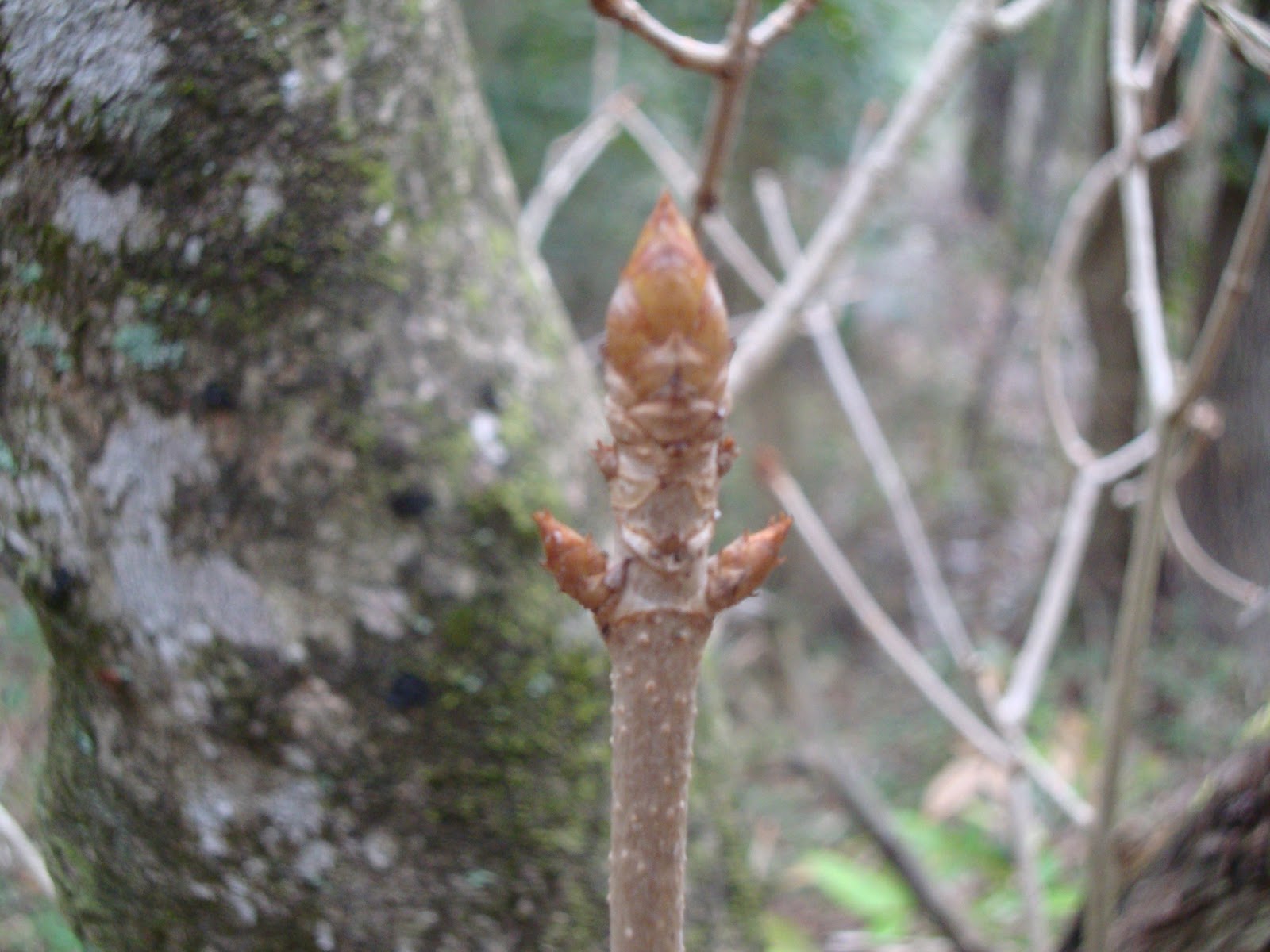
Red Buckeye (Aesculus pavia) overwintering buds

A couple of years later, when I moved to Austin, discovering the Red Buckeyes (Aesculus pavia) along the Greenbelt was a reunion of sorts.  Just as their relatives had in Ohio, the Red Buckeyes stood out in contrast to the late winter landscape, with fat terminal buds that swelled and turned red as the new spring leaves began to emerge.  Even more amazing, these familiar shrubs produced amazingly showy tubular flowers in clusters of red to pink to peach, flowers that I would expect to see on display in a botanical garden, not in flower in early spring in the xeric woodlands of central Texas.  I had trouble believing that these beauties were native wildflowers.

Red Buckeye (Aesculus pavia) flowers

Two varieties of Red Buckeye are native to central Texas – the common, red-flowered variety (Aesculus pavia var. pavia), which grows throughout the southeastern US as a small tree or large shrub, and a yellow-flowered shrub (Aesculus pavia var. flavescens) that is endemic to the western Edwards Plateau.  West of Austin, in the midst of the Hill Country, the two varieties hybridize and form peach- to pink- to orange-flowered varieties.  The showy flowers of both varieties appear in early spring, February to April, attracting hummingbirds, butterflies, and bees.  For me, spring has officially sprung when the buckeyes along the Greenbelt begin to bloom.

This year, the buckeyes began blooming later than usual due to the cold weather of early February, and it took three trips to the Greenbelt over the course of four weeks to document the shift from fat buds to open flowers. In mid-February, when the buckeyes begin blooming in some mild years, the overwintering buds were fattening and becoming more visible against the backdrop of late-winter browns but were showing no signs of opening into leaves yet.

Buckeye buds not yet open (February 19)

By late February, the buds on many buckeye shrubs had begun to open, turning pink as the leaves within began to expand.  On a few of the buckeyes, spring leaves were beginning to emerge, looking newborn, perfectly green, and not yet worn, torn, or faded by the rigors of the upcoming season.

Buckeye buds opening (February 26)

By mid-March, most of the buckeye shrubs had leafed out but were not yet flowering, still waiting for warmer, longer days and a stronger guarantee that the cold of winter was gone for good.

Buckeye after leaf out with flower stalk (March 13)

But a few buckeyes had begun to flower, officially beginning spring at the Greenbelt.  With the start of the central Texas summer less than two months away, that means that this spring, as with most springs, promises to be our shortest, fastest season.

Red Buckeyes begin flowering (March 13)

Sunday, February 27, 2011

The Greenbelt in February

I go to the Greenbelt to get away – away from my house and yard and all the work that needs to be done, away from all the distractions embedded in my daily routine, and away from my day job, which is "easy" and hourly yet still manages to come home with me.  The physical act of walking releases the catch in my brain that holds all those spinning thoughts, allowing the smells and sights and sounds of the woods along the creek to grab my attention and pull me out of my head and onto the damp trail under my feet.  So maybe it would be more accurate to say that I go to the Greenbelt in order to return, or to reset, to close all those windows that are open in the computer screen of my mind and to restart with just one focus, the plants of the forest along the creek.

Which is a huge expectation to have on the creek, and the trail, and all the plants that grow along it.  In that state of mind, distracted and restless and not sure whether I was ready to embrace the late start of spring, the season of acceleration, I went to the Greenbelt expecting to be dazzled by bright, fat Buckeye flowers and vibrant spring ephemerals.  Instead I found quiet.  The creek was still running, though barely so and only along the upstream half of the Greenbelt, the trees were still leafless, and the browned, crispy, long-dead grasses and herbs of last summer and fall still lined the trail and the creek.  Even the once-purple berries of the Beautyberry shrubs had shriveled and turned black.  The obvious landscape of greys and browns certainly wasn't about to grab my attention.


But the creek, even when it's barely running, and the experience of being out in the woods, even when the branches are bare, still has the effect of slowing me down, and, despite my impatience, I began to appreciate the damp smell of the woods and the misty, almost-raining morning that was contributing to the quiet.  Then I noticed the plants that thrive in the cool humidity and quiet between winter and spring.  The mosses seemed especially happy with the misty, damp conditions.


The ferns growing from the rock walls along the creek showed signs of freeze damage, with browned leaves and partially dead fronds.  But the ferns or parts of ferns that had survived the freezes of early February were growing as happily as the mosses, enjoying the non-stressful, humid weather.

Cliff Brake Fern (Pellaea ovata)

Once I began noticing some green, I realized that, actually, at the ground level, green was overtaking the brown.  New blades of grass were emerging from the leaf layer and green rosettes of annual herbs were establishing themselves, gathering strength to become the wildflowers of spring.


In the understory, native winter berries – red Yaupon and blue-black Silktassel – added color to the branches of evergreen shrubs.  Berries also hung on the branches of non-native shrubs, escaped from cultivation, including the small, blue-black fruits on Japanese Privet trees (Ligustrum japonicum) and Chinese Privet shrubs (Ligustrum sinese).  Nandina shrubs held huge clusters of red-orange fruits.  Nandina (Nandina domestica), like Japanese and Chinese privet, is a native of Asia that was brought to the US for use in gardens and has escaped from cultivation.  Unfortuantely, Nandina, Japanese Privet, and Chinese Privet are invasive and are spreading into streamside habitats around Austin.

Nandina (Nandina domestica) berries

And, though small and subtle, not yet grabbing my attention in numbers but there to be noticed as individual dots of color in the underbrush along the trail, the earliest wildflowers of the season were just starting to bloom.  The first wildflower that I spotted this season was Golden Grounsel (Packera obovata), a sunflower-family herb with bright-yellow flowers.  Golden Grounsel grows as a rosette of almost-round to oval leaves that become deeply lobed when the plant makes a flowering stalk.  Golden Groundsel prefers to grow in moist, calcareous soils and blooms February through April, making it one of the first wildflowers of the spring in central Texas.  Its yellow flowers attract bees and butterflies.

Golden Groundsel (Packera obovata) leaves

Golden Groundsel (Packera obovata) flowers

Roemer's Spurge, an annual herb of moist, shaded woodlands, was also beginning to bloom.  Roemer's Spruge (Euphorbia roemeriana) has unique leaves and branching.  The lower leaves on a stalk are alternate and elogated, then a whorl of three leaves gives rise to three stems, each holding an inflorescence (cluster of flowers).  The bract at the base of the inflorescence is almost circular, made of two fused leaves.  The flowers are tiny and bright yellow, appearing on the plants late February through May.

Roemer's Spruge (Euphorbia roemeriana)

Missouri Violet, a perennial herb that is a common spring ephemeral in moist, streamside woodlands throughout the central United States, was also blooming.  Missouri Violet (Viola missouriensis) is a perennial herb that grows as a rosette of heart-shaped leaves and blooms early in the spring, in February through April in central Texas.  Flowers on the wild violets signal that spring, though delayed by the cold weather and slow to get started this year, is on the way.

Missouri Violet (Viola missouriensis)

Wednesday, December 8, 2010

The Greenbelt in December

The wildflowers of fall, now faded, frozen, and dried, have disappeared into the underbrush along the Greenbelt trail.  Their broken stems and stiff seed heads were barely distinct from the brown grasses and leafless shrubs lining the trail, except that I remembered the dense stands of bright yellow Golden-eye that filled every clearing in October and, in remembering the flowers, was able to find their dried stalks.  My attention did not linger with the dead wildflowers for long, though, because soon I found myself looking up as I walked, turning and gazing and staring across the treetops to the bright red leaves of the oak trees above.


I have to apologize to the oak trees for dismissing them.  A few weeks ago, when I set out to document what I thought was the peak of our fall-color season, I was disappointed to find that the most brightly-colored, stunning examples of fall foliage being displayed in east Austin were on naturalized Chinese tallow trees.  I couldn't help but admire their colors as the Chinese tallow trees in my neighborhood turned from multi-colored, yellow and red and burgundy, to deep scarlet in recent weeks, yet I was also saddened each time I realized that the beautiful ball of red in my neighbor's yard, or down the street, or on the horizon, was being produced by an invasive pest of a tree.  So it was a real treat to find myself staring upward into the bright red leaves of native oak trees.


Two species of red oak trees are native to the Austin area, Spanish Oak and Shumard Oak.  Shumard Oak (Quercus shumardii) grows throughout the southern United States, from Virginia to north Florida and west to Texas.  The Shumard Oak is at the east end of its range in Texas, and therefore is restricted to streamside or bottomland sites with deep, moist soils.  Shumard Oaks grow to be large (80 to 100 feet) trees that often have buttressing around the base of the trunk.  The leaves on Shumard Oak trees are large (up to 8 inches), with the pointy-lobed pattern characteristic of red oak trees, and turn yellow to scarlet in the fall.

The Spanish Oak (Quercus buckleyi), which is also called the Texas Oak, is endemic to north, central Texas and southern Oklahoma.  Once considered to be variety of the Shumard Oak, Spanish Oak is now recognized as a distinct species by ecologists.  The leaves on a Spanish Oak tree tend to be smaller (up to 6 inches), with narrower lobes than those on the Shumard Oak, and turn yellow to red in the fall.  While most oak trees prefer slightly acidic soils, the Spanish Oak is adapted to the alkaline soils of the Edwards Plateau, where it is often found growing on limestone ridges, slopes, or creek bottoms with live oak and juniper (aka cedar) trees.

Juvenile red oak tree in fall

The oak trees turning red along the Greenbelt this month are probably Spanish Oak trees, given their habitat (limestone slopes above the creek), their associates (Ashe Juniper, Cedar Elm, and Plateau Live Oak), and their smaller-tree-with-smaller-leaves appearance.  But I can't be sure whether I was admiring the red leaves of Spanish Oak or Shumard Oak trees for two reasons.  One is simply that red oaks are tricky to identify because they vary greatly in their leaf shape and size.  The second reason is that here, on the edge of the Edwards Plateau, where Spanish Oak is at the eastern edge of its range and Shumard Oak is at the western end of its range, trees of the two species hybridize (interbreed).  So the native red oak trees that we have in Austin are not necessarily either Spanish Oak or Shumard Oak but, more likely, are some combination of both.


Since this weekend's trip to the Greenbelt, I am noticing red oaks, displaying leaves of yellow, orange, red, scarlet, and brown, all around Austin.  I wish that I could give each tree a name, rather than simply thinking of it as a "red oak," which is rather vague, given how many species of red oak there are.  But in town, the problem of oak tree identification is further complicated by the fact that oak trees are frequently planted for their beauty, shade, or color.  Northern Red Oak (Quercus rubra or Q. borealis) is widely planted in the United States and Europe for its beauty and wood.  Scarlet Oak (Quercus coccinea) and Pin Oak (Quercus palustris), two other northern species prized for their foliage, are also sold by nurseries, as are Black Oak (Quercus velutina), Water Oak (Quercus nigra), and Southern Red Oak (Quercus falcata), three southern species that have ranges into eastern Texas. 

In town, a red oak could be any number of species, or a hybrid of two of those species, and will have to simply be a Red Oak.  East of town, call a botanist and expect a lecture on the phenotypic plasticity within and between individuals and species of red oak trees.  West of town, though, if it wasn't planted by a human, then it is a Spanish Oak tree, a beautiful red oak that is unique to central Texas.  The Spanish Oaks have figured out how to grow in the rocky, limestone hills of central Texas, farther west than any of their east-coast, red-oak relatives and, in doing so, bring us native, red foliage in December. 

Tuesday, October 19, 2010

The Greenbelt in October

Sunflowers ruled along the upper stretches of The Greenbelt last weekend.  Yellow was the dominant color filling open fields, brightening woodland openings, and dotting the shadier parts of the trail.  Most impressive of the sunflowers were the Maximilian Sunflowers, whose six-foot-tall flowering stalks holding multiple, bright-yellow flowers, towered above the fields of yellow.

Maximilian Sunflowers (Helianthus maximiliani)

Maximilian Sunflowers (Helianthus maximiliani) spend most of the summer as much shorter rosettes of leaves, storing energy until the fall, when they send up their impressively tall flowering stalks.  They bloom from September through November, and their leaves and seeds provide food for birds and mammals.  These perennial sunflowers tend to live in colonies, like the one at the upstream end of the The Greenbelt trail, where woodlands give way to open meadow.  Last weekend, at the height of bloom, bees buzzed from one yellow flower to another, enjoying the buffet of nectar provided by Maximilian Sunflower, Golden-Eye (described below), and Broomweed.


Lee and I entered The Greenbelt at the end-of-the-trail entrance, a.k.a. "The Hill," where the first section of trail was a long, rocky descent into the Barton Creek floodplain.  The vegetation along that upper section of trail differed from the stream-side vegetation below.  Tatalencho (Gymnosperma glutinosum), a perennial herb with woody stems, was growing out of the limestone at the edge of the trail, blooming bright yellow.  Tatalencho blooms June through November.

Tatalencho (Gymnosperma glutinosum)

Evergreen Sumac (Rhus virens) shrubs lined the steeper sections of the descent, providing some shade.  Up close, I noticed that the shrubs were blooming in tiny, white flowers.  The leaves of the Evergreen Sumac are not truly evergreen, but remain on the plants through the winter, falling about a week before leaf-out in the spring.  Blooming July through October, Evergreen Sumac flowers provide nectar for butterflies.  In the winter, their fruits are food for birds and mammals, making Evergreen Sumac, which is also drought-tolerant, a useful landscaping shrub.

Evergreen Sumac (Rhus virens)

A few Kidney Wood shrubs bloomed alongside the Evergreen Sumac, adding fragrance to the air.  Plateau Agalinis (Agalinis edwardsiana), a close relative of Prairie Agalinis, was also in bloom along the upper section of the trail.  Plateau Agalinis, which tends to grow in dry, limestone soils, can be distinguished from Prairie Agalinis by its long pedicels, or stalks that connect each flower to the main stem of the plant.  Both Agalinis species bloom in the fall, providing nectar for butterflies.

Plateau Agalinis (Agalinis edwardsiana)

A rocky outcrop most of the way down the hill was dotted with the pink flowers of Small Palafox (Palafoxia callosa), an annual herb that reseeds itself on rocky slopes.  Small Palafox blooms August through November and attracts butterflies.

Small Palafox (Palafoxia callosa)

At the bottom of the hill, we headed upstream through the fields of yellow sunflowers to reach the uppermost falls.  We crossed the creek above the falls, delighted to see that the creek was running clear but shocked at the chill of the water as we stepped into it.  We followed the narrow south-side trail downstream though dense woods.  We detoured to look at two mini falls along the creek.  Below one of the mini falls, where the water was waist-deep and clear, we took off our shirts and jumped in.  The water was too cold to linger, but I enjoyed one more float in the creek, possibly the last of the season.

Frostweed (Verbesina virginica) was common along the trail, growing in small clearings.  I was surprised to see so much Frostweed because I thought that I had first seen Frostweed two weeks ago at Southeast Metro Park.  Apparently, I've walked by many Frostweed plants in the past without knowing their name.  I find it amazing how identifying a plant suddenly makes it visible in a known landscape.

Frostweed (Verbesina virginica)

A Cardinal Flower, bright red with striking three-part petals, grew alone in the shade.  Cardinal Flowers (Lobelia cardinalis) grow in moist soils along waterways or in stream beds and bloom from May through October.  Their tubular flowers provide nectar for hummingbirds.  Cardinal Flowers, which are perennial herbs, are becoming less common in our area due to over-picking.

Cardinal Flower (Lobelia cardinalis)

Blue Mistflower (Conoclinium coelestinum) also grew in the shade of understory shrubs.  Blue Mistflower is a perennial herb that grows in moist soils and blooms from July to November, attracting bees and butterflies.

Blue Mistflower (Conoclinium coelestinum)

Pink, white, red, and blue ... so many colors of wildflowers to see along the trail in October, a month known in temperate climates for the oranges and browns of autumn.  I also saw the pink of Wood-Sorrel flowers, the deep purples of Drummond's Wild Petunia, and many branches loaded with magenta berries of the American Beautyberry.

But, by far, yellow was the color of the day.  Yellow sunflowers dominated not only the open fields but also along the trails.  While I had to look for all of the other colors, yellow was around every corner, filling every clearing.  Most of the yellow along the trail was provided by colonies of Golden-Eye, an open, bushy, many-branched shrub that was covered in yellow blooms.  Golden-Eye (Viguiera dentata) is drought-tolerant and prefers part-shade, growing on limestone soils at the edges of woodlands and in pastures.  Golden-Eye blooms October and November, providing nectar for bees and butterflies.  Birds eat the seeds of Golden-Eye, which also provides cover for wildlife in woods and pastures.

Golden-Eye (Viguiera dentata)

In sunny openings between the trees, Golden-Eye grew thick and tall, filling the space with yellow.  In the part-shade of the woods, Golden-Eye was shorter and more-branched, but still covered in yellow.  As we neared our turn-around point, we rested in a shady spot, which, of course, was also filled with the yellow flowers of Golden-Eye.

Golden-Eye (Viguiera dentata) colony

At Sculpture Falls we crossed the creek, admiring the falls and noticing how much lower the water was than it had been a month ago.  We returned upstream along the main trail on the north side of the creek.

The north-side trail, which was wider, drier, and more elevated than the trail on the south side of the creek, was also lined with Frostweed and Golden-Eye.  A light-purple daisy, Texas Aster (Symphyotrichum drummondi var. texanum) grew in a few shady places along the trail.  Texas Aster is a perennial herb that blooms September through November.

Texas Aster (Symphyotrichum drummondi var. texanum)

Nearing the end of the trail, we took one last look at the creek and one more walk through the sunflower meadow before heading back up the hill.  With the midday sun overhead, I zigzaged from one side of the rocky trail to other, traveling between the small patches of shade provided by Evergreen Sumacs and Cedar trees.  The climb, as always, was longer than it had seemed on the way down, with the hill continuing up! around every corner, but was well worth the experience of running water and of the fields of yellow below.