Showing posts with label Austin wildflowers. Show all posts

Tuesday, July 3, 2012

June at the Greenbelt

The water is all but gone now, reduced in a matter of weeks from a flowing creek to a dry creek bed with a few muddy spots and murky pools, the largest and most lasting of which is the pond formed by the springs just downstream of Sculpture Falls.  The only place where a dog can get wet in the hot, dry years.  I was hoping that this wouldn't be one of those years, just as I did not welcome the return of record-breaking temperatures – I would've been happy to skip a year, or ten, in pursuit of the hottest June day ever – but at least we had the spring rains and, because of them, several weeks of (early) summer creek flow on Barton Creek.

Our wildflowers are adapted to this nonsense.  The spring bloomers, like Bluebonnets and wild mustard, are winter annuals that germinate in the fall, grow in the early spring, and bloom in late spring, completing their life cycle within the cool season.  The early summer bloomers, a mix of winter annuals like Indian Blanket and perennials like Winecup, similarly get their business of blooming done before the real heat of summer.  The fall bloomers, like Golden-Eye and Agalinis, grow in the spring, wait out the summer in near stasis, then bloom in the fall, once the heat of summer has passed.  And the few wildflowers remaining, the brave all-summer-long bloomers, take their cues from the weather as well, blooming sporadically from April to October, whenever we happen to get the rain.

So early June at the Greenbelt, with the water still running but not for much longer, was an ideal place to see wildflowers in bloom, a mix of annuals just this side of going to seed, perennial shrubs and vines flowering in the less stressful part of summer, and all-summer-long bloomers taking advantage of the moisture lingering in the ground around the creek.  Knowing that the water was waning, Lee and I headed to the upstream part of the Greenbelt trail to enjoy the end of the season.  Though it is counter-intuitive, Barton Creek dries up in its downstream stretches first, so when the creek bed is dry downstream of the Loop 360 overpass, water may still be flowing upstream of the Mopac overpass.  We started our walk even farther upstream, at the end-of-trail entrance, hiking down the long hill.  At the bottom of the hill, in an open field on the way to the uppermost falls, was a huge display of red and yellow and purple wildflowers.

Field of Indian Blanket, Mexican Hat, Brown-Eyed Susan, and Purple Horsemint

The dominant red and yellow flower in the field was Indian Blanket, a common Sunflower Family wildflower in Texas.  With yellow disc flowers (the center of the sunflower) that turn red as they bloom and red ray flowers (the part of the sunflower that looks like the petals) with yellow tips, the inflorescence of Indian Blanket looks like a red and yellow bulls-eye.  Indian Blanket (Gaillardia pulchella) is an annual that reseeds readily, forming huge colonies in open fields and along our roadways in the late spring.

Indian Blanket (Gaillardia pulchella)

The other red and yellow flower in the field was Mexican Hat, another common Sunflower Family wildflower.  The ray flowers of Mexican Hat are red with yellow and tend to droop downward, while the green to brown disc flowers form a tall column, giving the inflorescence a hat-like shape.  Mexican Hat (Ratibida columnaris) is a bushy, drought-tolerant biennial or perennial that grows on roadsides and in abandoned fields, blooming from April to July.

Mexican Hat (Ratibida columnaris)

The balance of yellow in the field of wildflowers was contributed by Brown-Eyed Susan.  Like Indian Blanket, Brown-Eyed Susan is annual in the Sunflower Family that forms huge, showy colonies in open, grassy areas.  The disc flowers of Brown-Eyed Susan are purple-brown while the ray flowers are yellow with a red-brown spot at the base of each and tend to droop downward.  Brown-Eyed Susan (Rudbeckia hirta) prefers sandy or limestone soils and blooms from April to July.

Brown-Eyed Susan (Rudbeckia hirta)

The purple flowers in the field were those of Purple Horsemint, another common wildflower that is known for its large, picturesque colonies.  The pink to purple flowers are two-lipped and spotted, whorled together into a dense inflorescence of flowers and bracts (the leaves beneath each flower) that are also purple.  Purple Horsemint (Monarda citriodora) blooms from May to June, and its flowers turn more whitish-purple toward the end of the bloom.

Purple Horsemint (Monarda citriodora)

The uppermost falls, usually a quiet spot for hot cyclists, older couples, and happy dogs, was crowded with the young sunbathers that usually gather at Twin Falls, confirming that the creek was indeed drying up downstream.  We crossed the creek above the falls and headed downstream along the trail.  This shady section of the trail, sandwiched between the creek and a slope forest, was still cool and moist, hanging onto the last of spring.

Along the trail, American Beautyberry shrubs were in flower.  American Beautyberry (Callicarpa americana) is a large shrub that is common throughout the southeastern United States.  At the eastern edge of its range in central Texas, it is mainly found along streams and in moist bottomlands.  While the purple berries of Beautyberry are a stand-out feature of the Greenbelt trail in the fall, the bunches of tiny pink-purple flowers that appear on the shrubs in May and June are easier to miss.

American Beautyberry (Callicarpa americana)

Thoroughwort, a smaller shrub in the Sunflower family that tends to grow on the rocky hillsides above the trail, was also in bloom.  Thoroughwort (Ageratina havanensis) is a perennial shrub that blooms on and off all summer, its flowers suspended on branches that seem to grow straight from the rocks on the cliff side of the trail.  The leaves of Thoroughwort are deltoid, or arrow-shaped, and the flowers are white, grouped together into inflorescences that look like miniature white pom poms.

Thoroughwort (Ageratina havanensis)

On the creek side of the trail, growing at the water line along a deeper, slower section of the creek, Buttonbush was also in bloom.  Buttonbush is a large, many-branched shrub that grows along streams, lakes, and ponds, blooming in the summer.  The leaves of Buttonbush (Cephalanthus occidentalis) are large and oval-shaped and the inflorescence is an off-white globe of flowers with long stamens that extend past the petals.  After flowering, the inflorescence dries into a brown ball of seeds ready to float downstream in the next flood.

Buttonbush (Cephalanthus occidentalis)

Also growing close to the creek, tangled in shady patch of understory, was the Snapdragon Vine.  The shiny leaves of the Snapdragon Vine look like those of English Ivy, a cross between a triangle and a heart, while the flowers have five, fused petals that are light violet to dark purple with white centers.  Snapdragon Vine (Maurandya antirrhiniflora) grows on rocky, limestone soils of the southern Hill Country and blooms after rains from March to September.

Snapdragon Vine (Maurandya antirrhiniflora)

Farther downstream, after passing the two mini falls, the trail moved away from the creek into a flat, wooded-to-open floodplain where Texas Lantana (Lantana horrida) was blooming in half-shady places.  Texas Lantana is a tough, drought-tolerant shrub that grows all over Austin, blooming in yellow and red-orange flowers all summer long, rain or not.  Lantana has square, rough-to-prickery stems and a strong aroma that I associate with the heat of summer.  I have trouble enjoying Lantana because of its commonness and because it grows wild along the south side of my house, where I can't decide if it is a weed or a wildflower.  But its flowers, grouped into round clusters, are bright and striking, and the plants seem to thrive on blazing heat and baking drought, qualities that are hard not to appreciate.

Texas Lantana (Lantana horrida)

The upstream section of the Greenbelt was surprisingly crowded that day, especially for a weekday, with crowds of swimmers at each falls, however minor, again reminding us that the season was about to be over.  Eventually, Lee and I found a couple of quiet places to get into the water before reaching Sculpture Falls, where we crossed to the main trail on the other side of the creek and headed back upstream.  Before long, a shady, tree-lined section of the creek lured us back to the water, where I found, beneath the warm water, active springs of cold water, and, around the corner, a murky backwater section of the creek that was overgrown in Dodder.  Dodder (Cuscuta sp.) is a parasitic vine in the Morning Glory Family that twines its yellow stems around its host plant.

Dodder (Cuscuta sp.) growing on plants in the creek

While Dodder, with its non-photosynthetic yellow stems, represents the darker side of the twining habit, literally living off its host plants, the Purple Leatherflower, a climbing vine that is a rare treat to find growing in the understory along streams in our area, represents the refined side, a vine that would be just as welcome in a garden as in the woods.  Purple Leatherflower (Clematis pitcheri) has shiny, lobed leaves and thick, bell-shaped, purple flowers that appear in May and June.

Purple Leatherflower (Clematis pitcheri)

The trail on the east side of the creek was wider, higher above the creek, and more exposed to the afternoon sun than the trail on the west side had been.  In those drier conditions, Turk's Cap, a shrub in the Hibiscus Family, was blooming in the shade of cedar trees.  Turk's Cap (Malvaviscus arboreus var. drummondii) is an herbaceous perennial that regrows from the ground each year, aggressively forming thick colonies in the shade of woods nears streams.  The flowers of Turk's Cap are bright red, with upright petals that remain half-closed and a column of fused stamens that rises above the petals.  The staminate column, also bright red, is decorated, on the sides, with the yellow ends of the stamens (male parts) and, on the top, the red stigmas (female parts) of the flower.  Turk's Cap is one of our all-summer-long bloomers, making flowers from June through October that turn into round, red fruits.

Turk's Cap (Malvaviscus arboreus var. drummondii)

Velvet-Leaf Mallow, another shrub in the Hibiscus Family, was also in bloom.  Velvet-Leaf Mallow (Allowissadula holoserica) is a woody perennial that grows on dry, rocky soils of the Edwards Plateau.  Velvet-Leaf Mallow has toothed, heart-shaped leaves with wooly margins and flowers with five orange-yellow petals.  Velvet-Leaf Mallow produces flowers all summer, providing food for butterflies.

Velvet-Leaf Mallow (Allowissadula holoserica)

As the trail neared its upstream end, we returned to the territory of heat-loving sunflowers.  Part way up the long hill to Scottish Woods, a colony of blooming Nerve-Ray gave me an excuse to stop for a photo break.  The inflorescence of Nerve-Ray looks something like that of Echinacea, with narrow, yellow ray flowers that are widely spaced around a reddish-brown sphere of disc flowers.  Nerve-Ray (Tetragonotheca texana) gets its genus name (tetragon-) from its four-sided involucre, the green, fused leaf beneath the inflorescence.  Nerve-Ray is a bushy, many-branched shrub that grows on rocky soil in the southern Hill Country, blooming from April to September.

Nerve-Ray (Tetragonotheca texana)

Growing closer to the ground, its stems mixed with grasses midway up the hill, was Zexmenia, another bright yellow sunflower.  Zexmenia (Wedelia texana) is a perennial shrub that is woody at its base with herbaceous stems that hold the yellow, Cosmos-like flowers high above the low-growing plant.  Zexmenia blooms from May to September and is a host to native butterflies.

Zexmenia (Wedelia texana)

At the top of the hill we walked back into the city, happy for the swim but sad that the season was ending.  Though I have been in Austin for fifteen years, I still have to remind myself that "summer," in the up-north sense of summer as the peak growing season for plants, is a broken season in central Texas.  Summer begins in April, is suspended in June, resumes in September, and ends in October.  We are currently suspended, stranded in a three-month hiatus from summer.  Annual plants are done for the year and the perennials are in survival mode, waiting until ground-soaking rains break the hiatus.  Which could happen next week or in October.

I am, as usual, a bit stunned to be here.  Like a gambler who always thinks that this round will be the one, I am perpetually convinced that this summer will be the one that isn't broken, the one that is kept whole, or is at least extended a month or two, by summer thunderstorms.  It has happened before.  But I've been here long enough to expect nothing less than blazing heat.  So, as I arrive here yet again, I have to appreciate the native wildflowers and their ability to make a life between, before, around, or straight through, our broken summers.  One of these years, I'm going to figure out how to follow their lead.  Until then, here's to enjoying the water while it lasts.

Tuesday, April 24, 2012

April Wildflowers

The longer I live in Texas, the shorter the springs seem to get.  One moment the trees are bare and I'm appreciating the shapes of their branches against the blue skies of early February, noticing with alarm that the elms and ashes are already glowing in yellow-green, getting ready to flower, and, seemingly, the next moment I'm worried about keeping the back door closed between trips to the garden because the air conditioner is running and summer is here.  Already.  Again.

Luckily, for some sense of perspective, I take pictures.  Recently I uploaded a huge batch of photos onto the computer and then watched the "last import" as a slide show on super slow, ten seconds per picture, while listening to Fleetwood Mac's Over My Head on repeat on the headphones, because ever since catching a clip of that song on a late-night infomercial for the Midnight Special DVD collection, I can't get it out of my head.  Not to mention that Over My Head, the sentiments of it, of falling for a guy that's wrong for you but doing it anyway, because it sure feels nice, well, that about summarizes my feelings for the Austin summer after fifteen years of living here.  I know it's going to hurt me yet I am still hopeful that this year will be the one, the rainy summer when June is defined by thunderstorms, the tomatoes produce into July, the creeks run into August, and the Greenbelt is the seven-mile water park that it can be.  You can take me to that paradise anytime.

So, anyway, as I was watching those pictures, one at a time, all 134 of them, I realized that spring, though quick, was actually a process, not the overnight event that it felt like.  Even more amazingly, I was there.  I was hiking at the Greenbelt with Lee in late January when the red buckeyes leafed out even earlier that usual, and I was there again in February to notice the creep of green into the ground-level of the landscape, as the winter annuals and grasses emerged through the leaf layer.  I was there in March when the backyard colony of Spiderworts bloomed in purple and blue, I was out on the trail in the midst of this year's bluebonnet season, and I was back at the Greenbelt to see the green leap upward as the grasses flowered in blue and the vines and shrubs and trees leafed out.

Spiderworts (Tradescantia sp.) in the backyard

Then April arrived and, with it, the transition to summer.  Days got hot, nights got humid, and the end loomed near.  I realized that I ought to get outside into the last days of spring, to record the diversity of this year's wildflowers, before the ovens turned on.  Last April I found the best trail-side wildflower viewing at McKinney Falls State Park, where Lee and I hiked the Homestead Trail and saw many spring wildflowers.  So this April we returned to McKinney Falls, this time to check out the wildflowers along the Onion Creek Trail.

We walked counterclockwise from the parking lot by the Upper Falls.  The first section of the trail followed the floodplain of Onion Creek, where a mix of tall trees, mostly pecan, cedar elm, hackberry, and, adjacent to the creek, bald cypress and sycamore, shaded the trail.  Because of the shade, the understory was patchy, a mix of leafy, open forest floor and shade-tolerant perennials and shrubs.  The most common wildflower along that section of trail was Blue Curls.  In my thinking, Blue Curls is the shady-places wildflower of April in the Austin area, but I may be biased by so many hours spent on the Greenbelt Trail, where Blue Curls is a major player each spring.

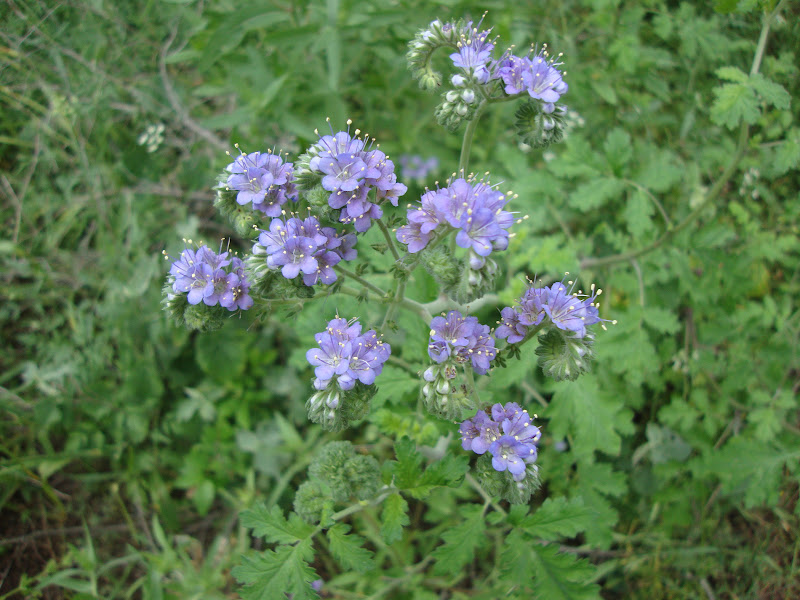
Blue Curls (Phacelia congesta)

Blue Curls is easily recognized by its curling inflorescences of many blue, five-petal flowers accented by long, yellow-tipped stamens.  The inflorescence of Blue Curls is known as a "scorpioid cyme" – scorpioid for the curling, scorpion's-tail shape and cyme for the type of inflorescence (group of flowers) where the terminal, or end, flower blooms first.  Blue Curls (Phacelia congesta) is in the Hydrophyllaceae Family, a surprise to me given that the scorpioid cyme is a hallmark of the Boraginaceae, or Borage Family.  But my botanical instincts proved to be correct when I looked up the Hydrophyllaceae and discovered that it is one of those contested plant families that is thought to be either a subfamily of or closely related to the Boraginaceae.  Blue Curls, borage or not, is a striking wildflower that is common throughout the Hill Country, blooming blue from March to May.

A relative of Blue Curls, which also blooms blue in the spring in shady spots in central Texas, is Baby Blue Eyes.  The single flowers of Baby Blue Eyes are light blue to purple with white centers, and each of the five petals is has a rounded notch.  Baby Blue Eyes (Nemophilia phacelioides) is a winter annual that grows in shady woodlands, canyons, and streamsides, blooming March to May.

Baby Blue Eyes (Nemophilia phacelioides)

Soft-Hair Marbleseed, a Borage Family plant that also has a scorpioid cyme, was blooming in a couple of the sunnier places along the first stretch of trail.  Each flower of Soft-Hair Marbleseed (Onosmodium bejariense) is white and tubular, with a spire-like tip.  Soft-Hair Marbleseed grows in open woodlands and on roadsides in the southeastern part of the Hill Country and blooms in March and April.

Soft-Hair Marbleseed (Onosmodium bejariense)

Another of the wildflowers that I noticed along the Onion Creek section of the trail was a rare treat, the Scarlet Leatherflower.  The unique, vase-shaped pink flowers of the Scarlet Leatherflower grow on a vine with asymmetric leaves that, if not for the lobe on one side that makes each leaf asymmetric, would be heart-shaped.  Scarlet Leatherflower (Clematis texensis) is a uncommon vine that grows over cliffs and shrubs in shady areas near streams in our area.   In fact, as a Hill Country endemic, ours is the only area in the world where it grows, blooming in its striking flowers April through June.

Scarlet Leatherflower (Clematis texensis)

One of the understory shrubs, Wafer Ash, was also in bloom, nearing the end of its flowering season.  Wafer Ash (Ptelea trifoliata) grows as a shrub to small tree in shady, woodland areas in central Texas.  It is commonly found growing underneath the mix of pecan, cedar elm, hackberry, and Spanish oak trees that grow along our waterways.  Its Latin species name, trifoliata, refers to its leaves-of-three, which often lead hikers to fear that it is Poison Ivy.  The leaves of Wafer Ash can be distinguished from those of Poison Ivy by the lack of notches in the leaflets.  While Poison Ivy has notched leaflets, the three leaflets that make up a Wafer Ash leaf are smooth, non-notched ovals.  The common name of the shrub refers to the thin, wafer-like fruits (actually samaras, like those of elm trees) that form after the flowers fade in late spring.

Wafer Ash (Ptelea trifoliata)

Filling out the ground layer of the understory were colonies of False Day Flower.  When I mentioned earlier that, in March, I was there to see the green leap upward as the grasses flowered in blue what I really meant is that I was there to see the huge colonies of False Day Flower form flowering shoots and bloom.  If Blue Curls is my shady-places wildflower of April, then False Day Flower is my shady-places wildflower of March, because, though it is botanically inaccurate to say that the grasses flowered in blue, that is what it feels like in March along the streams of the Hill Country.   False Day Flower (Tinantia anomala) is a monocot, which is why it has grass-like leaves, but it is not a grass; instead it is a relative of the spiderworts that grow in my backyard.  Its flowers are blue, with two petals and three tufted upper stamens that look like two eyes and a nose.  False Day Flower is a winter annual that germinates in the fall, grows through the winter, and leaps into flower in the early spring, forming large colonies of what look like blue-flowered grasses along waterways and on moist, shaded slopes.  False Day Flower blooms from March to May.

Colony of False Day Flowers (Tinantia anomala)

False Day Flower (Tinantia anomala)

About a third of the way around the loop, the trail climbed away from Onion Creek onto higher land above the floodplain and the taller, eastern-forest trees of the bottomland gave way to live oak, mesquite, and cedar (Ashe juniper).  Along this dryer section of trail, woodland was interspersed with open fields populated by grasses, wildflowers, and cacti.

The abundant cactus in the grassy breaks was the Texas Prickly Pear, which was blooming in showy yellow flowers, some of which had orange-tinted centers.  Texas Prickly Pear (Optunia engelmannii var. linheimeri) is common in fields and pastures of central and south Texas, where it grows aggressively, forming wide and tall thickets of spiny cactus pads.  To ranchers, it is a pest, but to wildlife, it is a food source.  The flowers are especially important to native bees, but they must also be a great nectar source for a variety of insects because whenever I find a Prickly Pear in bloom and look into the flowers, I find an array of flies, bees, and beetles feverishly chomping away.  Birds and animals eat the red fruit, called tunas, that form in the late summer.  Humans can eat the tunas as well, but be forewarned that the fruit, just like the cactus pads of the Texas Prickly Pear, have tufts of miniature, barbed spines, called glochids, that are hard to see and even harder to remove from your skin once attached.  Texas Prickly Pear blooms in the spring.

Texas Prickly Pear (Optunia engelmannii var. linheimeri)

The open, sunny fields between the woodlands were filled with wildflowers, some that I've written about recently, like Prairie Verbena (Verbena bipinnatifida) and Texas Star (Lindheimera texana), some that I saw last year on the Homestead Trail, like Prairie Larkspur (Delphinium carolinianum) and Engelmann's Daisy (Engelmannia peristenia), and some that I haven't yet had the chance to document, like Standing Winecup.  Of all the wildflowers in bloom, Standing Winecup was the stand out, blooming in bright magenta with tall flowers elevated above the sea of green grasses, cacti, and shrubs.

Prickly Pear, False Day Flower, Winecup, and Indian Blanket

Standing Winecap (Callirhoe digitata) is one of the poppy mallows of our area, a relative of hibiscus and Turk's Cap.  Standing Winecap is a drought-tolerant perennial that grows in fields and open woods, preferring rocky, dry soils, and blooms from April to June.  Like other Mallow Family plants, the stamens and pistil of Standing Winecap are fused into a single column in the center of the flower, the petals of which can be reddish-purple, dark purple, or white.

Standing Winecap (Callirhoe digitata)

The flowers of Indian Blanket, red and yellow in co-centric circles like a floral bull's eye, also stood out in the green landscape.  Indian Blanket (Gaillardia pulchella) is one of the famous and popular wildflowers of central Texas because it grows happily along our highways and in open grassy areas throughout central and western Texas.  Indian Blanket is heat- and drought-tolerant and reseeds easily, established large, dense colonies in areas with limestone soils and good drainage.  The flowers of Indian Blanket, on the plants from April through June, are important to native bees.

Indian Blanket (Gaillardia pulchella)

Brown-Eyed Susan, like Indian Blanket, is a Sunflower Family plant that also establishes large, showy colonies in open fields or woodland breaks with sandy or well-draining soil.  The ray flowers (the part of the sunflower inflorescence that looks like the petals) of Brown-Eyed Susan are yellow with a red-brown spot at the base and tend to droop downward.  The disc flowers at the center of the inflorescence are packed tightly together to form a purple-brown cone.  The flowers of Brown-Eyed Susan (Rudbeckia hirta) provide nectar for butterflies and bees, and the seeds are food for birds.  Brown-Eyed Susan is an annual to short-lived perennial that blooms April to June.

Brown-Eyed Susan (Rudbeckia hirta)

Yarrow, a wildflower that is common throughout North America, is a perennial with ferny, lacy leaves that grows as a rosette in the early spring before producing tall flowering stalks in the spring.  Each flowering stalk holds many white clusters of flowers that bloom from March to June.  Yarrow (Achillea millefolium) is common where soils are disturbed, preferring partial shade such as at the edge of a woodland.  Yarrow flowers provide nectar to native bees.

Yarrow (Achillea millefolium)

The blue-purple with white flowers of Mealy Sage were also starting to bloom along the trail.  Mealy Sage (Salvia farinacea) gets its name from the white-hairy sepals that cover the flowers before they bloom, giving the flower stalks a fuzzy (or mealy?) look.  Mealy Sage is a drought-tolerant perennial that prefers sunny locations with limestone soils, making it a good match for central Texas.  Mealy Sage blooms in April and May, or after summer rains, providing nectar for butterflies, bees, and hummingbirds.

Mealy Sage (Salvia farinacea)

A few huge pink-violet blooms of Texas Thistle stood on tall stems above the mass of grasses and spring wildflowers.  Texas Thistle, a drought-tolerant biennial, grows in dry fields and roadsides throughout the state.  Though often viewed as a weed, Texas Thistle (Cirsium texanum) is an important nectar source, providing food for butterflies, bees, and bumblebees, and its seeds are eaten by birds.  Texas Thistle blooms from April to July.

Texas Thistle (Cirsium texanum)

Bull Nettle is another wildflower that stands out in a crowd.  With large, hairy, lobed leaves and spiny stems, Bull Nettle (Cnidoscolus texanus) looks intimidating, as it should, given that the whole plant is covered in stinging hairs that cause a burning rash when touched.  The bright white, star-shaped flowers only make the plant more noticeable in the spring.  Bull Nettle is a common perennial that tolerates the heat and drought of central Texas, blooming into the summer.

Bull Nettle (Cnidoscolus texanus)

The last section of the trail looped back to the Upper Falls.  For Lee and me, the best part of visiting the park is walking between the falls, enjoying the huge Bald Cypress trees along the creek and scrambling across the volcanic rock on either side of the Lower Falls.  In between the falls, growing out of a rocky outcrop, I found another lovely wildflower blooming.  Greenthread, a Sunflower Family annual that is named for its narrow-leaved foliage, blooms in bright yellow from April to June.  Greenthread (Thelesperma filifolium) prefers dry, sandy or gravely soils and provides nectar for butterflies.  I think this was my best picture of the day.

Greenthread (Thelesperma filifolium)

In the canyon along Onion Creek, in between the falls, a population of Rough-Leaf Dogwood trees grows.  Dogwood trees are rare in central Texas, limited to shady bottomlands where water is year-round and taller trees, like the old Bald Cypress along Onion Creek, provide shade.  In other words, the dogwoods in Texas are a relic of a wetter time, southern outliers of trees that, in these times, are found mainly in eastern or western forests, not in the dry middle of the continent.  Yet we have a population of Rough-Leaf Dogwood (Cornus drummondii) right here at McKinney Falls, so I am always happy to see them.  I was especially pleased on this visit because the small trees were blooming.  The leaves of Rough-Leaf Dogwood are oval-shaped and rough to the touch, with wavy edges and parallel veins.  Their white flowers are cross-shaped, with four petals, and are clustered together into large inflorescences.  The Rough-Leaf Dogwoods bloom in April and May.

Rough-Leaf Dogwood (Cornus drummondii)

We ended our hike at the field across from the parking lot, where the April wildflowers had turned the open space into a sea of yellow sunflowers punctuated by the red of Indian Blanket, the blue of Texas Bluebonnet, and a few tall, white flowers.  The white flowers that stood above the rest on prickly, blue-green foliage belonged to White Prickly Poppy (Argemone albiflora), a drought-tolerant wildflower that is common in abandoned fields and roadsides in central Texas.  With its prickly growth habit and seeds that are toxic, White Prickly Poppy is regarded as weed, but its flowers are as beautiful as those of any domestic poppy and provide nectar for bees and beetles.

White Prickly Poppy (Argemone albiflora)

Spring came early this year and, with it, the sense that summer was never far behind.  Yet by mid-April, it felt like we were granted an extension, a few more weeks of the glorious, summer-up-north weather that we call spring.  I know that the real heat is just around the corner, but I also know that, counter to my instincts, this is not the time of year to think ahead.  These are the sunny days to enjoy.  But, still, I am hopeful that this will be the year that the rains continue, the year that the drought is lifted, the year that I get to write about summer wildflowers.  I know that it is foolish to place my hopes on the Texas summer.  But it sure feels nice.

Saturday, March 24, 2012

Snake Trail

In the southeast corner of Travis County, across the highway from the high school where I used to teach, hidden in the back of a quiet metro park that is mostly used for its baseball fields, is a hiking trail.  I am a fan of this hiking trail, because it is quiet and hidden and a place that I discovered, not in a hiking book or by word of mouth, but simply by stumbling into it.  This trail is also on my short list of places to hike on the weekend because it is close to home, a twenty-minute drive from east Austin, it is about three miles long, a good length for a midday walk, and it is a loop where, if walked in the clockwise direction, the best part of the trail, the shady, hilly woodland section featuring several cedar-log wooden bridges, is the last part of the trail.

The "primitive trail" at Southeast Metropolitan Park is a young trail in a new park.  What this means in practical terms is that trail itself was recently cut into the landscape, creating an ecological disturbance.  So walking the trail is like walking through a demonstration of what secondary succession looks like in central Texas, and the sunny parts of the trail are flanked on either side by dense stands of annual plants, a mix of native wildflowers, non-native invasives, and enormous, weedy sunflower relatives – think of the B-movie version of the many mutant offspring of a dandelion and a thistle.  To me, this is a plant-viewing trail, a place where I have seen many fall wildflowers, where I hope to return to see many spring wildflowers, and where I don't mind wading through overgrown sections of trail to discover a new plant or two.


To Lee, who likes to hike in his Tevas and is along for the walk rather than the botany lesson, wading through the undergrowth is less charming.  There is a reason why this trail isn't overrun with people, he reminded me as we made our way down a muddy section of trail last Saturday.  In truth, many sections of the trail were muddy, still sticky from recent rains, and our shoes become caked with heavy clay that had to be scraped off periodically.  And the reason, to Lee's thinking, that the trail is not much used – because it is an east-side trail – actually refers to a few of the less-appealing features of the trail, like the outstanding views of industrial smokestacks along the new toll road, the stench of the upstream waste-water treatment plant that sometimes accompanies the hike, and the tendency for the trail to be overgrown with weeds of terrifying sizes.  So, when I suggested that we go for a walk at "the place by the school," Lee responded with, "You mean the stinky place?"

This time, I had a brilliant counter-argument:  lots of wildflowers and no hipsters.  Last Saturday was the last Saturday of spring break, which, in Austin, means the last Saturday of SXSW.  Leaving the house without running into annoying packs of hipsters was near impossible.  Crossing downtown and stepping foot onto the popular and famous Greenbelt Trail were out of the question.  But it was a sunny, warm day and I wasn't going to let 'South By' keep me from walking in the woods.  So we headed east, and I was right about both of my predictions.  We didn't run into any hipsters, in fact, we didn't pass anyone on the trail.  And the wildflowers were amazing, blooming in yellow and blue all along the trail.


The majority of yellow blooms were on huge stands of Annual Bastard Cabbage.  From the name alone, it is clear that Annual Bastard Cabbage (Rapistrum rugosum) is not a well-loved plant.  An introduced species from Eurasia and northern Africa, Bastard Cabbage is an aggressive weed that quickly colonizes sunny, disturbed soils along roads, fields, and waterways.  In Texas, Bastard Cabbage is classified as a "terrestrial noxious weed" because of its ability to outcompete the native wildflowers during their winter growth season, forming dense single-species stands.  Since learning to recognize Annual Bastard Cabbage – I didn't used to notice it much, thinking it was just a wild mustard – I've realized just how common this plant is around Austin, turning our roadsides lemon yellow.  From a distance, the blooms look like an Impressionist painting, so many dots of pastel yellow fading into the horizon.  Up close, the plant is a leggy, weedy looking mustard, with many cross-shaped, four petaled flowers and even more seed pods.

Annual Bastard Cabbage (Rapistrum rugosum)

The dominant blue-flowered plant along the trail was the Texas Bluebonnet, a wildflower that is both native and very well-loved.  Texas Bluebonnet (Lupinus texensis) thrives in sunny places with disturbed soils, like abandoned fields, roadsides, or along a young trail.

Texas Bluebonnets (Lupinus texensis)

Texas Bluebonnet and Annual Bastard Cabbage were, by far, the most abundant wildflowers in bloom along the trail.  Both are winter annuals, or single-season plants that germinate in the fall, grow as leafy rosettes through the winter, and bolt and bloom in the spring.  Another native winter annual, Lindheimer Daisy (Lindheimera texana), was also in bloom, in bright, sunflower yellow.  Lindheimer Daisy grows in sunny, grassy areas and blooms in the spring, from March to May.

Lindheimer Daisy (Lindheimera texana)

The salmon-orange blooms of Scarlet Pimpernel, also a winter annual, were visible in the greenery at the side of the trail.  Scarlet Pimpernel (Anagallis arvensis), a native to Canada that has expanded its range throughout the United States, grows low to the ground in moist areas.

Scarlet Pimpernel (Anagallis arvensis)

In addition to the winter annuals, a few perennial wildflowers were also beginning to bloom along the primitive trail.  Wild Garlic (Allium drummondii), a perennial that regrows from underground bulbs each spring, forms large colonies in open grassy areas.  Wild Garlic is a native, edible plant that blooms in white to pink wildflowers in the spring.

Wild Garlic (Allium drummondii)

Prairie Verbena is a native perennial that also grows in open grassy areas.  Prairie Verbena (Glandularia bipinnatifida) is a long-season bloomer that brings purple to our roadsides and fields, rain permitting, from March through October.

Prairie Verbena (Glandularia bipinnatifida)

So, despite the muddy trail, the outing was a success:
outside √
in the woods √
lots of wildflowers √
no hipsters √
no snakes ?

Well, it was a success until we encountered the snake.  Usually, snake encounters are cause for excitement of the Quick, grab the camera sort.  But as I came to a full stop in the trail and watched this snake slither into the undergrowth, I realized that there was something wrong with its tail, which was bent up perpendicular to the rest of its body.  Then I realized that the bent-up tail was actually a rattle, which meant that I was watching a rattlesnake cross the trail, and I lowered the camera and ceased to move.  The snake was short, only two or three feet long, and fat, looking like it just ate something.  Once the snake had crossed the trail and was hidden under a carpet of spring leaves, only visible from its rattle on one end and its darting black tongue on the other, it stopped moving.  Lee tried to take a picture from a distance then we hurried by the snake, making a respectful arc around its rattle end.

And then we continued down the overgrown trail, wading periodically through dense stands of grasses and enormous, leafy weeds.  In other words, we, the only humans on the trail, were wading through miles of prime snake habitat.  I kept my eyes peeled on the trail a few yards ahead while Lee began seriously regretting his decision to wear open-toed shoes.  What would we do if one of us did get bit by a snake? he began to wonder aloud.  I tried to be the rational one, pointing out how this was my first rattlesnake sighting in many years of hiking in central Texas and how the snake wasn't aggressive, in fact was simply trying to hide from us.  In truth, my legs were feeling very bare as I brushed through all that post-spring-rains growth.  Luckily, the most overgrown parts of the trail were soon behind us, and my focus returned to taking pictures of all the blue and yellow wildflowers that were around every corner.


The last part of the trail, which passed through a shady cedar woodland, was wide and clear, free of a leafy understory.  Soon we were back on the gravel trail leading to the car, relaxed and joking about our terrifying snake sighting.  If the rains continue, I want to return to the trail to see the next wave of wildflowers, the late-spring bloomers.  Lee swears he won't return without proper shoes and a good whacking stick.  My task, between now and then, is to figure out how to effectively counter-respond when Lee says, after I suggest that we go for a hike at the place by the school, You mean the snake place?

Wednesday, September 28, 2011

In Search of Water

This summer just won't end.  For weeks, since the calender said that fall was approaching (hah!), we've been waiting for an opportunity to get outside for a hike, preferably not in the triple-digit heat.  Finally, last week, with a shared weekday off for our anniversary, Lee and I decided that, running water or not, hot summer day or not, we were just going to have to get out in it.

We went to the Hamilton Pool Preserve, a Travis county park where Hamilton Creek, a tributary of the Pedernales River, flows over a ledge, as a waterfall, into a pool in a limestone grotto below, creating a natural swimming hole.  As one of the last places with running water and reliable swimming in dry summers, Hamilton Pool is very popular on weekend days in the summer and regularly fills to capacity.  Arriving late on a Monday morning, we were looking to miss the crowds and have the trail to ourselves.  We were also hoping that the spring-fed creek would be flowing.


Hamilton Creek was running, though barely so.  A trickle of water fell from the top part of the creek into the pool, which was open for swimming, though the water was a murky green.  We walked around the pool, enjoying the cool air along the back side of the grotto, where rock walls out of reach of the midday sun still held, even at noon, the cool of the evening, then we headed out on the trail to the river.

This was the restorative part of the journey, walking beneath healthy cypress trees with their roots in the creek below.  The creek wasn't running quickly, but it was a couple feet deep in places, with cool water that was still supporting fish and turtles and baby cypress trees.  The presence of water made all the difference, cooling and humidifying, in a pleasant way, the air in the canyon along the creek.  For that short stretch of creek we left the drought that has so defined this summer, the extreme and lasting heat, the dry winds, and the lack of rainfall, in the uplands above.  In this way, the preserve is doing its job, providing a refuge for plants and animals through the roughest months of the year.  And providing me a place to breathe fresh, tree-made oxygen and gaze up into the branches of cypress, Spanish oak, and elm trees still holding onto their green leaves.


Along the trail at ground level, the pink-purple flowers of Simple-Leaf Tick Clover caught my eye.  I knew immediately that the flowers belonged to the Pea Family, but it took me a bit of looking to locate the species.  Tick clovers make attractive pink-purple flowers from May through October but are more commonly known for their annoying seed pods that stick to socks and pant legs in the fall and winter, which is why they are also called Beggar's Ticks.  The Simple-Leaf Tick Clover (Desmodium psilophyllum) is the only species of tick clover in this area that has simple leaves rather than the trifoliate (composed of three leaflets) leaves of other tick clovers.

Simple-Leaf Tick Clover (Desmodium psilophyllum)

Blue Mist-Flower also bloomed along the creek.  Blue Mist-Flower (Eupatorium coelestinum) is a late-summer to fall blooming perennial that is common in moist, shady habitats in central Texas.

Blue Mist-Flower (Eupatorium coelestinum)

As Hamilton Creek and the trail neared the Pedernales River, the canyon widened and the trail climbed away from the creek.  The water of the creek disappeared beneath the sandy creek bed into groundwater, so the creek, though running in the section beneath the pool, did not flow into the Pedernales River.  The river itself was also dried up, with rolling mounds of hot sand left where the river usually flowed.  Lee and I walked along the riverbed, hoping to spot a flowing portion of the river around the next bend, but we didn't get far before the course, sharp grains of sand accumulating between our feet and our Tevas motivated us to step into the warm pools of water, all that remained of the Pedernales river.  As far as we could see in both directions, the river was reduced to intermittent pools, and some of the cypress trees along the river were responding to the drought by turning orange-red, getting ready to drop their leaves two months early.


In a few low spots, the sand was still moist, indicating that the river may have flowed, or at least held more discontinuous pools of water, very recently.  Heat-hardy wildflowers were blooming along the riverbank, making the most of the receding water supply.  Small, pink blooms of Prairie Agalinis hid in a tangle of greenery alongside a tall stand of bright-yellow Tatalencho.  Farther down the bank, a colony of White Boneset bloomed.  White Boneset (Eupatorium serotium), a perennial in the sunflower family, prefers the moist soil along streams, where it blooms from August through October.

White Boneset (Eupatorium serotium)

Clammyweed, a sticky plant in the same family as the plants that produce caper berries and peppercorns, has distinctive flowers with pink to purple stamens that are much longer that the white petals.  Clammyweed (Polanisia dodecandra) is common in dry creek beds, along low-flowing creeks, and on roadsides, blooming May through October.

Clammyweed (Polanisia dodecandra)

The showiest and most abundant flowers along the river bed were the orange-highlighted yellow flowers of the Rattlebush.  Rattlebush (Sesbania drummondii) is a woody shrub that is common along waterways and in dry stream beds in central and east Texas.  The leaves of Rattlebush, like those of many heat-tolerant shrubs in the Pea Family, are compound, composed of many (20 to 50) small leaflets.  The seedpods of Rattlebush, which are are flattened around each seed, remain on the plant into the winter, long after the leaves have fallen from the plant.  The mature seeds are loose in the pods and rattle when shaken by the winds of winter cold fronts, giving the plant its name.  The seeds of Rattlebush are poisonous.

Rattlebush (Sesbania drummondii)

Wanting to escape the bright sun of midday and the sharp sand of the river bed, Lee and I returned, high-stepping to kick sand from our Tevas with every step, to the trail along the creek.  Usually I prefer a loop trail, and the chance to walk down a new section of trail for an entire hike, but this time I was glad to return back along the same short trail, to get another dose of what has been almost entirely missing from my life this summer, walking in the woods along running water.