Tuesday, April 24, 2012

April Wildflowers

The longer I live in Texas, the shorter the springs seem to get.  One moment the trees are bare and I'm appreciating the shapes of their branches against the blue skies of early February, noticing with alarm that the elms and ashes are already glowing in yellow-green, getting ready to flower, and, seemingly, the next moment I'm worried about keeping the back door closed between trips to the garden because the air conditioner is running and summer is here.  Already.  Again.

Luckily, for some sense of perspective, I take pictures.  Recently I uploaded a huge batch of photos onto the computer and then watched the "last import" as a slide show on super slow, ten seconds per picture, while listening to Fleetwood Mac's Over My Head on repeat on the headphones, because ever since catching a clip of that song on a late-night infomercial for the Midnight Special DVD collection, I can't get it out of my head.  Not to mention that Over My Head, the sentiments of it, of falling for a guy that's wrong for you but doing it anyway, because it sure feels nice, well, that about summarizes my feelings for the Austin summer after fifteen years of living here.  I know it's going to hurt me yet I am still hopeful that this year will be the one, the rainy summer when June is defined by thunderstorms, the tomatoes produce into July, the creeks run into August, and the Greenbelt is the seven-mile water park that it can be.  You can take me to that paradise anytime.

So, anyway, as I was watching those pictures, one at a time, all 134 of them, I realized that spring, though quick, was actually a process, not the overnight event that it felt like.  Even more amazingly, I was there.  I was hiking at the Greenbelt with Lee in late January when the red buckeyes leafed out even earlier that usual, and I was there again in February to notice the creep of green into the ground-level of the landscape, as the winter annuals and grasses emerged through the leaf layer.  I was there in March when the backyard colony of Spiderworts bloomed in purple and blue, I was out on the trail in the midst of this year's bluebonnet season, and I was back at the Greenbelt to see the green leap upward as the grasses flowered in blue and the vines and shrubs and trees leafed out.

Spiderworts (Tradescantia sp.) in the backyard

Then April arrived and, with it, the transition to summer.  Days got hot, nights got humid, and the end loomed near.  I realized that I ought to get outside into the last days of spring, to record the diversity of this year's wildflowers, before the ovens turned on.  Last April I found the best trail-side wildflower viewing at McKinney Falls State Park, where Lee and I hiked the Homestead Trail and saw many spring wildflowers.  So this April we returned to McKinney Falls, this time to check out the wildflowers along the Onion Creek Trail.

We walked counterclockwise from the parking lot by the Upper Falls.  The first section of the trail followed the floodplain of Onion Creek, where a mix of tall trees, mostly pecan, cedar elm, hackberry, and, adjacent to the creek, bald cypress and sycamore, shaded the trail.  Because of the shade, the understory was patchy, a mix of leafy, open forest floor and shade-tolerant perennials and shrubs.  The most common wildflower along that section of trail was Blue Curls.  In my thinking, Blue Curls is the shady-places wildflower of April in the Austin area, but I may be biased by so many hours spent on the Greenbelt Trail, where Blue Curls is a major player each spring.
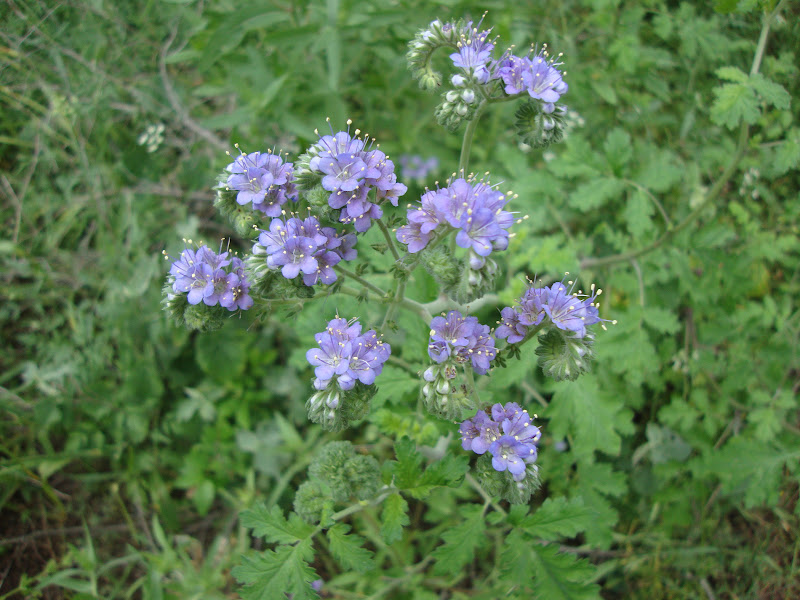
Blue Curls (Phacelia congesta)

Blue Curls is easily recognized by its curling inflorescences of many blue, five-petal flowers accented by long, yellow-tipped stamens.  The inflorescence of Blue Curls is known as a "scorpioid cyme" – scorpioid for the curling, scorpion's-tail shape and cyme for the type of inflorescence (group of flowers) where the terminal, or end, flower blooms first.  Blue Curls (Phacelia congesta) is in the Hydrophyllaceae Family, a surprise to me given that the scorpioid cyme is a hallmark of the Boraginaceae, or Borage Family.  But my botanical instincts proved to be correct when I looked up the Hydrophyllaceae and discovered that it is one of those contested plant families that is thought to be either a subfamily of or closely related to the Boraginaceae.  Blue Curls, borage or not, is a striking wildflower that is common throughout the Hill Country, blooming blue from March to May.

A relative of Blue Curls, which also blooms blue in the spring in shady spots in central Texas, is Baby Blue Eyes.  The single flowers of Baby Blue Eyes are light blue to purple with white centers, and each of the five petals is has a rounded notch.  Baby Blue Eyes (Nemophilia phacelioides) is a winter annual that grows in shady woodlands, canyons, and streamsides, blooming March to May.

Baby Blue Eyes (Nemophilia phacelioides)

Soft-Hair Marbleseed, a Borage Family plant that also has a scorpioid cyme, was blooming in a couple of the sunnier places along the first stretch of trail.  Each flower of Soft-Hair Marbleseed (Onosmodium bejariense) is white and tubular, with a spire-like tip.  Soft-Hair Marbleseed grows in open woodlands and on roadsides in the southeastern part of the Hill Country and blooms in March and April.

Soft-Hair Marbleseed (Onosmodium bejariense)

Another of the wildflowers that I noticed along the Onion Creek section of the trail was a rare treat, the Scarlet Leatherflower.  The unique, vase-shaped pink flowers of the Scarlet Leatherflower grow on a vine with asymmetric leaves that, if not for the lobe on one side that makes each leaf asymmetric, would be heart-shaped.  Scarlet Leatherflower (Clematis texensis) is a uncommon vine that grows over cliffs and shrubs in shady areas near streams in our area.   In fact, as a Hill Country endemic, ours is the only area in the world where it grows, blooming in its striking flowers April through June.

Scarlet Leatherflower (Clematis texensis)

One of the understory shrubs, Wafer Ash, was also in bloom, nearing the end of its flowering season.  Wafer Ash (Ptelea trifoliata) grows as a shrub to small tree in shady, woodland areas in central Texas.  It is commonly found growing underneath the mix of pecan, cedar elm, hackberry, and Spanish oak trees that grow along our waterways.  Its Latin species name, trifoliata, refers to its leaves-of-three, which often lead hikers to fear that it is Poison Ivy.  The leaves of Wafer Ash can be distinguished from those of Poison Ivy by the lack of notches in the leaflets.  While Poison Ivy has notched leaflets, the three leaflets that make up a Wafer Ash leaf are smooth, non-notched ovals.  The common name of the shrub refers to the thin, wafer-like fruits (actually samaras, like those of elm trees) that form after the flowers fade in late spring.

Wafer Ash (Ptelea trifoliata)

Filling out the ground layer of the understory were colonies of False Day Flower.  When I mentioned earlier that, in March, I was there to see the green leap upward as the grasses flowered in blue what I really meant is that I was there to see the huge colonies of False Day Flower form flowering shoots and bloom.  If Blue Curls is my shady-places wildflower of April, then False Day Flower is my shady-places wildflower of March, because, though it is botanically inaccurate to say that the grasses flowered in blue, that is what it feels like in March along the streams of the Hill Country.   False Day Flower (Tinantia anomala) is a monocot, which is why it has grass-like leaves, but it is not a grass; instead it is a relative of the spiderworts that grow in my backyard.  Its flowers are blue, with two petals and three tufted upper stamens that look like two eyes and a nose.  False Day Flower is a winter annual that germinates in the fall, grows through the winter, and leaps into flower in the early spring, forming large colonies of what look like blue-flowered grasses along waterways and on moist, shaded slopes.  False Day Flower blooms from March to May.

Colony of False Day Flowers (Tinantia anomala)

False Day Flower (Tinantia anomala)

About a third of the way around the loop, the trail climbed away from Onion Creek onto higher land above the floodplain and the taller, eastern-forest trees of the bottomland gave way to live oak, mesquite, and cedar (Ashe juniper).  Along this dryer section of trail, woodland was interspersed with open fields populated by grasses, wildflowers, and cacti.

The abundant cactus in the grassy breaks was the Texas Prickly Pear, which was blooming in showy yellow flowers, some of which had orange-tinted centers.  Texas Prickly Pear (Optunia engelmannii var. linheimeri) is common in fields and pastures of central and south Texas, where it grows aggressively, forming wide and tall thickets of spiny cactus pads.  To ranchers, it is a pest, but to wildlife, it is a food source.  The flowers are especially important to native bees, but they must also be a great nectar source for a variety of insects because whenever I find a Prickly Pear in bloom and look into the flowers, I find an array of flies, bees, and beetles feverishly chomping away.  Birds and animals eat the red fruit, called tunas, that form in the late summer.  Humans can eat the tunas as well, but be forewarned that the fruit, just like the cactus pads of the Texas Prickly Pear, have tufts of miniature, barbed spines, called glochids, that are hard to see and even harder to remove from your skin once attached.  Texas Prickly Pear blooms in the spring.

Texas Prickly Pear (Optunia engelmannii var. linheimeri)

The open, sunny fields between the woodlands were filled with wildflowers, some that I've written about recently, like Prairie Verbena (Verbena bipinnatifida) and Texas Star (Lindheimera texana), some that I saw last year on the Homestead Trail, like Prairie Larkspur (Delphinium carolinianum) and Engelmann's Daisy (Engelmannia peristenia), and some that I haven't yet had the chance to document, like Standing Winecup.  Of all the wildflowers in bloom, Standing Winecup was the stand out, blooming in bright magenta with tall flowers elevated above the sea of green grasses, cacti, and shrubs.

Prickly Pear, False Day Flower, Winecup, and Indian Blanket

Standing Winecap (Callirhoe digitata) is one of the poppy mallows of our area, a relative of hibiscus and Turk's Cap.  Standing Winecap is a drought-tolerant perennial that grows in fields and open woods, preferring rocky, dry soils, and blooms from April to June.  Like other Mallow Family plants, the stamens and pistil of Standing Winecap are fused into a single column in the center of the flower, the petals of which can be reddish-purple, dark purple, or white.

Standing Winecap (Callirhoe digitata)

The flowers of Indian Blanket, red and yellow in co-centric circles like a floral bull's eye, also stood out in the green landscape.  Indian Blanket (Gaillardia pulchella) is one of the famous and popular wildflowers of central Texas because it grows happily along our highways and in open grassy areas throughout central and western Texas.  Indian Blanket is heat- and drought-tolerant and reseeds easily, established large, dense colonies in areas with limestone soils and good drainage.  The flowers of Indian Blanket, on the plants from April through June, are important to native bees.

Indian Blanket (Gaillardia pulchella)

Brown-Eyed Susan, like Indian Blanket, is a Sunflower Family plant that also establishes large, showy colonies in open fields or woodland breaks with sandy or well-draining soil.  The ray flowers (the part of the sunflower inflorescence that looks like the petals) of Brown-Eyed Susan are yellow with a red-brown spot at the base and tend to droop downward.  The disc flowers at the center of the inflorescence are packed tightly together to form a purple-brown cone.  The flowers of Brown-Eyed Susan (Rudbeckia hirta) provide nectar for butterflies and bees, and the seeds are food for birds.  Brown-Eyed Susan is an annual to short-lived perennial that blooms April to June.

Brown-Eyed Susan (Rudbeckia hirta)

Yarrow, a wildflower that is common throughout North America, is a perennial with ferny, lacy leaves that grows as a rosette in the early spring before producing tall flowering stalks in the spring.  Each flowering stalk holds many white clusters of flowers that bloom from March to June.  Yarrow (Achillea millefolium) is common where soils are disturbed, preferring partial shade such as at the edge of a woodland.  Yarrow flowers provide nectar to native bees.

Yarrow (Achillea millefolium)

The blue-purple with white flowers of Mealy Sage were also starting to bloom along the trail.  Mealy Sage (Salvia farinacea) gets its name from the white-hairy sepals that cover the flowers before they bloom, giving the flower stalks a fuzzy (or mealy?) look.  Mealy Sage is a drought-tolerant perennial that prefers sunny locations with limestone soils, making it a good match for central Texas.  Mealy Sage blooms in April and May, or after summer rains, providing nectar for butterflies, bees, and hummingbirds.

Mealy Sage (Salvia farinacea)

A few huge pink-violet blooms of Texas Thistle stood on tall stems above the mass of grasses and spring wildflowers.  Texas Thistle, a drought-tolerant biennial, grows in dry fields and roadsides throughout the state.  Though often viewed as a weed, Texas Thistle (Cirsium texanum) is an important nectar source, providing food for butterflies, bees, and bumblebees, and its seeds are eaten by birds.  Texas Thistle blooms from April to July.

Texas Thistle (Cirsium texanum)

Bull Nettle is another wildflower that stands out in a crowd.  With large, hairy, lobed leaves and spiny stems, Bull Nettle (Cnidoscolus texanus) looks intimidating, as it should, given that the whole plant is covered in stinging hairs that cause a burning rash when touched.  The bright white, star-shaped flowers only make the plant more noticeable in the spring.  Bull Nettle is a common perennial that tolerates the heat and drought of central Texas, blooming into the summer.

Bull Nettle (Cnidoscolus texanus)

The last section of the trail looped back to the Upper Falls.  For Lee and me, the best part of visiting the park is walking between the falls, enjoying the huge Bald Cypress trees along the creek and scrambling across the volcanic rock on either side of the Lower Falls.  In between the falls, growing out of a rocky outcrop, I found another lovely wildflower blooming.  Greenthread, a Sunflower Family annual that is named for its narrow-leaved foliage, blooms in bright yellow from April to June.  Greenthread (Thelesperma filifolium) prefers dry, sandy or gravely soils and provides nectar for butterflies.  I think this was my best picture of the day.

Greenthread (Thelesperma filifolium)

In the canyon along Onion Creek, in between the falls, a population of Rough-Leaf Dogwood trees grows.  Dogwood trees are rare in central Texas, limited to shady bottomlands where water is year-round and taller trees, like the old Bald Cypress along Onion Creek, provide shade.  In other words, the dogwoods in Texas are a relic of a wetter time, southern outliers of trees that, in these times, are found mainly in eastern or western forests, not in the dry middle of the continent.  Yet we have a population of Rough-Leaf Dogwood (Cornus drummondii) right here at McKinney Falls, so I am always happy to see them.  I was especially pleased on this visit because the small trees were blooming.  The leaves of Rough-Leaf Dogwood are oval-shaped and rough to the touch, with wavy edges and parallel veins.  Their white flowers are cross-shaped, with four petals, and are clustered together into large inflorescences.  The Rough-Leaf Dogwoods bloom in April and May.

Rough-Leaf Dogwood (Cornus drummondii)

We ended our hike at the field across from the parking lot, where the April wildflowers had turned the open space into a sea of yellow sunflowers punctuated by the red of Indian Blanket, the blue of Texas Bluebonnet, and a few tall, white flowers.  The white flowers that stood above the rest on prickly, blue-green foliage belonged to White Prickly Poppy (Argemone albiflora), a drought-tolerant wildflower that is common in abandoned fields and roadsides in central Texas.  With its prickly growth habit and seeds that are toxic, White Prickly Poppy is regarded as weed, but its flowers are as beautiful as those of any domestic poppy and provide nectar for bees and beetles.

White Prickly Poppy (Argemone albiflora)

Spring came early this year and, with it, the sense that summer was never far behind.  Yet by mid-April, it felt like we were granted an extension, a few more weeks of the glorious, summer-up-north weather that we call spring.  I know that the real heat is just around the corner, but I also know that, counter to my instincts, this is not the time of year to think ahead.  These are the sunny days to enjoy.  But, still, I am hopeful that this will be the year that the rains continue, the year that the drought is lifted, the year that I get to write about summer wildflowers.  I know that it is foolish to place my hopes on the Texas summer.  But it sure feels nice.

Saturday, March 24, 2012

Snake Trail

In the southeast corner of Travis County, across the highway from the high school where I used to teach, hidden in the back of a quiet metro park that is mostly used for its baseball fields, is a hiking trail.  I am a fan of this hiking trail, because it is quiet and hidden and a place that I discovered, not in a hiking book or by word of mouth, but simply by stumbling into it.  This trail is also on my short list of places to hike on the weekend because it is close to home, a twenty-minute drive from east Austin, it is about three miles long, a good length for a midday walk, and it is a loop where, if walked in the clockwise direction, the best part of the trail, the shady, hilly woodland section featuring several cedar-log wooden bridges, is the last part of the trail.

The "primitive trail" at Southeast Metropolitan Park is a young trail in a new park.  What this means in practical terms is that trail itself was recently cut into the landscape, creating an ecological disturbance.  So walking the trail is like walking through a demonstration of what secondary succession looks like in central Texas, and the sunny parts of the trail are flanked on either side by dense stands of annual plants, a mix of native wildflowers, non-native invasives, and enormous, weedy sunflower relatives – think of the B-movie version of the many mutant offspring of a dandelion and a thistle.  To me, this is a plant-viewing trail, a place where I have seen many fall wildflowers, where I hope to return to see many spring wildflowers, and where I don't mind wading through overgrown sections of trail to discover a new plant or two.


To Lee, who likes to hike in his Tevas and is along for the walk rather than the botany lesson, wading through the undergrowth is less charming.  There is a reason why this trail isn't overrun with people, he reminded me as we made our way down a muddy section of trail last Saturday.  In truth, many sections of the trail were muddy, still sticky from recent rains, and our shoes become caked with heavy clay that had to be scraped off periodically.  And the reason, to Lee's thinking, that the trail is not much used – because it is an east-side trail – actually refers to a few of the less-appealing features of the trail, like the outstanding views of industrial smokestacks along the new toll road, the stench of the upstream waste-water treatment plant that sometimes accompanies the hike, and the tendency for the trail to be overgrown with weeds of terrifying sizes.  So, when I suggested that we go for a walk at "the place by the school," Lee responded with, "You mean the stinky place?"

This time, I had a brilliant counter-argument:  lots of wildflowers and no hipsters.  Last Saturday was the last Saturday of spring break, which, in Austin, means the last Saturday of SXSW.  Leaving the house without running into annoying packs of hipsters was near impossible.  Crossing downtown and stepping foot onto the popular and famous Greenbelt Trail were out of the question.  But it was a sunny, warm day and I wasn't going to let 'South By' keep me from walking in the woods.  So we headed east, and I was right about both of my predictions.  We didn't run into any hipsters, in fact, we didn't pass anyone on the trail.  And the wildflowers were amazing, blooming in yellow and blue all along the trail.


The majority of yellow blooms were on huge stands of Annual Bastard Cabbage.  From the name alone, it is clear that Annual Bastard Cabbage (Rapistrum rugosum) is not a well-loved plant.  An introduced species from Eurasia and northern Africa, Bastard Cabbage is an aggressive weed that quickly colonizes sunny, disturbed soils along roads, fields, and waterways.  In Texas, Bastard Cabbage is classified as a "terrestrial noxious weed" because of its ability to outcompete the native wildflowers during their winter growth season, forming dense single-species stands.  Since learning to recognize Annual Bastard Cabbage – I didn't used to notice it much, thinking it was just a wild mustard – I've realized just how common this plant is around Austin, turning our roadsides lemon yellow.  From a distance, the blooms look like an Impressionist painting, so many dots of pastel yellow fading into the horizon.  Up close, the plant is a leggy, weedy looking mustard, with many cross-shaped, four petaled flowers and even more seed pods.

Annual Bastard Cabbage (Rapistrum rugosum)

The dominant blue-flowered plant along the trail was the Texas Bluebonnet, a wildflower that is both native and very well-loved.  Texas Bluebonnet (Lupinus texensis) thrives in sunny places with disturbed soils, like abandoned fields, roadsides, or along a young trail.

Texas Bluebonnets (Lupinus texensis)

Texas Bluebonnet and Annual Bastard Cabbage were, by far, the most abundant wildflowers in bloom along the trail.  Both are winter annuals, or single-season plants that germinate in the fall, grow as leafy rosettes through the winter, and bolt and bloom in the spring.  Another native winter annual, Lindheimer Daisy (Lindheimera texana), was also in bloom, in bright, sunflower yellow.  Lindheimer Daisy grows in sunny, grassy areas and blooms in the spring, from March to May.

Lindheimer Daisy (Lindheimera texana)

The salmon-orange blooms of Scarlet Pimpernel, also a winter annual, were visible in the greenery at the side of the trail.  Scarlet Pimpernel (Anagallis arvensis), a native to Canada that has expanded its range throughout the United States, grows low to the ground in moist areas.

Scarlet Pimpernel (Anagallis arvensis)

In addition to the winter annuals, a few perennial wildflowers were also beginning to bloom along the primitive trail.  Wild Garlic (Allium drummondii), a perennial that regrows from underground bulbs each spring, forms large colonies in open grassy areas.  Wild Garlic is a native, edible plant that blooms in white to pink wildflowers in the spring.

Wild Garlic (Allium drummondii)

Prairie Verbena is a native perennial that also grows in open grassy areas.  Prairie Verbena (Glandularia bipinnatifida) is a long-season bloomer that brings purple to our roadsides and fields, rain permitting, from March through October.

Prairie Verbena (Glandularia bipinnatifida)

So, despite the muddy trail, the outing was a success:
outside √
in the woods √
lots of wildflowers √
no hipsters √
no snakes ?

Well, it was a success until we encountered the snake.  Usually, snake encounters are cause for excitement of the Quick, grab the camera sort.  But as I came to a full stop in the trail and watched this snake slither into the undergrowth, I realized that there was something wrong with its tail, which was bent up perpendicular to the rest of its body.  Then I realized that the bent-up tail was actually a rattle, which meant that I was watching a rattlesnake cross the trail, and I lowered the camera and ceased to move.  The snake was short, only two or three feet long, and fat, looking like it just ate something.  Once the snake had crossed the trail and was hidden under a carpet of spring leaves, only visible from its rattle on one end and its darting black tongue on the other, it stopped moving.  Lee tried to take a picture from a distance then we hurried by the snake, making a respectful arc around its rattle end.

And then we continued down the overgrown trail, wading periodically through dense stands of grasses and enormous, leafy weeds.  In other words, we, the only humans on the trail, were wading through miles of prime snake habitat.  I kept my eyes peeled on the trail a few yards ahead while Lee began seriously regretting his decision to wear open-toed shoes.  What would we do if one of us did get bit by a snake? he began to wonder aloud.  I tried to be the rational one, pointing out how this was my first rattlesnake sighting in many years of hiking in central Texas and how the snake wasn't aggressive, in fact was simply trying to hide from us.  In truth, my legs were feeling very bare as I brushed through all that post-spring-rains growth.  Luckily, the most overgrown parts of the trail were soon behind us, and my focus returned to taking pictures of all the blue and yellow wildflowers that were around every corner.


The last part of the trail, which passed through a shady cedar woodland, was wide and clear, free of a leafy understory.  Soon we were back on the gravel trail leading to the car, relaxed and joking about our terrifying snake sighting.  If the rains continue, I want to return to the trail to see the next wave of wildflowers, the late-spring bloomers.  Lee swears he won't return without proper shoes and a good whacking stick.  My task, between now and then, is to figure out how to effectively counter-respond when Lee says, after I suggest that we go for a hike at the place by the school, You mean the snake place?

Friday, February 17, 2012

Sink Wife

The only part of my house that is clean right now is the kitchen sink.  Hair-and-lint balls are piling up in the corners and behind doors, bike tire trails from the front door to the kitchen crisscross wet-leaf trails from the back door, and the microscopic life forms of the bathroom are reaching visible colony sizes.  But the stainless steel kitchen sink, the place where all the greens get double washed, is spotless, shiny even, the well-maintained hub of the household.


Which is no surprise given that, lately, I feel like I live at that sink, constantly standing over it as I cut and tear leaves from their stems, bathe greens in a sink full of water, and move greens from the water to the strainer then back to a fresh bath of water then finally to the spinner for drying.  Or I'm washing the bulky dishes, like salad-mixing bowls and food processor parts, that inevitably follow salad making or greens cooking.  Basically, in these cloudy days of early spring, I'm feeling like a sink wife, a woman whose sink-related chores are never-ending and largely unseen, without which the steady gallop of greens consumption, so necessary if we're going to make this leap from fall to spring garden in about a month, would come to a standstill.  Forward progress is at stake here.

It amazes me how tedious forward progress, lived at the daily level, really is.  For instance, I want to grow some of my own produce in my own yard.  Which is a lovely goal, and one that is very clear in its idea phase – I want to grow greens! – and at fruition – This spinach salad is so delicious!  Even most of the obvious in-between steps, like selecting the seeds, planting the seeds, thinning the seedlings, and weeding the garden, are things that I look forward to doing, side effects from the original produce-growing goal that really are part of the reason that I want to be growing greens in the first place, because I like spending time in the garden.  But then the repetitive tasks sneak in, like processing the greens.


Greens – lettuces, spinach, chard, beet greens, Asian greens, mustard, kale, etc – are dirty.  Not dirty in a gross or bad way, but literally dirty: coated in garden soil, which is splashed on their leaves every time it rains, carrying pieces of mulch, and host to caterpillars, beetles, and aphids.  And, while baby greens are edible as whole leaves, mature greens have large leaves that need to be torn or cut into smaller pieces and from which the woody, central veins need to be removed.  This is the work of the sink wife, taking a bucketful of muddy, nearing-shrub-size plants and transforming them into a bowlful of greens that are ready to be cooked or coated in salad dressing.  Cut, toss stem in compost, tear, toss greens in sink.  Repeat about 137 times.  Slosh greens in water to loosen dirt, transfer to strainer, drain and clean the sink, and repeat.  Repeat.  To repeat is the tedious part of the growing-produce goal, and it is in the midst of the repeat, as I stare out the kitchen window and shift my weight from one leg to the other, that the emotions of the sink wife arise.  The feelings of being trapped in a never-ending process, the sense of being unappreciated for all this effort, and the fear that the work that I am doing is not valuable.

Valuable to whom?  This is a problem that I have, a problem common to many women and a few caretaker men, having been raised by mothers who told us that we could do anything that we wanted while showing us how to silently anticipate the needs of everybody around us.  As their mothers did before them.  I want my work, my time, to be valuable to somebody else, and I have trouble spending my time in ways that are simply valuable to me.  Still, I don't think that the fears of the sink wife are just about value.  I think they run deeper.

To the issue that has been all consuming for me lately: time.  How I spend my time.  The sink wife is the part of me that fears that I am wasting my time standing over the sink, stripping cilantro leaves from their stems to make pesto, or tearing apart lettuce and spinach leaves to make a salad mix, or cutting thick veins from huge mustard leaves to cook into a curry.  The sink wife is the part of me that fears that the whole process, the whole growing-greens project that I have chosen to do, is a waste of time.  That I have made the wrong choice.  That I am doing the wrong thing.

The sink wife arises in the midst of the tedious, repetitive work because that is where I am least distracted by doing.  When I'm in the garden, I'm enjoying being outside too much to question it, and by the time that I am cooking, I'm either busy chopping onions or I'm close enough to the finish that I can see, or smell, the upcoming meal.  But in the midst of the slow, repetitive detail work, the fears beneath, that I am not doing it right, that I am making the wrong choices, they come bubbling up through the sink full of leaves to greet the silence.  I have time to think and wonder and question, so here come the questions:  Am I doing the right thing?  Am I doing it right, this life?

A better question to ask might be, How am I doing it?  Am I enjoying this quiet time in front of the sink, surrounded by the abundance of greens that I have grown, separating leaves from stems into a spotless sink while listening to Maná and daydreaming, or am I worrying about whether I am doing the right thing?


Friday, February 3, 2012

Ten Pound Cauliflower

It would seem to be in bad taste, as a gardener, to rank the relative preciousness of the vegetables in my fall garden, something like ranking the handsomeness of the half dozen or so cats that call our backyard their home away from home, when, really, each is perfect in its own way, and, seriously, the only one kitty who really matters (just ask her) is our Benji.  But then came the cauliflowers, each a one-time harvest, each in a bright, new-to-me color, and each with a lengthier ripening time than the last, and they just seemed to demand exactly that – a ranking.  So, with my apologies to the many wonderfully nutritious greens in the front yard that have been waiting patiently for their harvest days as the spoiled nursery transplants on the south side of the house get all the attention, I present, for cool season 2011-2012, the Top Ten Moments in Cruciferous Abundance.

10.  The third broccoli plant of the season to reach harvest size was the Premium Crop.  The Premium Crop produced a medium-sized head that I harvested on December 13, which was 63 days after transplanting.  The Premium Crop, like the two earlier broccoli plants before it, had the good fortune of producing its broccoli head in what turned out to be (at least so far, knock on wood) the coolest part of this mild winter.  Because of which, the Premium Crop reached harvest size slowly, and I managed to harvest it before it showed any signs of being past its prime.  I cooked the Premium Crop into a broccoli-cheddar soup.

Premium Crop Broccoli

9.  By the time the fourth broccoli plant of the season, the Marathon Broccoli, was ready to harvest, we were enjoying an unseasonably (even for Austin) warm January, which meant that I found myself in a sudden state of broccoli abundance, with main heads of the later plants and side heads of the earlier plants all reaching harvest size at once.  I harvested the Marathon Broccoli on January 6, 87 days after transplanting.  I made the Marathon Broccoli into a salad that wasn't very successful because I blanched the broccoli to make the salad, and it just didn't hold up to even a couple of minutes of cooking the way that cauliflower does.  The salad tasted good but the texture was not great, so I'll be sticking to cauliflower salads for the time being.

Marathon Broccoli

8.  This was the first year that I was able to grow broccoli and cauliflower in a full-sun location.  Last year I grew them in the shady backyard and, years before that, my community garden plot was partially shaded.  As a result of the sunny location, almost all of the main broccoli heads were larger than any I had grown before.  But it was the broccoli side shoot production that really amazed me this year, turning what I thought was a single-harvest event into a two-month-long broccoli season.  The Packman Broccoli started the broccoli season with the first main head on November 28, then followed with several ready-to-harvest side shoots by the first week in January.  The combined size of the "side" shoots far exceeded the size of the original main head, explaining why some gardeners advise harvesting the central stalk early to encourage side shoot growth.  Given the lack of side shoots in my broccoli-grown-in-the-shade history, I thought those people were crazy, but the Packman showed me how huge a second harvest can be.  Side shoot harvest continued until January 26, when I harvested the side shoots of the Premium Crop and Marathon broccoli plants, officially closing out the broccoli season.

Packman Broccoli Side Shoots

Premium Crop and Marathon Side Shoots

7.  The last broccoli plant to produce its central head was the Arcadia Broccoli, which I harvested on January 13, a full 94 days after transplanting.  It was a large, dense broccoli head but I'm not sure about its flavor because I gave it to some friends.  The exceptional quality of the Arcadia Broccoli was its long time to harvest, given that so many times I pick out variety of broccoli transplants, only to have them all reach harvest size in the same week.  So, in the land of warm winters and fast broccoli growth, it is nice to know of Arcadia and its slower-growing ways.

Arcadia Broccoli

6.  The first cauliflower of the season to emerge from within its leaves and, once visible, quickly grow to harvest size, was the white Snow Crown cauliflower.  I cooked the white cauliflower into a cauliflower curry.

5.  I planted three heads of cabbage this year but lost one to an omnivorous neighborhood mammal on a health kick.  I harvested the Fast Vantage Cabbage on January 20, or 97 days after transplanting into the front yard garden.  Sliced and cooked into a stir fry with tempeh and black bean sauce, the Fast Vantage was sweet and tender, making me wonder why cabbage has such a bland reputation.  Fresh cabbage is wonderful and takes a long, cool season to grow, making it something of a delicacy here in Texas where the hot season is reliably long and the cool season is anything but reliable.  And, as any gardener knows, the omnivorous neighborhood mammals only eat the best, and the rarest, that a garden has to offer.

Fast Vantage Cabbage

4.  The biggest broccoli head of the season was produced by the Blue Wind Broccoli, which I harvested on December 6 and baked into a Broccoli Cheese Pie.  The Blue Wind Broccoli also went on to grow large side shoots that made their way into another large batch of broccoli cheddar soup on January 11, making the Blue Wind the most productive of the broccoli plants this season.

Blue Wind Broccoli Side Shoots

3.  The purple Graffiti Cauliflower reached harvest size at the same time as the yellow cauliflower, in the middle week of January, which, for this season, was the absolute peak of cruciferous abundance.  Between January 11 and 20, I harvested the several broccoli side shoots (filling the bowl in the photo above), the Arcadia broccoli, two cauliflower, and a cabbage.  And that's not counting all the cruciferous greens, like mustard and kale and Asian greens, reaching maturity in the front yard garden at the same time.  Needless to say, if there were an LD50 for cruciferous vegetables, I would now be able to report on it.  Between the yellow and the purple cauliflower, I thought that the yellow one was going to reach its harvest day a bit sooner, but one day I walked around the house to find that the entire purple cauliflower plant had wilted.  So I harvested the Graffiti Cauliflower on January 15, which was 96 days after transplanting, and revived it by placing its stem into water.

Graffiti Cauliflower

I used the purple cauliflower to make a magenta-colored cauliflower salad.  I know, cauliflower salad sounds about as appetizing as dormitory food.  But last winter I discovered a recipe for Italian-Style Cauliflower Salad in the The Victory Garden Cookbook, an old-school gardener's guide to what to do with all of those vegetables, and since then cauliflower salad has been one of my take-to-work-for-lunch staples.  The salad combines cauliflower, blanched for three minutes to mellow the raw cauliflower edge, with olives, capers, and a lemon-garlic-olive oil dressing.  I usually add a can of garbanzo beans and a chopped hunk of feta cheese to make the salad more substantial.  Before cooking the purple cauliflower, I read that adding vinegar to the water helps the cauliflower to retain its color (and the anthocyanin nutrition associated with it) during cooking.  Given that Austin water is fairly basic, I added a generous half cup of vinegar to the boiling water that I used to blanch the cauliflower, which remained purple but took on a bit more of a pink-purple, or magenta, shade in the water.


2.  The Cheddar Cauliflower was ready to harvest on January 17, or 98 days after transplanting, but I didn't harvest it until January 20, and it used those few extra sunny days on the plant to grow into the Ten Pound Cauliflower.  Now, to be honest, we don't have a scale, so I don't know for sure what the Cheddar Cauliflower weighed at harvest time.  I just know that it was ginormous and far heavier than our eight-pound cat.  Seriously.  I decided to bake it, in the style of macaroni-and-cheese, simply substituting the cauliflower for pasta.  But all that cauliflower didn't fit in the three-quart baking dish, so that day I also had an improvised cauliflower-mayo-and-whatever's-in-the-fridge salad for lunch, before the baked cauliflower for dinner.  Like I said, it was a week of cruciferous abundance.  About that baked cauliflower... it tasted awfully good but that much cauliflower, even though I blanched it before baking, released a whole lot of water during cooking, so the dish didn't look appetizing, more like a not-yet-pureed soup than a baked dish.  I'll have to work on that.

Cheddar Cauliflower

At harvest time, with kitty and cabbage for scale

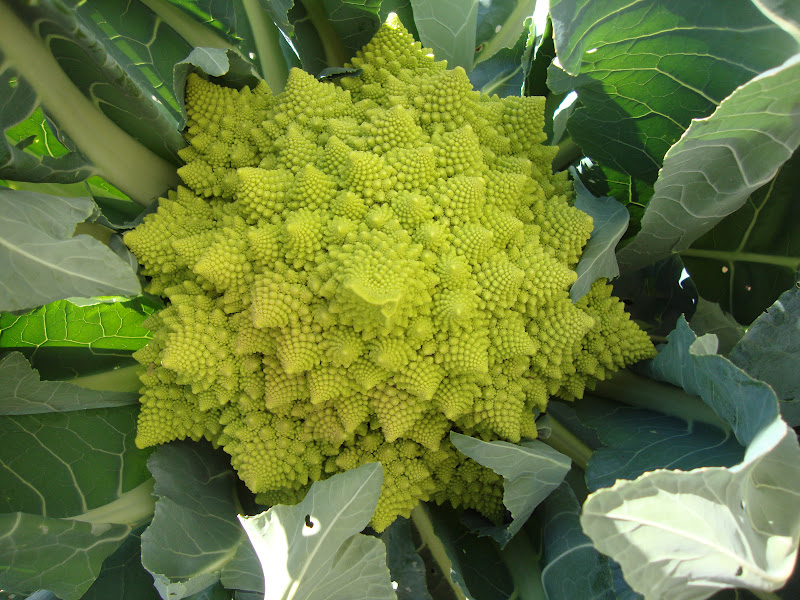
1.  The Veronica Romanesco Cauliflower, being both the last of the cauliflowers to reach harvest size – on January 29, a full 110 days after transplanting – and the coolest-looking vegetable that I have ever grown, inspired this whole list.  It was the Romanesco that put the whole season into a line, leading from the earliest broccoli, to all those unexpected broccoli side shoots, to the cauliflowers in bright colors, and finally to the apex of the season, the bright yellow-green Romanesco cauliflower with its whorled florets.  The Romanesco was so crazy, built looking that I didn't want to cut it into pieces because it felt too much like I was ruining mother nature's personal art project.  But as Lee said, You might as well cut it up now that you've cut it off the plant.  So I carefully disassembled the Romanesco cauliflower, leaving as many florets as I could intact and marveling over how each floret really was a miniature version of the whole head.  In fact, considered individually, each floret looked like a miniature, yet to-scale, version of a magical mountain where gnomes, the type that might nurse a wandering Snow White back to health, might live.  And, in case of doubts, I was quite sober as I was thinking all of this, drinking my morning chai as I made the final Italian-Style Cauliflower Salad of the season, this time adding pasta and Parmesan cheese (instead of garbanzo beans and feta) to create a couple of satisfying meals.  With the crunch of cauliflower, a taste in between broccoli and cauliflower, and its fractal good looks, Romanesco cauliflower is now on my list of favorite vegetables.

Veronica Romanesco Cauliflower

Italian-Style Cauliflower Salad
Adapted from The Victory Garden Cookbook

1 large head of cauliflower
1 cup pimento-stuffed green olives, sliced (or black olives)
2 tablespoons capers
1 (15 ounce) can of garbanzo beans, drained and rinsed
4 ounces feta cheese, crumbled
1 or 2 cloves garlic, crushed
2 tablespoons lemon juice
1/2 cup extra virgin olive oil
1 teaspoon sea salt
freshly ground black pepper

[OR, instead of the garbanzo beans and feta cheese, substitute:
1/2 pound pasta, cooked according to package, rinsed, and cooled
1 cup grated Parmesan cheese]

Disassemble the cauliflower and chop into bite-size pieces.  Soak the cauliflower pieces in water to remove dirt or bugs, then rinse.  Blanch the cauliflower pieces in boiling, salted water for three minutes, then remove immediately, drain, and shock in ice water to cool.  Drain the cauliflower pieces.

In a large bowl, combine the olives, capers, garbanzo beans and feta cheese (or pasta and Parmesan cheese), and cauliflower pieces.  In a small bowl, whisk together the garlic, lemon juice, olive oil, sea salt, and pepper.  Pour the dressing over the cauliflower mixture and stir well to combine.  Refrigerate and serve cold or room temperature.


Friday, January 27, 2012

Cauliflower Curry

Cauliflower are secretive plants, with long, blue-green leaves that are perfectly shaped for concealing.  I planted a colorful variety of cauliflower plants this year, a yellow one, a purple one, a green one, and a standard white one, but for most of the season I only knew that each would produce a different-colored head of cauliflower because that is what the seedling markers at the nursery told me.  As the neighboring broccoli produced heads that grew from small to big to should-have-been-harvested-yesterday, then set about even more openly making secondary heads, the cauliflower plants grew leafier, clutching any developing flower heads so tightly that even if I tried to catch a peek, all I could see at the center of each plant were so many scoop-shaped leaves wrapped tightly around each other.

When the first head of cauliflower finally did emerge from its leaves around the winter solstice, it was almost full size already, leaving me only a few days to enjoy the view of a growing cauliflower in the garden.  And, of course, it was the white cauliflower that matured long before the colorful ones, giving me a couple more weeks to stare sideways at the remaining plants, looking for signs of color emerging from within the standard cauliflower-plant leaves.

Snow Crown Cauliflower

But I don't want to downplay the loveliness of the white cauliflower.  I harvested the Snow Crown Cauliflower on December 27, which was only 77 days after transplanting it into the garden.  The Snow Crown produced a large, heavy head of cauliflower that was delicious and remained crunchy even after frying it and cooking it with vegetables.  In fact, even after about 20 minutes of cooking, I wondered if I should have cooked the cauliflower a little bit longer, because it was still that crunchy.  So, for texture and resilience to over-cooking, I give the Snow Crown very high marks.

Given that December was the month of the broccoli and cheese – broccoli-cheese pie, broccoli-cheese soup, and broccoli-cheese salad – I wanted to do something different with the first cauliflower of the season.  I surveyed cauliflower curry recipes online and discovered that some of them called for methi (fenugreek) and cilantro leaves, both of which were growing in the front yard garden.  I narrowed my search to "methi gobi masala" recipes, or fenugreek and cauliflower curry recipes, and found a few that would make good use of the early, white cauliflower while also giving me a reason to harvest some fenugreek and cilantro.


All that remained was prep the cauliflower for cooking, which took me back, as breaking apart a head of cauliflower always does, to the first time that I prepped cauliflower.  It was a Sunday afternoon in the fall of my year of living at House of Commons, a vegetarian housing co-op in west campus.  I was cooking dinner for the house, or more accurately, I was assisting my co- dinner cook, who was the one with the recipe and the clue as to how to deal with so many heads of cauliflower.  My job was to prep the cauliflower, which the recipe instructed me to do by "disassembling" each head into florets.  Disassemble the cauliflower?

I should probably also mention that I was high at the time that I was reading those instructions, not because I had smoked cannabis any time recently, because, even in my early 20's, I was the sort of overly responsible person who actually preferred to do the major tasks of the day sober, and only then, with the work done and the dishes washed, I might have a beer or smoke some weed.  But on this particular Sunday I was still high from the brownie that I had eaten the day before on a house excursion to the Marley Fest.  So, 24 hours later, still high and by this point annoyed by it, missing my focused, sober self, I turned over that first head of cauliflower and began disassembling it, as the recipe instructed.   And I realized then that to disassemble was the absolute perfect verb for the situation, for breaking apart a head of cauliflower, which had the heft and the solidity and, when turned over, the internal framing of something that was built.  Maybe that is why those cauliflower plants are so secretive in their progress, protective of their process as they build a heavy head of curds that can only be accessed with a sharp knife and an eye for structure.


Methi Gobi Masala (Cauliflower with Fenugreek Curry)
Adapted from recipes here, here, and here

1 bunch fresh fenugreek (methi) leaves
1/2 bunch fresh cilantro leaves

1 large head of cauliflower
safflower (or canola) oil for frying (optional)

2 tablespoon safflower (or canola) oil
1 teaspoon cumin seeds
6-8 curry leaves
1 large onion, chopped

4-5 green chilies, seeded and chopped
5-6 garlic cloves, peeled
1 inch fresh ginger, peeled and sliced
1 large tomato, chopped
1 teaspoon turmeric
1/2 teaspoon red chili powder
1 teaspoon coriander powder
1/2 to 1 teaspoon sea salt (to taste)

Remove the fenugreek (methi) leaves from the stems and wash the leaves thoroughly.  Set the leaves aside.  Remove the cilantro leaves from the stems and wash the leaves thoroughly.  Set the leaves aside.

Disassemble the head of cauliflower, or cut it into bite-size pieces.  Soak the cauliflower pieces in cold water to remove any bugs or dirt, then rinse and dry.

Heat a generous amount of safflower oil (about 1/4 cup) in a large frying pan over medium-high heat.  Fry the cauliflower for about 5 minutes, stirring frequently, until the cauliflower is browned.  Be sure not to overcook the cauliflower – it should still be crispy.  Remove the cauliflower from the oil and set aside on a paper towel.  Alternatively, to reduce the amount of oil in the recipe, blanch or steam the cauliflower for 5 minutes, then immediately drain and cool the cauliflower pieces.

Heat 2 tablespoons safflower oil in a frying pan over medium-high heat.  (If you fried the cauliflower, simply return that pan to the burner.)  Add the cumin seeds and curry leaves and fry for about a minute, or until the cumin seeds brown and become aromatic.  Add the onion and cook, stirring periodically, until the onion is softened, about five minutes.  Remove the curry leaves.

Place the green chilies, garlic cloves, and ginger pieces into a food processor and pulse a few times to make a chunky paste of the fresh spices.  Add the paste of spices to the pan where the onions are cooking, stir well, and continue cooking for another few minutes.  Add the tomato, stir well, and cook until the tomato juices are released.  Add the turmeric, red chili, and coriander powders and stir to mix thoroughly.  Add sea salt to taste.

Add the cauliflower to the pan and cook, stirring periodically, for 8 to 10 minutes, or until the cauliflower is tender-crispy and uniformly mixed with the onions and spices.  Add the fenugreek (methi) leaves and cook, stirring periodically, for another 5 minutes.

Remove from the heat, stir in the cilantro leaves, and serve hot with basmati rice or naan bread.

Thursday, January 12, 2012

The Other Outside

Lee and I went hiking three times in the first week of the new year, twice at the Greenbelt and once at McKinney Falls.  It felt wonderful to be outside, to be in the woods, to soak in the sun of a few perfect-temperature days.  This is my new year's resolution, I thought to myself as we walked, to get outside more, to go for more walks, to enjoy the nice days of Austin's cool season before the brutal days of summer arrive.  And, while I was in the woods, walking down a trail, breathing in the earthy smells of recent leaf fall and post-rain regrowth, and appreciating the fact that each species of tree has a characteristic branching pattern and shape, like a visual fingerprint, that allows me to recognize it, even in winter, especially in winter, even without leaves, my intention was very clear and direct: I enjoy being outside and I want to spent more time here.

Bald Cypress in winter

Back at home, where broccoli and bok choy need to be harvested and cooked yesterday, and post-rain regrowth means that winter annuals (better known as weeds) threaten to overtake every non-mowable corner of the yard, and I find myself dressing for work by pulling jeans, washed and dried two days ago, out of the tangle of underwear and socks that is still sitting in the dryer, my mental resolution list becomes more muddy.  I want to get outside more, I want to go for more walks, I want to keep up with all the vegetables in the front yard and cook more meals from scratch, and, while I'm at it, I want to weatherize the house and replace the dead shrubs in the yard and read more books and write more and do my taxes before April and keep the house clean and spend more time with Lee and on and on and on...  Until, eventually, it is hard for me to distinguish between what I want and what I think I should be able to do with my waking hours.  Between being outside and the Other Outside.

I learned of the Other Outside from Benji, our cat.  At 17, largely retired from the territorial life of neighborhood kitty politics that goes on in our yard and garden, she is content to rule the household from inside, curled up on a couch pillow or stretched out in a sunny window.  But as the household ruler, she reserves the right to go outside when she wants, to smell the wind and find out what's up in the larger world of the backyard, to supervise my garden projects, or to interfere Lee's or my attempt to leave for work.

Benji checks out this year's kale

Though Benji is the most vocal (and loudest) cat that I have ever known, she always asks to go outside in silence, by queuing up at the back door.  I'm not sure how else to describe it, because, though she only a forms a line of one, she knows how to sit in such a way, with her nose pointed so purposefully toward the back door, that there is simply no doubting her intent.  She plans to go outside and she expects that one of her humans will promptly open the back door for her then hold the screen door patiently while she considers whether she really wants to step outside and, if so, whether she might like a moment to rub her cheek on the screen door before exiting.  When she is leaving home in protest, because I am doing something despicable like running the vacuum cleaner, the expression on her face as she lines up at the door is only subtly different, yet unmistakable.  If she had possessions, her bags would be packed, including letters of disapproval addressed to all the proper authorities, citing violations of Kitty Code 3-B: No Vacuum Cleaners Shall Be Run in The House.  Be sure to send us postcards, I tell her as she slips out past the vacuum cleaner.

The problem with the outdoors is that it is not always what a kitty imagined it would be.  For much of the year it is too hot, the back steps being one of the parts of the yard that is heated into submission every afternoon of the summer.  Other times of the year the outdoors is too cold, or too wet, or too windy for a kitty to linger.  And, even on the nicest of days, unless one of us humans steps outside as well, the outdoors is filled with cats, those annoying creatures that Benji wants little to do with since reaching the age of what my parents call "the entity," or the older, opinionated, female cat who no longer wishes to consort with all those lowly felines.  So, inevitably, and very often quickly, within a few minutes of leaving the house, Benji wants to come back inside.  This time, because we can't see her lining up outside the door, she yells and we come running to repeat the process of opening the back door then holding the screen door patiently while she considers whether she really wants to step inside and, if so, whether she might like a moment to rub her cheek on the screen door before entering.

Ideal for kitties: an open door

Most of the time, after trotting back inside with a How could you put me out there in that heat/cold/wet/wind? meow, Benji resumes reign of the household from one of her sleeping spots.  Occasionally, though, shocked by the inhospitable weather in the backyard but still wanting to go outside, Benji decides that she will instead go to the Other Outside so she queues up at the other door, the door leading from the kitchen to the carport.  Seriously? we ask her when she sets her nose in the direction of the Other Outside, Doesn't a kitty know that when it's cold and windy in the backyard, that it is also cold and windy in the front yard?

But I can't really find fault with Benji for insisting that the Other Outside, the outdoors that conforms to her idea of how the outdoors should be, exists, given how much time I spend gazing out of windows and thinking about my own, human version of the Other Outside, or what Cheri Huber describes as the alternate, parallel reality that exists simultaneously with this reality, and in that one, everything is as it should be.  In other words, the land of shoulds.  Where I know what I should know, I do what I should do, I feel what I should feel, and I always make the right decision.  The problem with the Other Outside is that, while it seems helpful, like a map or a guide toward what I want for my life, it is actually a constant reminder of all that I am lacking and all that I am not.  Because, in reality, I can't work full time and get enough sleep and take care of myself and be a good girlfriend to Lee and get everything else on my to-do lists done.  I can only do a few of those things on the list.  And I'm hardly going to feel good about getting those few things done if I am constantly thinking about all of the other things that I could also be getting done, if only I was living as I should be, as I do in the fictional Other Outside.

So, this year, I resolve to spend more time being outside, working in the garden with Benji or walking along our local Boggy Creek or hiking in the woods with Lee, and less time thinking about the Other Outside.

Barton Creek in January

Thursday, December 15, 2011

Worthy of Broccoli

Broccoli is just too easy – easy to plant, easy to grow, easy to harvest, and immediately ready to chop up and cook.  Broccoli straight out of the garden is always delicious, a once-a-year treat, yet I always fell a little bit sad after I cut the head off a broccoli plant, leaving the plant decapitated and empty-looking, because, aside from a few tiny side heads that may or may not ripen, that is it for that plant.  Harvesting greens is an ongoing process of continual thinning, and harvesting summer fruits, like tomatoes, peppers, and okra, is a season lasting a few weeks to a few months, but harvesting broccoli is a one-time gig.  I look forward to it, and then it is over.

Usually, it is the wait for broccoli that, at least psychologically, extends the season, but my broccoli grew so quickly this year that I didn't get a chance to anticipate the upcoming harvest.  And this was despite the fact that I planted broccoli transplants a few weeks later than usual this year, on October 11.  I planted the baby broccoli into the raised bed along the south side of the house, where the hot sun of October (technically, a summer month in 2011) created greenhouse-like conditions.  The baby plants struggled with the heat for about a week, and then they began growing in earnest.  Within two weeks of planting, they had doubled in size, and by early November, having already grown together into a mass of greenery, they were growing so fast that I every day they seemed bigger than they had been the day before.

The day after planting (October 12)

Established and growing (October 27)

Bigger every day (November 6)

By mid November, the plants were so gigantic that I began joking that I wouldn't be surprised if a baby t-rex crawled out from under their leaves.  Then we had some good rain and I came down with my second head cold of the month and spent my free time sleeping, blowing my nose, and studying the color of my mucus.  Every other day I decided that I had a sinus infection and would call the doctor first thing tomorrow, and every other day I decided that, actually, I was getting better.  Eventually I was back to my just-a-slight-mold-allergy-because-I-live-in-Austin self and realized that I ought to walk around the house and check on those huge broccoli plants.

Full-grown broccoli plants (November 26)

Given their late planting date, I wasn't expecting ripe broccoli until January.  But there they were, at the end of November, forming huge flower heads.  The first broccoli to ripen was the Packman Broccoli, which produced a medium-sized, dark-green head with uniformly large flower buds.  I harvested the Packman on November 28, which was 48 days after transplanting.   Immediately after harvesting, I washed, chopped, and sautéed the broccoli in olive oil.  Eaten with just a sprinkling of nutritional yeast, salt, and pepper, the broccoli was tender and delicious.  Lee also noticed that it was sweeter tasting than store-bought broccoli, lacking the aftertaste of broccoli that has been refrigerated.

Packman Broccoli

The next broccoli in the queue to be harvested was obviously the Blue Wind Broccoli, which was forming a huge, dense head of broccoli flowers.  The weather cooled down – I finally turned our heat on due to consistently cooler nights – so I had a few days to watch the huge broccoli head before harvesting.  And, though the Packman broccoli had been delicious, I was feeling disappointed, as I am prone to being with broccoli, about how quickly it was gone.  So as I watched the Blue Wind grow bigger, I thought about how I could make more of an event of its harvest, how I could cook it into something worthy of such a huge, beautiful, one-time-and-then-gone broccoli head.

I harvested the Blue Wind Broccoli on December 6, which was 56 days after transplanting.  The broccoli head that it produced was enormous, with a dense center of smaller, lighter flower buds.  I tried, unsuccessfully, to get a picture that really documented how big this head of broccoli was.  Lee and I tried to get Benji to sit next to the broccoli but she loudly reminded us that kitties don't do wet and quickly fled the scene.  I also tried to get a picture of the head of broccoli with a ruler nearby for scale, but the angles just weren't right.  I'll just say this:  it was the biggest head of broccoli that I've ever grown, easily the equivalent of a rubber-banded bunch of broccoli from the grocery store.

Blue Wind Broccoli

I baked the huge broccoli into a Broccoli Cheese Pie because that seemed like the greatest honor that I could bestow upon a vegetable, to make it into several memorable, looking-forward-to-it meals.  I didn't have a recipe so I went by what I knew about cooking broccoli and potatoes and cheese sauces and poured it all into a pie crust.  My recipe is below, and the pie was delicious, but I will warn that it was also soupy when warm.  This is a problem that I have with savory pies, and I've come to the conclusion that this is why savory pies are usually made and sold in the single-serving "pot pie" size, so that the soupy, saucy insides are contained.  My fruit pies, aided by natural pectins and a bit of flour, usually solidify enough after baking (and cooling a bit) that I can cut out a slice without the filling from the adjoining pieces running out, but with this Broccoli Cheese Pie, once one slice was removed, the cheesy filling from the rest of the pie pooled in that empty space.  Maybe that is just the way it is with savory pies, or maybe I used too much sauce or not enough flour to thicken the sauce.  In any case, the pie was, as Lee put it, so good that he wanted to crawl inside of it.  We split the last third of the pie on a cold evening with a strong imperial stout, with Benji curled up in my lap.  In our family of three, there is no greater event in which a vegetable can hope to play a starring role.


Broccoli Cheese Pie

For the crust:
3 cups flour
12 tablespoons cold butter, unsalted
1 teaspoon salt (omit if butter is salted)
approx. 1/2 cup (+ 2 to 4 tablespoons) cold water

For the filling:
4 medium-sized organic potatoes
1 huge head of broccoli (or one bunch from the store)
2 tablespoons olive oil
1 large onion, chopped
6-8 cloves garlic, minced

For the sauce:
4 tablespoons butter
4 tablespoons flour
1 cup vegetable stock
1 cup whole milk (or 1/2 cup milk + 1/2 cup half & half)
10 oz sharp cheddar, grated
fresh cracked back pepper

Preheat the oven to 375˚ F.

The pie crust recipe that I use for all pies, sweet or savory, is from The New Moosewood Cookbook by Mollie Katzen.  It's a simple recipe that makes plenty of dough and rarely gives me any trouble.  I also think it's delicious.  But, obviously, if you have a preferred pie crust recipe, you can use that.  You will need to make enough for a double crust, bottom and top.

To make the dough, measure the flour and salt into a medium bowl and stir.  Cut the butter into chunks and add to the flour.  Using a pastry cutter or two forks, mix the butter into the flour until the butter chunks are no bigger than small pebbles.  (You can do this step in a food processor in a few pulses, which saves time and work, though then you have to clean the food processor parts.)  Add the cold water to the flour and butter mixture a little at a time, mixing the dough well with your hands after each addition.  Keep adding cold water until the dough is able to hold together.  In my experience, this usually takes 2 to 4 tablespoons of cold water in addition to the half cup in the recipe, but the exact amount of water needed each time I make crust depends on the ambient humidity (seriously!), so I have to go by feel.  Press the dough into one big ball.   Cut the dough in half using a knife.  Press each half of dough into a round, flat circle (about 6 inches in diameter by 1/2 inch deep) and wrap each round in saran wrap.  Place the dough rounds in the refrigerator.

Scrub the potatoes and chop into chunks.  Steam or boil the potatoes until they are tender, which takes about 20 minutes.  Drain the potatoes and set aside in a large bowl.

Wash the broccoli.  Discard any tough parts of the stem and slice tender parts of the stem.  Cut the head of the broccoli into bite-size florets.  Set aside.

Heat the olive oil in a large skillet over medium-high heat.  Add the onion and sauté, stirring periodically, until the onion is translucent, about 5 minutes.  Add the garlic and cook another minute or two, stirring frequently.  Add the chopped broccoli, stir, and cover the skillet so that the broccoli will steam.  As the broccoli cooks, stir occasionally and add water as needed to keep the onion-garlic-broccoli mixture from burning.  When the broccoli is bright green and tender, remove from the heat, season with black pepper, and add the mixture to the bowl with the potatoes.

In a medium pot, melt 4 tablespoons of butter.  Whisk 4 tablespoons of flour into the butter until it is a uniform paste.  Add the vegetable stock.  If it is hot (I use the liquid from steaming the potatoes to make the stock), the stock will thicken immediately.  Add the milk and continue to whisk until the sauce thickens.  Turn down the heat and stir in the cheese a little at a time.  Turn off the heat and season with black pepper.  Pour the cheese sauce over the potato-broccoli-onion mixture and stir to combine.  The pie filling is now ready.

Flour your counter.  Retrieve one dough circle from the refrigerator and unwrap it.  Lightly flour each side of the dough circle and lightly flour the rolling pin.  Use the rolling pin to flatten the dough into a pie crust.  Keep rolling until the dough is an inch or two bigger than you pie pan.  Carefully fold the crust in half and lift it into the pie pan.  Unfold the crust and loosely fit it to the pie pan.  Retrieve the other dough circle from the refrigerator and repeat the process of making a second pie crust.  Carefully fold the second crust in half and cut small vent holes into the crust.  Pour the pie filling into the bottom crust and level it out.  Place the top crust over the filling, unfold it, and pinch the two crusts together around the edges of the pie.

Bake the pie at 375˚ F  for 45 minutes, or until the crust is lightly browned and the filling is bubbling.