Wednesday, September 28, 2011

In Search of Water

This summer just won't end.  For weeks, since the calender said that fall was approaching (hah!), we've been waiting for an opportunity to get outside for a hike, preferably not in the triple-digit heat.  Finally, last week, with a shared weekday off for our anniversary, Lee and I decided that, running water or not, hot summer day or not, we were just going to have to get out in it.

We went to the Hamilton Pool Preserve, a Travis county park where Hamilton Creek, a tributary of the Pedernales River, flows over a ledge, as a waterfall, into a pool in a limestone grotto below, creating a natural swimming hole.  As one of the last places with running water and reliable swimming in dry summers, Hamilton Pool is very popular on weekend days in the summer and regularly fills to capacity.  Arriving late on a Monday morning, we were looking to miss the crowds and have the trail to ourselves.  We were also hoping that the spring-fed creek would be flowing.


Hamilton Creek was running, though barely so.  A trickle of water fell from the top part of the creek into the pool, which was open for swimming, though the water was a murky green.  We walked around the pool, enjoying the cool air along the back side of the grotto, where rock walls out of reach of the midday sun still held, even at noon, the cool of the evening, then we headed out on the trail to the river.

This was the restorative part of the journey, walking beneath healthy cypress trees with their roots in the creek below.  The creek wasn't running quickly, but it was a couple feet deep in places, with cool water that was still supporting fish and turtles and baby cypress trees.  The presence of water made all the difference, cooling and humidifying, in a pleasant way, the air in the canyon along the creek.  For that short stretch of creek we left the drought that has so defined this summer, the extreme and lasting heat, the dry winds, and the lack of rainfall, in the uplands above.  In this way, the preserve is doing its job, providing a refuge for plants and animals through the roughest months of the year.  And providing me a place to breathe fresh, tree-made oxygen and gaze up into the branches of cypress, Spanish oak, and elm trees still holding onto their green leaves.


Along the trail at ground level, the pink-purple flowers of Simple-Leaf Tick Clover caught my eye.  I knew immediately that the flowers belonged to the Pea Family, but it took me a bit of looking to locate the species.  Tick clovers make attractive pink-purple flowers from May through October but are more commonly known for their annoying seed pods that stick to socks and pant legs in the fall and winter, which is why they are also called Beggar's Ticks.  The Simple-Leaf Tick Clover (Desmodium psilophyllum) is the only species of tick clover in this area that has simple leaves rather than the trifoliate (composed of three leaflets) leaves of other tick clovers.

Simple-Leaf Tick Clover (Desmodium psilophyllum)

Blue Mist-Flower also bloomed along the creek.  Blue Mist-Flower (Eupatorium coelestinum) is a late-summer to fall blooming perennial that is common in moist, shady habitats in central Texas.

Blue Mist-Flower (Eupatorium coelestinum)

As Hamilton Creek and the trail neared the Pedernales River, the canyon widened and the trail climbed away from the creek.  The water of the creek disappeared beneath the sandy creek bed into groundwater, so the creek, though running in the section beneath the pool, did not flow into the Pedernales River.  The river itself was also dried up, with rolling mounds of hot sand left where the river usually flowed.  Lee and I walked along the riverbed, hoping to spot a flowing portion of the river around the next bend, but we didn't get far before the course, sharp grains of sand accumulating between our feet and our Tevas motivated us to step into the warm pools of water, all that remained of the Pedernales river.  As far as we could see in both directions, the river was reduced to intermittent pools, and some of the cypress trees along the river were responding to the drought by turning orange-red, getting ready to drop their leaves two months early.


In a few low spots, the sand was still moist, indicating that the river may have flowed, or at least held more discontinuous pools of water, very recently.  Heat-hardy wildflowers were blooming along the riverbank, making the most of the receding water supply.  Small, pink blooms of Prairie Agalinis hid in a tangle of greenery alongside a tall stand of bright-yellow Tatalencho.  Farther down the bank, a colony of White Boneset bloomed.  White Boneset (Eupatorium serotium), a perennial in the sunflower family, prefers the moist soil along streams, where it blooms from August through October.

White Boneset (Eupatorium serotium)

Clammyweed, a sticky plant in the same family as the plants that produce caper berries and peppercorns, has distinctive flowers with pink to purple stamens that are much longer that the white petals.  Clammyweed (Polanisia dodecandra) is common in dry creek beds, along low-flowing creeks, and on roadsides, blooming May through October.

Clammyweed (Polanisia dodecandra)

The showiest and most abundant flowers along the river bed were the orange-highlighted yellow flowers of the Rattlebush.  Rattlebush (Sesbania drummondii) is a woody shrub that is common along waterways and in dry stream beds in central and east Texas.  The leaves of Rattlebush, like those of many heat-tolerant shrubs in the Pea Family, are compound, composed of many (20 to 50) small leaflets.  The seedpods of Rattlebush, which are are flattened around each seed, remain on the plant into the winter, long after the leaves have fallen from the plant.  The mature seeds are loose in the pods and rattle when shaken by the winds of winter cold fronts, giving the plant its name.  The seeds of Rattlebush are poisonous.

Rattlebush (Sesbania drummondii)

Wanting to escape the bright sun of midday and the sharp sand of the river bed, Lee and I returned, high-stepping to kick sand from our Tevas with every step, to the trail along the creek.  Usually I prefer a loop trail, and the chance to walk down a new section of trail for an entire hike, but this time I was glad to return back along the same short trail, to get another dose of what has been almost entirely missing from my life this summer, walking in the woods along running water.

Wednesday, September 7, 2011

Tomato Review

The tomato season is long past, and it was quick this year.  Before the weather cools and my thoughts turn to fall greens, I want to record how each of my tomato plants did this year.  I grew seven tomato plants this summer.  I bought all of them as baby plants in four-inch pots at the Natural Gardener on March 17, 2011, and planted them the next day.  They established immediately and grew quickly, doubling in size in a week and growing into full-size plants by the first of May.  I began picking ripe grape tomatoes on May 14, though it was another couple of weeks before the full-sized tomatoes began to turn yellow or red.  At the peak of this year's tomato harvest, around the time of the summer solstice (June 21), tomatoes of all sizes filled the kitchen table.  At the end of June, tomato production slowed as quickly as it had accelerated at the beginning of the month, so that by the second week in July, I was only picking a few, small tomatoes every day or two.  I stopped watering the plants in mid July and pulled them out on July 25.

Peak tomato harvest, June 21, 2011

Which all sounds very precise, with specific dates, thanks to the date stamps within all those digital photos.  While the dates will help me plan for tomato seasons to come, the reality of my tomato garden was far from precise or scientific, so, before I proceed with observations on how each tomato plant fared this year, I should make a few disclaimers.

First, this was my first summer to grow tomatoes in the raised-bed garden along the south wall of the house.  I built the retaining wall to make the garden this spring, amended the existing rocky soil with mulch, compost, and manure, and immediately planted.  The soil was very young and non-uniform, with intermixed patches of existing soil, composted organic matter, and raw or partially-decomposed organic matter.  Which was fairly normal for one of my gardens, especially in the first season or two, and it seemed to be fine for the young tomato plants, given how quickly they grew.  In addition to soil differences, each tomato plant had a different location along the south-wall garden, which was built to level out the slope along the side of the house.  As a result, the tomatoes at the west end of the garden grew in the deeper part of the raised bed than those in the east end.  The two tomatoes on the end of the row had fewer neighbors than the others and had better access to light but also had to deal with drier conditions on the edges of the garden.  Altogether, each tomato plant had its own microclimate in terms of soil depth, soil composition, light access, competition, and water retention.  All of which is, again, completely normal in any garden, but means that my results are simply that, my results, observations from my garden this year, not scientific conclusions about the performance of these tomatoes.


Next, I should mention that something ate my tomatoes this year.  Tomato loss is an expected part of growing tomatoes in Austin, where birds snack on the tomatoes, ruining whole fruit with a single peck, and healthy populations of fruit-eating mammals, including mice, rats, squirrels, opossums, skunks, and raccoons, have learned where all the best gardens are.  But, when I say that something ate my tomatoes this year, I mean that something ate my tomato plants, as in the tops of the green vines, which is something that I had never seen before and had never heard of.  I mean, who eats tomato plants?  My best theory was that the very fat green caterpillar that I found snacking on a green tomato was the culprit, or one of them.  I don't know where the caterpillar came from or what it would have turned into, had it lived long enough to metamorphosize into its adult form.  I moved it to my compost pile to fatten up a bit more before it was surely eaten by one of the animals – the fat lizard, the birds, the squirrels, or the roof rats – that frequent the compost pile.  In any case, the tomato-plant eating didn't seem to affect the tomato harvest, as it mostly happened after the plants had set fruit.


Finally, this summer was hot and dry.  By some measures, the hottest summer on record.  Given that warm temperatures at night slow down and eventually stop tomato plants from setting fruit, a hot summer means a short tomato season.  In early June, the plants were covered with green tomatoes, but, as those tomatoes ripened, new green tomatoes did not appear in their place, so that by early July, the plants were almost bare of fruit.  By early July, the plants were also weary from lack of water.  I watered the plants deeply twice a week throughout the season, but all my watering couldn't make up for the lack of summer thunderstorms this year.  We only had two thunderstorms in the tomato season, one in mid May and one in mid June.  Every so many years, we have a rainy June with cooler temperatures, and then the tomato season is longer and more productive, favoring later-season tomatoes adapted to humid, milder conditions.  This year was the opposite, a short, fast, hot and dry season favoring early-season tomatoes and those adapted to hotter, drier conditions.

The first tomato to ripen this year was the Cupid Hybrid grape tomato.  I started eating grape tomatoes off the plant in mid May and soon was picking a small handful of tomatoes every day or two.  The plant continued to produce until mid July, though by then the fruits were smaller and infrequent.  We ate most of the grape tomatoes as snacks straight out of the bowl.  The tomatoes were sweet-tart with good texture and a slight pear shape.

Cupid Hybrid Grape Tomatoes

I think of the Porter tomato as the Texas workhorse tomato.  When I was new to gardening in Texas, a veteran gardener suggested that I get a Porter tomato at the upcoming plant sale because, regardless of how hot, or dry, or flooded, the upcoming summer proved to be, the Porter would produce.  She was right, the Porter tomato always produces, whether we're in stage four of the drought or recovering from the 100-year floods, so every year I try to find a Porter tomato plant to grow.  True to form, the Porter tomato won this season's endurance test.  It began making ripe tomatoes just after the grape-tomato plant in May and continued to make tomatoes into July.  In fact, the Porter tomato outlasted me this year – despite the hot temperatures and drought, the Porter was still setting fruit in early July when I decided that the tomato season was over.  When I pulled the plants, the Porter was by far the biggest plant in the row, having taken over its own space and also much of its neighbors' space.

Porter Tomatoes

So, if the Porter tomato is such a reliable workhorse, why grow any other tomato in Texas?  First, Porter tomatoes are small, "plum tomato" size, and therefore are not ideal for cooking because, in order to make a tomato sauce or soup from a batch of Porters, all of them would have to be skinned, which would be tedious.  Given their size, Porters are best eaten fresh, sliced in half or quartered into salads.  The other thing about Porters is that their taste is inconsistent.  I've heard that they are one of those tomatoes that are loved by some and hated by others, but I think the truth may be more that they are sweet and delicious some years but bland and mushy other years.  Porters are like the insurance policy of tomato growing in Texas – if June is rainy and cool, the Porters won't be great but also won't be much needed, but if it's 107˚ F with oven-like high-pressure winds, the Porters will still be producing garden-fresh tomatoes while all those fancy heirlooms fail to thrive.  This year, this brutally hot and dry year, the Porters were sweet and delicious.  For most of June and into July, I packed Porter tomato and basil pasta salads for lunch, then sliced Porters onto crackers to eat with cheddar and beer as a midnight snack when I got home from work.


Of the full-size tomatoes, the JD's Special C-Tex Early Black was the most productive in the early part of the season, in mid June.  JD's Special made lots of round, medium-sized tomatoes with dark-green shoulders on deep red fruits.  The tomatoes were very prone to cracking – most of the fruits had splits running down the tomato from the stem end or all the way around the tomato, circling the stem.  The cracking was worse following the June rainstorm, leading me to think that the JD's Special C-Tex Early Black tomato, specially bred for our central Texas summers (hence the "C-Tex"), is another tomato, like the Porter, meant to keep us in tomatoes even in the drought years.  I tried to minimize the impact of the cracking by harvesting the fruit early, as soon as the bottom part of the tomato was red, before the cracks were big enough to attract ants.  The ripening tomatoes were then prone to shriveling (around the cracks) and softening, even when the tomatoes were still green at the stem end.

JD's Special C-Tex Early Black Tomatoes

Because of the cracking, the JD's Special tomatoes were mainly cooking tomatoes this summer.  They were the tomatoes that I wanted to use first to prevent spoilage, the tomatoes that needed to have parts cut out of them, the tomatoes that became the basis for tomato sauce and tomato soup.  They did not peel easily, both due to the cracks and the under-ripeness of the top parts of many of the fruits at the time of cooking, but the dark red flesh cooked down into wonderful tomato goodness.  I feel a bit unfair defining those tomatoes so strongly on their splits given that the tomatoes themselves were actually quite juicy and delicious.  And given that the tomato sauce that I made from JD's Special tomatoes, along with a mix of other tomatoes from the garden, was one of the highlights of the tomato season.


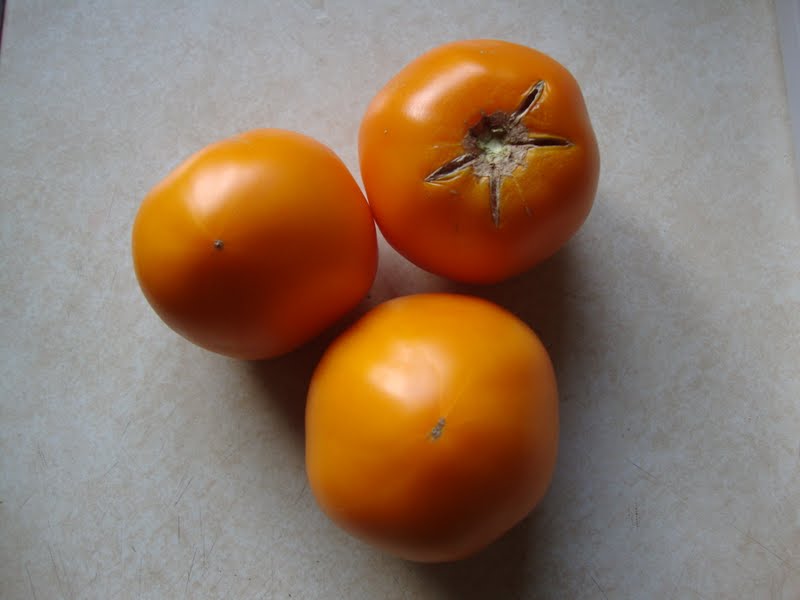
The Sunmaster hybrid tomato, another tomato that was specifically bred for hot summers, was the most productive plant in the later part of this year's short season, in late June.  When the other tomatoes were slowing down, the Sunmaster had its heyday, producing many shiny, orange-red, medium-sized tomatoes.  In fact, of the tomatoes that I grew this year, the Sunmaster tomatoes were most like those in the produce section at the grocery store:  bright, shiny, red fruits, free of splits or blemishes, and long lasting.  By early July, the rows of to-be-eaten tomatoes on our kitchen table had dwindled down from a colorful mix of red, golden, striped, and dark-fruited tomatoes to just the red tomatoes, just the long-lasting Sunmasters.  The Sunmasters were also easy to peel, making them ideal for cooking or canning.  Compared to the other full-sized tomatoes, though, the Sunmasters had a fairly bland taste, which was not surprising given their uniformity and longevity.  A garden-fresh Sunmaster was still miles better, in flavor and especially in texture, than those grocery-store tomatoes.  Overall, given the productivity of the Sunmaster in the hot summer, its beautiful, long-lasting fruits, and the rich flavor of the tomatoes after being cooked down into sauce or soup or okra masala, I will be looking for a Sunmaster plant next spring.

Sunmaster Hybrid Tomatoes

The Cherokee Purple, an heirloom tomato known for producing delicious, dark-colored tomatoes, was the least productive tomato in my garden this year.  In fact, I only harvested three or four tomatoes from that plant.  They were delicious, with the fluted shape that I associate with the best tomatoes, but apparently Cherokee Purples don't like the oven-like heat of a hot year in central Texas because the plant was by far the smallest in the row.

Cherokee Purple Tomatoes

The Old German, an heirloom tomato with huge, striped, yellow-orange-red tomatoes, was my favorite tomato of the season.  Sauces and soups and pasta salads aside, the real joy of the tomato season is simple tomato and toast:  toasted, buttered bread with fresh, sliced tomatoes sprinkled with sea salt, nutritional yeast, and a drizzle of olive or flax oil.  Yum.  It's a snack that I enjoy year-round, even with greenhouse tomatoes, but with fresh tomatoes it is especially good, and with heirloom tomatoes, the kind that have seeds throughout their juicy flesh instead of in compartments like the modern hybrid tomatoes, it is dreamy.  This year, the clear tomato-and-toast winner, the tomato with the sweetest, juiciest flavor, was the Old German.  The easy-to-peel fruits of the Old German were also beautiful in cross-section, with golden, orange, peach, and red flesh that cooked down into a sweet, bright-orange sauce.  The Old German plant was not as productive as JD's Special or the Sunmaster in terms of number of fruits, but each tomato was heavy, so that each time I picked an Old German tomato I carried it carefully into the kitchen with that feeling of gardener pride, look what I grew!  The large fruits, which had splits from the stem end, were prone to molding once they had ripened on the kitchen table, so they needed to be eaten fairly quickly.  But needing to eat the Old German tomatoes was a lovely problem to have for a few weeks and, considering the heat of the summer, I was impressed that the Old German kept making its big tomatoes into the first week of July.

Old German Tomatoes

Finally, there was that yellow tomato on the end of the row.  This year I was clever and stuck the plant labels in the ground next to each tomato cage so that, in June, when harvesting, I would know what each plant was.  All of the tags survived except for that tomato on the west end of the row, the tomato planted in the biggest tomato cage in the deepest part of the new garden.  I was sure that it was a Celebrity tomato, a solid workhorse of a producer that grows huge, sprawling vines and makes many fruits, until I realized that its fruits were turning golden instead of red.  Then I looked for the tag and it was long gone, probably lost during mulching.  The plant itself was not sprawling but relatively contained considering its spot on the end of the row.  The plant also was the first of the row to wilt, possibly because it was on the west end of the row, with the harshest afternoon sun exposure.  In any case, it wasn't a Celebrity tomato.  Its fruits were medium-sized, heart-shaped, and golden yellow, and I would guess that it was an "early" tomato, given that, among the full-sized tomatoes, it was the first plant to make ripe tomatoes and the first plant, aside from the non-productive Cherokee Purple, to give up production in the name of heat.  The golden fruits were sweet, with the low-acid flavor of yellow tomatoes, very easy to peel, and had beautiful golden flesh.  Given what I observed about the plant, I think it was a Jubilee tomato plant, but I can't be sure that I didn't grow one-of-a-kind, accidental hybrid that snuck into somebody's greenhouse, given how readily tomatoes of unknown parentage sprout from my compost.

Jubilee (?) Tomatoes

Saturday, August 27, 2011

All That Okra

I'm not an okra eater.  At least, prior to this summer I wasn't an okra eater.  I would buy it occasionally in the summer when it was available, but then I would struggle to eat it before it went soft, after which I would decide not to buy any more for the season.  So I was going against the conventional garden wisdom of grow what you will eat when I planted a row of okra in the front-yard garden this spring, taking a risk that the plants would be beautiful but that their fruits would go to waste.  Because a corollary to the grow-what-you-will-eat rule is that the plants that you don't want to eat – the mustards that flower too early and the kales that never make it to tonight's menu – are always the biggest, healthiest, most prolific plants in the garden.

I started down the path of okra growing because the seed packet was appealing.  I'm a fairly controlled spender in most areas of life, but, when it comes to seed packets and the promise of a new season, I tend to get carried away.  So I was quickly won over by the promise of high yields of tender Cajun Delight okra pods to use in "salad, stir-fries, gumbo, or pickled."  The idea of growing okra was also appealing given that I garden in central Texas, where the summer temperatures exceed 100˚ F for weeks at a time (or this year, for months at a time), which severely limits the variety of vegetables in my summer garden.  Okra, originally from west Africa, is adapted to growing in hot, humid conditions, and is grown as a hot-season staple throughout tropical and sub-tropical regions of the world.  So it makes more sense to grow okra in the summer here than to struggle to keep, say, tomatoes, with all their water and nutrient needs and wimpy inability to set fruit on hot nights, alive and producing through a summer like this one.

Okra plants in the garden

The thing is, I knew what to do with all those tomatoes, but I had no idea what to do with all that okra.  But I wanted to figure it out.  I wanted to become an okra eater.  And what better way to learn how to cook with okra than to have a continuous supply of it flowing into my kitchen for several weeks?

My okra plants were beautiful, with huge, deeply-lobed leaves and hibiscus-like flowers.  Okra (Abelmoschus esculentus) is in the Malvaceae, or Mallow Family, also known as the Hibiscus Family, which, back before it got expanded and complicated by the molecular biologists, was characterized by showy, radially-symmetric flowers with long, attractive pistils (below, the stalk in the middle of the flower with the sticky, burgundy tip, which is the female part) decorated with many stamens (the many small, yellow parts along the stalk of the pistil, which are the male parts).  The bottom line of all this flower talk is that, if not for the fact that okra plants modestly hide their flowers beneath their huge leaves, I would expect to see trays of okra seedlings on sale in the ornamental flower section of nurseries in late spring.

Okra (Abelmoschus esculentus) flowers

Okra plants also turned out to be easy to easy to grow, even in the heat of the summer.  They grew, continually producing new leaves and new flowers and new okra pods, week after week, on only two waterings a week, seemingly unfazed by the over-100-degree temperatures and oven-like high-pressure winds that sucked the life out of everything else this summer.  The plants grew so tall that I joked that I was going to need a step ladder to harvest by the end of the summer.  And they continued to make okra pods, day after day after day.

That was the high-maintenance part of growing okra, that the pods needed to be harvested every day, starting in mid May and continuing until I decided to pull the plants due to my own heat exhaustion in mid August.  Picking okra pods was a quick daily chore but not a fun one.  The plants were itchy and sticky, attracting ants and aphids and fluffy, white scale insects.  The okra plants also had spines, tiny, almost-not-visible prickers just like the small spines on prickly pear cactus, that stung my skin and were nearly impossible to locate.  And the consequences for skipping a day of harvesting were immediate – longer, tougher, less-edible okra pods, many of which went straight to the compost pile.  I skipped two days of harvesting only a couple of times and, in just 72 hours, the pods grew to nearly foot long and terrifying in their woodiness.

Totally thrilled to be harvesting okra

Each day's harvest was not very big, just a handful or two of okra pods, which didn't seem like much until the daily handfuls began to accumulate into bagfuls in the refrigerator.  Then came the challenge that I had anticipated, figuring out what to do with all that okra.

First, I made okra pickles, which proved to be the best way to use up a bunch of okra pods at once.  I pickled the okra in an apple cider vinegar brine (2 cups vinegar, 1-1/2 cups water, 3 tablespoons pickling salt, 2 bay leaves).  I added a clove of garlic, halved, a hot pepper, and a teaspoon each of black peppercorns, mustard seeds, and cumin seeds to each pint jar before packing it with whole okra pods.  Over the course of the summer I made three batched of okra pickles, about 20 pints in total.  At first I wasn't sure how often I would want to eat okra pickles, but they are growing on me and seem to be getting better with age.  My new favorite after-work snack is okra pickles with sharp cheddar and a strong IPA.


The only downside to pickling was that it was A Production, and a hot production at that.  It takes my water-bath canning pot nearly an hour to reach a boil, plus the brine has to boil, plus the jars have to be prepped, then more jars have to be prepped when I realize I don't have enough jars for all that okra, plus the okra has to be washed and stemmed, so the whole process takes a couple of hours and turns the kitchen into a steamy, hot pickle factory for the rest of the afternoon, as the thick-bottomed boiling pot slowly releases all that stored heat into the already-hot house.  Perhaps someday I will have this house properly weatherized but, until then, baking, brewing, canning, pickling, and other steam-producing projects are really best saved for the cooler months.  I needed to find some quicker, fresh-eating options for the okra.

Lee carried out the second solution, the tried-and-true southern way of eating okra: breaded and fried.  I washed and trimmed both ends off the okra pods, then chopped them into two or three pieces per pod.  Lee dunked the chopped okra into an egg-milk mixture then breaded it in a seasoned cornmeal and flour mixture then fried it in safflower oil in a hot skillet.  The fried okra was so delicious that we ate a double batch in one sitting.


Finally, I turned to Indian cuisine, which has many uses for the humblest of vegetables, for an okra, or bhindi, recipe.  I found a recipe for Bhindi Masala that looked promising and basically followed that, increasing the amount of okra (I had a lot on hand) and using jalapeño peppers from the garden and the last of the season's tomatoes.  The resulting dish was very tasty, as promised, and, eaten with rice, was dinner for two plus satisfying leftovers for two for the next night.  At the end of the okra season, after I had cut down the plants, I made this dish one more time.  It wasn't quite as amazing with store-bought tomatoes but it was still delicious, providing a reason to look forward to next summer's okra harvest.

In the end, we didn't eat all of that okra.  Some pods grew too long to eat and one batch of pods went soft in a bag in the refrigerator and had to be composted.  But, overall, I made use of most of the okra that I grew this summer.  Plus we have a store of okra pickles for the fall – I hope they last until the porter and stout season – and fond memories of that Okra Masala dish.  Now we are okra eaters.


Bhindi (Okra) Masala
adapted from Charishma's Very Tasty Bhindi Masala

I harvest okra daily, or at least every other day, and place pods in a bag in the refrigerator, accumulating pods until I have enough to cook or pickle.  I compost overly large pods (over four inches) and any pods that begin to soften or develop black spots, which happens after about a week and a half in the refrigerator.  This means that, during okra season, I expect to cook or pickle okra pods about once a week to keep up with the daily harvest.

I use safflower oil as the neutral-flavored, high-heat vegetable oil for this recipe, but canola, grape seed, or vegetable (usually soy) oil will work just as well.  What's important is that the oil is fresh, because stale oil will ruin any dish, regardless of how much spice is used.


1 pound young (2-4 inches) okra pods

2 tablespoons safflower oil
1 tablespoon cumin seeds
1 teaspoon mustard seeds
2-4 jalapeño peppers, minced
1 large onion, chopped

1/4 cup safflower oil
1-1/4 tablespoons coriander powder
1/2 teaspoon red chili powder
1/2 teaspoon turmeric
2 medium tomatoes, chopped
1 teaspoon salt (or to taste)

Wash and rinse the okra pods.  Remove the stem and bottom end from each pod then chop the remaining okra into two or three pieces.  Set aside.

Heat two tablespoons safflower oil in a skillet over medium-high heat.  Toss in the cumin and mustard seeds and stir.  Once the cumin seeds have become aromatic and the mustard seeds have begun to pop!, add the jalapeño peppers and onion.  Fry slowly, stirring periodically, on medium heat until the onions are browned, about ten minutes.  Set aside.

Heat 1/4 cup safflower oil in a wok over high heat.  Add the chopped okra and stir fry until the okra is bright green and aromatic, about five minutes.  Reduce the heat to medium, add the onion mixture to the okra, and stir to combine.  Add the coriander, red chili, and turmeric powders, stirring well.  Allow the mixture to cook for about five minutes.  Add the tomatoes, stir to combine, and cover the wok.  Allow the mixture to cook, now covered, for another several minutes, stirring occasionally to distribute the tomato juices as they are released.  Uncover the wok, add salt to taste, and mix well.  Cook for a minute or two longer.

Serve hot over basmati rice or with Indian breads.

Tuesday, July 26, 2011

My History of Maná

How do I begin, in a blog about plants, to write about Maná?  Maná is my favorite band and has been for almost twenty years.  Last month I took Lee to hear Maná in concert in San Antonio.  I expected a good show, which is always dangerous, to have expectations and hopes about a concert in a huge venue like the AT&T Center, but I was blown away anyway by how amazing Maná was en vivo.  I've been in a Maná trance ever since, reliving their albums, blissed out on their beats, even as the awful mix of modern, whiny, white-people music plays at work, and trying to figure out a way to justify writing about Maná here, where I write about my garden and kitchen.

I could find a way to connect Maná to plants or cooking.  I could talk about how the band uses its money and super-group status in Latin America to fund Selva Negra, an organization that oversees conservation, habitat restoration, and social development projects in Mexico.  One such project teaches women in poor communities how to grow fresh vegetables using minimal water; another is dedicated to the reforestation and conservation of a rainforest in Oaxaca.  Or I could talk about Fher's lyrics, about all the images of sea and forest, sun and moon, and butterflies and birds that are in the songs of Maná.  Or I could point out that Maná is, more than likely, what is playing in my kitchen when I am washing greens or making pesto or frying okra, that the opening notes of each Maná album transport me back to one of the kitchens of my adult life.  Or I could just say that, for the past few weeks, as I've sat on a cinder block in the shade of the front porch with my travel clock, waiting to move the garden hose to the next plant, I've been thinking about where I was when I fell in love with each of Maná's albums, and allowing, in the slowness and heat of July, each of those images to develop into a snapshot.


I heard Maná for the first time when I was 18.  It was January of 1993, I was a freshman in college, and winter term had just ended, bringing back to campus all the students who had the fortune to spend that cold month somewhere other than northern Ohio.  Among those returning from the south was my friend Natasha, who had spent the month in Guadalajara and brought back a CD that was huge in Mexico at the time, Dónde Jugarán Los Niños?  I'm not sure if I was hooked on the album from the beginning, or if that came later, once Natasha and I were roommates sophomore year.  I know that at some point I was spending more time with the CD than she was, and would use any cooking excuse, from baking apple pie in the dorm kitchen sophomore year to mixing granola in the Fairchild Co-op kitchen junior year, to borrow and play that CD.  Most of all, I remember the small kitchen in the floor of the house on North Main Street that Sara, Dominic, Natasha, Spike, and I shared senior year, where one Saturday I baked several chocolate layer cakes from scratch for our "special meal" at Third World Co-op.  I had the album on repeat all day and, to this day, whenever I hear the opening beats and Yay oh oh of "De Pies a Cabeza," I remember that day spent drinking coffee, eating chocolate cake batter, and bopping along with Maná.  Soon after that, I finally bought my own copy of Dónde Jugarán Los Niños? and decided that I was Maná's biggest white-girl fan.

Falta Amor came next.  Now, here I have to point out, for historical accuracy, that Falta Amor was actually released two years before Dónde Jugarán Los Niños?  (And, for the real sticklers, there was an even earlier Maná album, self-titled Maná, that was released in 1987.  I have that CD – what kind of biggest white-girl fan would I be if I didn't? – but it is horribly dated and I think I only listened to it a couple of times before filing it away.  Luckily, the band changed labels and found their sound before Falta Amor.)  Falta Amor includes the band's first big hit, "Rayando el Sol," which is a lovely song.  But I have live versions of "Rayando" on other albums so Falta Amor, though important to me in the mid-1990's, is the one Maná album that is not in my regular rotation.  Because of which, it is also the album that is most located in a particular time and place to me, to my bedroom in the house on North Main Street in Oberlin, overlooking the ash tree, reading The Elephant Vanishes by Haruki Murakami.  Which sounds fairly magical, to be 21, listening to my new favorite band while discovering a new favorite author, but that moment was a bright spot, or more accurately a peaceful moment, in a spring that was otherwise defined by stress, from drama in the lives of my closest friends, from honors-thesis writing, and from the knowledge that I was about to be graduated from college with no earthly clue what I wanted to do with my life.

The next year, back in Oregon, back living with my parents at age 22, I got a job as a line cook at a café in Salem and a copy of the new Maná album, Cuando Los Ángeles Lloran.  Though I did a lot of baking that year, trying to make whole-grain muffins as good as those from the local Great Harvest, I'd listen to Maná upstairs, in what we called the "Nana room," the addition that had been built onto the house to accommodate my Nana's decline into Alzheimer's.  Nana had died two years earlier, but the memory of her, of what the disease had done to her, and to my mom, and to the family, remained in the house.  My favorites on the album were "El Reloj Cucú" and "Ana," both sad songs with distinctive intros that take me back to that rainy winter spent gazing out over the east-end pasture where the horses were grazing or staring at the river meanders on the inside of the CD cover.  At the time, my mom was getting into Afro-pop music, which provided a window out of her depression, so occasionally we would go to town and search the world music section together.  On one of those trips, I found a CD called Hace Mucho Calor that was a compilation of many Latin artists, including a cover of "Fool in the Rain" by Maná.  I've since lost that CD, but when I think of listening to Cuando Los Ángeles Lloran, I immediately think of Hace Mucho Calor, and of the two songs on it, #4 and #9, that I adored.  I discovered Soraya that year as well – amazingly, I first heard "De Repente" on my way home from work one night on the local AM radio station that usually played accordion-heavy norteño music.  And I've gotten into a few Latin acts since then, including Jaguares, Juanes, and Reik, but it's always been Maná that I come back to, Maná that I want to listen to over and over again.

My parents sent me Sueños Líquidos for Christmas of 1997.  I had moved to Austin that summer and was in the process of moving for the third time within the House of Commons.  House of Commons was, and still is, a vegetarian housing co-op in west campus.  Think big hippie house with 25 housemates, a Zen garden, under-maintained compost piles, lots of bike parking, and a clothing-optional pool.  I was moving from a third-floor double into Room 7, a second floor, L-shaped single overlooking the front garden.  "Lucky Room 7" is what Will, who had lived in the room before me, called it, assuring me that the room would be good for my sex life, and, indeed, within days of moving into Room 7, I had a boyfriend.  Jason, the new boyfriend, had a habit of walking into my room, which would too quickly become our room, when "Robame el Alma," #7 on Sueños Líquidos, was playing, so we called that his song.  Little did I know that, for the next seven years, he would robame el alma.  Note to self, be more careful with 7's.

By the time that Maná MTV Unplugged was released, Jason and I had moved out of House of Commons into an apartment on West 17th Street.  I had started graduate school at UT then dropped out after only a year and was bumming around on savings.  I had a community garden plot and a mountain bike that I painted tractor green.  My routine was to sleep late, go for a run, then make toast-tomato-cheese melts in the toaster oven and listen to Maná before heading to the Sunshine gardens.  The peaceful routine was a cover for my actual emotional state, that of acute anxiety.  I would stand in the front room of that brick-floor, cinder block apartment on West 17th, looking out the front windows past my motley assortment of potted trees and houseplants on the balcony, while trying desperately to become the way that I felt when I heard the line in "Desapariciones" that went por qué no todos somos iguales.  I loved that line, that rhythm, that emotion, and tried, over and over again, to hang onto it.  That was my peace in the otherwise anxious fall of 1999 – my first fall garden and a line in a Maná song.

Revolución de Amor was a revolution.  It didn't come out until 2002, a full five years after Sueños Líquidos.  In between the two, Maná released "Corazón Espinado" on Santana's Supernatural album as well as the Maná MTV Unplugged album, which they toured the US promoting.  There was talk of Maná crossing over into the US market.  With Revolución, that was over.  Maná was back to Maná, back to Mexico, back to its core fan base in Latin America.  Political, unapologetic songs and straight-forward rock beats.  I saw Maná live for the first time on the Revolución de Amor tour.  Jason and I drove to Dallas to see them.  I wish that I remembered the concert better.  I know that I enjoyed the show and that I was impressed with the band, with Fher's voice and stage presence, with Alex's relentlessness on the drums, with Sergio's skill on guitar.  They started exactly on time and played for three hours, and still I didn't want them to stop.  The concert felt like a huge pro-Mexico rally, complete with soccer balls kicked into the crowd, but, even as the tallest, whitest girl in my row, I still felt included because Fher's message was, as it always has been, Todos juntos.

Soon after Revolución came out, I moved into an apartment off North Loop, into my own space for the first time in my life.  So maybe Revolución spoke so loudly to me because I was undergoing my own quiet revolution.  At work, I was moving up the co-op hierarchy, from Jason I was slowly but steadily separating, and at home I was finally building my own space, in an apartment with almost no furniture and a bedroom painted purple.  The Revolución years were years of rediscovering the Moosewood Cookbook and learning to cook gratins and risottos from Vegetarian Cooking for Everyone, and included the rainy-June summers of 2003 and 2004, when the counter between my small kitchen and living room was covered in ripening tomatoes.  In that apartment I learned to can tomatoes, figured out how to cook eggplant properly, in lots of olive oil, and organized many pizza nights for one.  I remember singing along with "Pobre Juan" and thinking about his disappearance into the borderland deserts of Mexico, as I set out my dinner – a salad, a few slices of a pizza (the other pieces carefully wrapped in foil for lunch tomorrow and the day after), a pint of homebrew beer, and my partially-smoked bowl of weed – on the floor beside the spot where I sat to watch free cable on my free TV.  All carefully timed to be ready just before the opening murder of an old Law & Order rerun or, better yet, an Inspector Lynly mystery. 

Amar Es Combatir came out just after I moved into this house.  I was still so attached to Revolución that I had trouble adjusting to the new album and told my mom that it was, Okay... just starting to grow on me, but soon I was looking forward to a sweet song in the middle called "Bendita Tu Luz."  Not long after that, "Bendita Tu Luz" was my new favorite song and Amar Es Combatir was my new favorite album.  Even now, ask me what one CD that I would take to a desert island, and I would have to say, Amar Es Combatir.  It's that good of an album, from one end to the other, and part of the happiness of Amar is that it transports me back to the early days in the house, before the foundation work and the failed attempts at rat extermination, before the brutally hot summers and equally brutal electric bills, to the early days with Lee, when the so many rooms of this house were not so many rooms to clean or to renovate or to cool but, instead, were so many places to have sex.  Afterwards, when the smell of cooking onion and garlic brought Lee into the kitchen to find me singing along with Maná, we would slow dance to "Bendita Tu Luz" and I would try, with little success, to explain the lyrics in English.  It's prettier in Spanish, I would finally tell him, It's a love song.

Amar Es Combatir has remained my most frequently played CD for the five years since it was released in 2006.  In the years between, Arde el Cielo was released, containing live versions of three songs from Amar and many classics from other albums, all sung to a huge, adoring audience in Puerto Rico, plus two new studio songs.  One of those new songs, "Si No Te Hubieras Ido," is the one that I most strongly associate with those years, when I was commuting to and from Del Valle to teach high school biology.  During the school year I was always working, either at work early to set up a lab, or at work late for tutoring, or grading papers at the kitchen table, or writing tomorrow's lesson at my computer late at night.  On the drive between home and school, when my failing car radio was cooperating, I'd listen to the Pop-en-Español station in hopes of hearing Maná.  One early morning, as I turned onto Airport Road, "Si No Te Hubieras Ido" began playing.  I turned up the radio and savored some Maná in the car.  For the rest of that day, and, really, for the rest of my time as a teacher, I survived with the help from a line from that song, El ritmo de la vida me parece mal.

Drama y Luz is the new Maná album, released this spring.  I listened to it over and over again for weeks, imprinting it on my brain for the concert.  I have favorite parts – the opening of the first song, the pace and chorus of "Mi Reina del Dolor," and the emotion in the No te olvido paloma, me haces falta mi vida lines in "Vuela Libre Paloma" – and I love to get "Latinoamérica" stuck in my head right before leaving for work in the afternoon, so I can sing it in the car.  But it's too early to say what memories will be tied to Drama y Luz because it's still the soundtrack of the present, of working swing shift and planning my weeks around watering days and our meals around mountains of okra, eggplant, and basil.  And the soundtrack of this brutally hot summer is further complicated by the fact that, since the concert, in my Maná trance, I've got the entire CD collection out and have been listening to all of them, but especially to Arde el Cielo, the live album, wanting to hold onto the energy of that night with Maná.


Going to a concert in San Antonio, at the AT&T Center, was a big adventure for Lee and me.  We're normally homebodies and nature people, more inclined to venture out to the Greenbelt during the day than to "go out" in the evening.  When we do go out, we arrive shortly after the doors open for the day at the co-op brewery, or when we do take a road trip, it's rarely to anyplace farther than one of the semi-local state parks, like Pedernales, an hour away, or McKinney Falls, which is practically in our neighborhood.  So the drive to San Antonio was an event for us, and the AT&T Center was immediately overwhelming in its size and crowdedness and layout – how do we get to the upper floor for the balcony seats?  Eventually we found bathrooms and the escalator to the upper level and made our way to our seats, which were high, so high, above the stage on what felt like the side of a steep, crowded mountain.  Then we waited, because I had told Lee that Maná would start on time, for the concert to begin, watching AT&T commercials in Spanish.  But, when the band started, all of that anxiety, of the drive, of the parking, of the huge, crowded venue and the seats on the side of a mountain, and of the wait, was gone within the first few beats of "Lluvia al Corazón."

The Maná concert was epic.  That's Lee's word – epic – but I can think of no better descriptor.  Weeks later, I'm still reliving it, still replaying the music, still in love with the band.  The design of the show was perfect, not that a rock concert is about design, but, in such a large arena, visuals and effects are part of the experience, and too often the screen and technical stuff detract from the music.  But Maná's people are obviously the best, because the video screens were visible but not distracting, so that my focus stayed on the stage, on the band members, while softer visuals floated across curtains on the stage.  More importantly, the visuals and effects, and all of the high-quality planning that obviously went into creating the show, was secondary to the sound.  The sound was the show.  From the first beats of "Lluvia al Corazón" to the final notes of "En el Muelle de San Blas," I was entranced, in it, not caring in the least that my seat was so high up or so far away.  The sound was so good that, at times, I just closed my eyes and existed in the music, soaking in Maná.  So good that I could feel the music, feel the bass drum, yet never reached for my ear plugs.  So good that songs that had never been my favorites on a CD came to life in concert.

Just as the band came alive in concert, with Fher clapping, Arriba, arriba, San Antonio! between songs, with Alex twirling and spinning and crashing down as he held the beat, or beats, even through the pauses and introductions, with Sergio looking especially tanned and fit as he leaned into each guitar solo, while Juan remained, as always, the steady bass player in the shadows.  They played several songs from the new album and many classic hits from past albums, including "Mariposa Traicionera," "Corazón Espinado," "Rayando el Sol," and "Labios Compartidos."  But they especially devoted time to the songs of Dónde Jugarán Los Niños?, which was where the crowd, a mixed-ages group of Latinos, many of whom had grown up listening to Maná or, like me, could describe the arc of their adult life set to Maná, went the most wild.  The energy in that huge space was amazing, with so many people singing along that Fher could simply point his mike to the crowd and the song would be carried.  Over and over again, song after song.  So I guess I can't point to any one thing – the sound or the skill of the band or the right mix of songs or the energy of the crowd – that made the concert so enjoyable.  It was all of those things, all together, merging with so many years of emotions and memories tied to listening to Maná.

I have only one, small complaint about the show, and that is that they did not play "Bendita Tu Luz."  When the lights came back on and the people in our row had started leaving, Lee and I looked at each other and asked, sadly, "Bendita Tu Luz"?  I really wanted to hear that song live, was looking forward to it throughout the concert.  So it was a disappointment to leave without hearing my song, but as we sat in the parking lot surrounded by cars playing every Maná album from Dónde Jugarán Los Niños? to Drama y Luz, I thought about the fact that there were simply so many good Maná songs that not all of them could make it into the show.  Or, perhaps, not playing "Bendita Tu Luz" was Mana's way of making sure that I will see them in concert on their next tour.

Until then, thank you, Maná, for so many years of great music.  Thank you for carrying me from dorm rooms to co-op houses to apartments to a house of my own.  Thank you for the inspiration and the support and the honesty.  But most of all, Gracias por tanto amor.

Tuesday, June 28, 2011

Tomato Sauce

These are the tomato days of summer, the season of plenty.  Tomatoes, arranged by picking day and relative ripeness, have taken over the kitchen table.  Bags of recently harvested eggplant, okra, and peppers crowd the vegetable drawer of the refrigerator.  The basil is still trying to flower and needs to be trimmed back yet again.  I plan my schedule for the week around watering days, Thursdays and Sundays, and I start every other day with a trip into the garden with the cat (my supervisor), a pair of scissors, and a bowl for harvesting okra, eggplant, and tomatoes.


So why do I have a hard time enjoying this season of plenty?  Granted, watering is a chore in the drought and the daytime temperatures, by the time I get up, given my swing-shift schedule, are downright unpleasant.  But that's just the Texas summer.  The real challenge for me is that I experience the plenty not as abundance but as an extended to-do list: make pesto; eat more tomatoes; make baba ganoush; bake a pesto pizza, a margarita pizza, an eggplant pizza; make fresh salsa; make tomato soup; buy extra pasta, cheese, bread, and crackers; make an eggplant stir fry; figure out what to do with all that okra; make tomato sauce.

I put off making tomato sauce.  Not because it was difficult or less appealing, but because the tomatoes, picked slightly under-ripe to minimize splitting and bird and ant damage, and lined up on the kitchen table, seemed more able to wait than the eggplant and okra sitting in damp bags in the refrigerator.  So I pickled the okra, and baked and fried the eggplant, and made another batch of pesto, and, then, once the refrigerator wasn't so full, decided it was time to make fresh tomato sauce.

I started with several tomatoes, I'm guessing about two pounds.  These were the big tomatoes, as opposed to the grape and Porter tomatoes that I save for eating fresh, a mix fruit from JD's Special C-Tex Early Black, Old German, Sunmaster, and the one that I thought was a Celebrity that is actually making golden tomatoes.  (Note to self, it works better to write down the names at planting time than to rely on the labels staying in the ground.)  I skinned the tomatoes, chopped them, allowing some of the excess water drain away, and cooked them down in a pan where I had already fried onion and garlic in olive oil.  Once the tomato juices were reduced, I added fresh basil, salt, and black pepper.  It was a simple sauce, and the only real work of it was in de-skinning the tomatoes and trimming basil leaves from their stems.


But this simple tomato sauce had nothing to do with what I think of as "tomato sauce".  It wasn't dark red and it didn't have any of the citric acid bite of canned tomatoes.  It wasn't pastey or sugary or overly crowded with dry herbs.  Instead it was sweet and garlicky, minty in the way of fresh basil, and alive tasting.  The concentrate of summer.

Sitting at the table, surrounded by ripening tomatoes, eating fresh tomato sauce and Parmesan cheese over spaghetti, I had a moment of insight into Italian cooking and what tomato sauce originally was, back before it was a canned food.  I imagined an Italian woman, in the heat of summer, faced with basketfuls of ripening tomatoes and a hedge of basil that wouldn't stop flowering, deciding that the only way to deal with all those tomatoes was to cook them down into a sauce.  And that sauce would have been the basis of meals for the season, eaten over pasta, between bread and cheese, or chunky with added vegetables.  What a wonderful tasting season that would have been.  No wonder we try to capture it in a can.

Summer Tomato Sauce

2 pounds fresh, locally-grown tomatoes
2-4 tablespoons extra-virgin olive oil
1 medium onion, chopped or thinly sliced
6-8 cloves of garlic, peeled and minced
1 teaspoon salt
1-2 bunches fresh basil, stems removed, coursely chopped
fresh cracked black pepper

Bring a large pot of water to a boil.  If you're going to serve the sauce over pasta, this can be the pasta water.  Cut the top (where the stem attaches) out of the tomatoes.  Drop the tomatoes into the boiling water for about 30 seconds, or until the skin begins to peel.  Carefully remove the tomatoes from the boiling water.  Rinse the tomatoes under cold water and remove the skins.  Chop the tomatoes and set aside in a colander so that the excess water can drain from the tomatoes.

In a large frying pan, heat the olive oil.  Cook the onion over medium heat until it begins to brown, about ten minutes.  Add the garlic and cook, stirring frequently, for another couple of minutes, or until the sting of the garlic is mellowed.

Add the chopped tomatoes and salt and stir to combine.  The sauce will be watery at this point, but that is okay because cooking will reduce the sauce, concentrating all that fresh tomato goodness.  Simmer on medium-high heat for about 15 minutes, or until the liquid is reduced (but not boiled away) and the tomatoes are cooked down to the desired consistency.  Add the basil, stir well, and cook for another minute.  Season with black pepper to taste.

Serve over pasta or with toasted bread.  Top with Parmesan cheese.

Wednesday, June 15, 2011

Bug Refuge

I have a bug habitat in my garden.  I know that it's a common practice, or at least an advocated practice among organic gardeners, to provide a place for the bugs, both good and bad, in the garden in the hopes of keeping the unwelcome bugs in check.  But providing a bug refuge is not really something I meant to do so much as something I've happened into.

It started with the basil.  Basil is relentless in its drive to flower and, of course, flowering is exactly what I don't want it to do, because flowering will rob the leaves of sugar, making the leaves that I want to harvest bitter.  So every few days I trim away flowering buds, making the basil plants bushier with each trimming, doubling the number of branches that can bloom every time I trim the plants.  Which in turn doubles the number of leaves in each potential harvest, though the leaves are smaller.  We're living in the basil-rich season, eating the leaves in salads and on pizza and with pasta, with a batch of pesto always at the ready in the fridge, but, much as I enjoy this season and look forward to it through the winter and spring, there will come a point where the basil plants and I will grow weary of this race and I will simply let them flower.  It seems like the decent thing to do for the plants after a season of thwarting their continuous, heroic attempts to flower.


What I've found, as I've allowed summer-weary basil plants to flower, is that there is another reason to let the plants keep their garden space for weeks after their harvest window is over: the bees adore the flowers.  And I like supporting the bees, especially in the heat of the summer.

The summer is not the only tough season for the bees.  A few months ago, just after the late-season freezes but before the spring wildflowers began, the bees were desperate for food.  So when the cilantro bolted, transforming itself from a neat, leafy row of herbs into a dense, tall hedge of feathery leaves, I left it in place for the bees.  It looked a bit out of place, a wall of greenery at the front of the garden, prompting Lee to ask, What is that tall stuff?, but was quickly covered in white inflorescences.  And just as quickly covered in bees.  So I allowed the cilantro to keep its garden space for weeks after it had bolted even though I really needed that space to plant this summer's basil.  Eventually a wind- and rainstorm knocked over the hedge of cilantro, turning it into enough of an eyesore, right there by the front sidewalk, that I had no guilt about removing it to the compost pile.  The bees buzzed around me as I pulled the plants – they certainly didn't care whether the plants were lying on their sides.


With the cilantro gone, the garden looked empty.  The okra and beans were still just rows of seedlings and the eggplant and basil were new transplants, small and far from each other.  In the back corner, though, the fennel and sorrel remained.  I tried to harvest some of the fennel for its bulbs but, because of the freeze or maybe because I waited too long, most of the fennel plants had started to bolt, turning their base bulbs knuckly and tough.  I tried cooking a few of the bulbs that hadn't yet produced flowering stalks, sliced thin and cooked forever in butter and white wine, but, though delicious, the fennel was still so fibrous that chewing it lasted indefinitely.  So I left the remaining fennel plants to bloom, telling myself, The fennel is for the bees.


Now the fennel is flowering and over six feet tall, nearly as tall as the front roof of the house.  The yellow, umbrella-shaped inflorescences bob in the hot winds of this June, high above the feathery green foliage, giving the plants a surreal look.  What are those Dr. Seuss looking plants?, one neighbor asked.  The bees are not confused.  The bees love the flowers, as do flies and butterflies and many types of wasps.  Huge, colorful wasps.  And the aphids – I noticed a couple of weeks ago that many of the fennel inflorescences have been overtaken by aphids.  I was tempted to remove those clusters of flowers, in fact, my neater, tider, things-in-their-place self would have loved to bag up the aphid-covered parts for yard-waste pickup.  Then I remembered that the fennel was for the bugs and decided to leave the aphids alone, even though the sight of them, in numbers, makes my arms itch as I brush past the fennel flowers.


An interesting thing happened when I left the aphids alone.  The ladybugs showed up.  First, just a few ladybugs, followed by a few ladybug larvae.  Now it's a ladybug orgy out there, with ladybugs breeding and ladybugs eating and ladybug larvae dangling from the undersides of aphid-covered umbels.  The aphid situation is no better, in fact, the aphids now cover even more of the flowering fennel.  Still, I'm happy to be breeding ladybugs in the heat of the summer. 


And it's possible that the bug refuge is helping my other plants.  At the same time that I noticed the beginnings of aphid infestation on the fennel, I also noticed that ants were farming aphids on some of the okra plants growing across the path.  I washed those aphids off but expected them to return in force, but they haven't.  The okra continues to grow and flower and make okra pods that have to be harvested every day so they don't become ginormous, and as I'm out there every day in the sticky, scratchy plants, I haven't noticed much aphid activity.

I'm not sure how long the fennel will last, or if I will come to regret allowing the aphid population to grow without the check of the garden hose and some strategic trimming.  But I am convinced that having flowers, especially the big, messy flowering stalks of carrot-family herbs like cilantro and fennel, in the garden attracts pollinating insects.  I also find myself wondering where the ladybugs will live next, after the fennel goes to seed, because I'm liking this practice of leaving a few of last season's plants to flower amidst this season's vegetables.  For the bees.

Wednesday, May 25, 2011

Bottomland

When I think of bottomlands, I think of the south, the romantic, idealized south, as in the Indigo Girls Southland in Springtime.  I think of lush, tall hardwood forests surrounding a meandering river that is barely contained in the flood season and changes course every 100 years or so, remapping the layout of the bottomland as it does so.  I think of the Big Thicket forests of east Texas and the floodplain forests along the Neches River that I have read about but have yet to visit.  I think of cypress-lined bayous and old river channels and swampy floodplains fed by tributary streams.  I think of the diverse old cathedral forests that grew on this continent before we cut them down and dammed the rivers that fed them.

Closer to home, the streams run intermittently and the rivers, like the Pedernales, that manage to flow year-round flow through rocky, limestone landscapes where hardwood trees, like cypress and sycamore and pecan, are restricted to the banks of the rivers.  Where the rivers are big enough to have created bottomlands, that land has long been cleared for farming or development and that river has been dammed to create reservoir lakes.  I understand why rivers are dammed – for electricity, for water, for flood control, and for recreation – but I still dream of a world without dams, a world where the rivers flow free.  I try to imagine downtown Austin before the dams were built along the Colorado River.  What if, instead of Lady Bird Lake, we had several blocks of forested greenbelt surrounding the original, natural river?

In reality the bottomland forests of central Texas, long a rarity in this area, functioning as small refuges for plants and animals existing on the western or southern edges of their ranges, are all but gone.  So I was pleasantly surprised the Saturday before last when Lee and I went for a hike and found ourselves descending through a slope forest into a bottomland forest on the banks of the Colorado River, just fifteen miles downstream from Austin.  We were hiking in the McKinney Roughs Nature Park, an LCRA park on Highway 71 that is thirteen miles east of the airport.  This was our third attempt to visit the park (hikers, beware, the park is closed on holidays and does not open until noon on Sundays), so it was with relief that we drove through the open gates, paid for our hiking passes ($4 per person), and got our map of the eighteen miles of trails in the park.

Colorado River from the Bluff Trail Overlook

We followed the McKinney Roughs Bluffs and Bottoms Hike, as outlined in the guidebook, and found that, even with our park map, it was extremely helpful to have the guidebook with us given the sheer number of trail junctions along the way.  We started from the visitor center onto the Ridge Trail, which cuts through woodland typical of our area, a mix of cedar (Ashe juniper), cedar elm, Spanish oak, and mesquite interspersed with cactus-filled fields.  I was surprised to notice that many of the Spanish oak trees were just leafing out, in the middle of May.  Perhaps the thunderstorms the week before had finally convinced the trees to leaf out for another summer.  I also noticed Blackjack Oak, a tree that is uncommon in the Austin metro area, in the mix of trees.  Blackjack Oak is common in the Lost Pines area of Bastrop county and, indeed, the McKinney Roughs park contains the westernmost chunk of that pine forest. 

But this time we were heading for the river and its floodplain, and for the Giant Pecan Tree growing in the bottomland forest.  Once we descended into the floodplain, we saw few other hikers but several groups of horseback riders.  And, of course, we saw lots of trees.  Tall trees.  In fact, I can say without qualification that we walked through a forest, which is rare in this area.  We have tree-lined creeks and cedar-oak woodlands and live oak savannas and cedar shrublands, but we really don't have many full-on forests close to Austin.  In central Texas, my motivation for hiking, rather than getting out in the woods, has become getting out in the bushes.  I love this area, but sometimes this native Oregonian needs to feel the full height of trees towering overhead.


The floodplain forest was a mix of cottonwood, hackberry, box elder, mulberry, sycamore, and pecan trees, hardwoods that are common along waterways in the eastern US.  The trees were tall and thick-trunked and, indeed, did tower overhead.  For me, the highlight of the trail was feeling immersed in a forest, not just surrounded by a group of trees but truly in the midst of a forest in a place where forest seemed to be thriving.  Though we did have backtrack to find the main attraction – the park map was a greater help than the guidebook in this – we eventually found the Giant Pecan Tree and spent a few minutes gazing up into its branches and trying to take a representative photo.  Unfortunately, though the tree is the biggest in the park and almost twelve feet in circumference, I was too busy trying to capture the canopy overhead to take a shot of the wide trunk.  Oops!  The good news is that the 150-year-old tree looks healthy overhead.


From the pecan tree, we headed back to the visitor center by following the Park Ho signs (seriously).  Along the way we spotted a few armadillos and were able to watch one of them as it dug up an ant mound and snacked on the ant larvae, totally unaware of our presence the whole time.  By the time we got back to the parking area, we had hiked several miles and felt exercised for the day.  While we did find the Giant Pecan Tree, we hadn't walked through the pine forest, or viewed the river from Meditation Point, or stepped into the river from the Riverside Trail.  So I guess we will have to return to McKinney Roughs on another day, in another season, for another walk in the bottomland forest.