Tuesday, March 22, 2011

Red Buckeye

I have a fondness for Red Buckeyes.  They were one of the first wildflowers that I learned to identify in Texas.  They are one of the earliest bloomers along Barton Creek, and they have bright red, tubular flowers that they hold right at eye level, like a trail-side banner announcing the arrival of spring.  Buckeyes also have distinctive, palmately-compound leaves shaped like five-sided stars.  Their leaves emerge even earlier than their flowers, all bright green and shiny and so stiffly-creased that they remind me of newborn horses struggling to stand on all four legs.

Red Buckeye (Aesculus pavia) new spring leaves

I first met the buckeyes, the Aesculus genus, in northern Ohio.  I was an undergrad doing a research project and my mission was to survey the understory plants of floodplain forests.  The problem was that it was winter, and winter in northern Ohio was no joke – biting cold, lots of snow, and not a leaf to be found on any of the young trees that I was trying to identify.  I had to learn to distinguish between the mess of sticks that was the winter forest understory using branching patterns and overwintering buds, and I quickly found that, among temperate trees, alternate branching was more common than opposite branching.  If mycologists had their "LBM's," or little brown mushrooms, so many average-looking, average-size mushrooms, that winter I struggled with the "ABB's," or alternate brown buds, so many alternate-branched trees with frustratingly average-looking brown buds.

What saved me were the opposite-branched trees – the maples, the ashes, and the buckeyes – and their uncomplicated branches.  The Ohio Buckeyes (Aesculus glabra) were particularly easy to spot, with thick, opposite branches and fat, shiny, many-scaled buds that stood out even in the stark Ohio winter.  I am a buckeye, they shouted, and they were common in the most disturbed and saddest floodplain sites that I visited.  They became early friends, lending me a sense of competence long before I could tell an elm twig from a cherry twig just by the angles and lines, and inspired me to keep on with my baggies of twigs and identification keys.

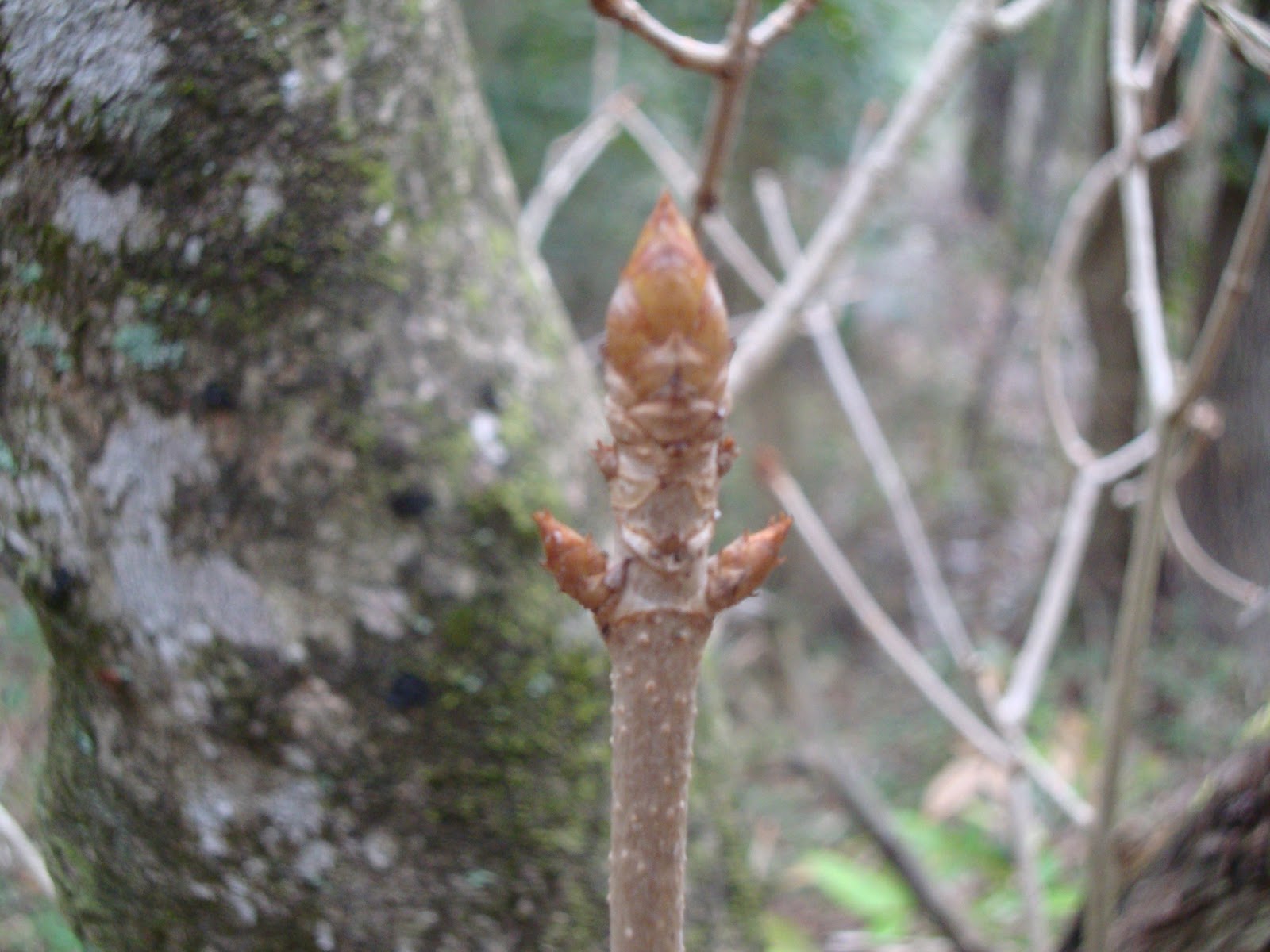
Red Buckeye (Aesculus pavia) overwintering buds

A couple of years later, when I moved to Austin, discovering the Red Buckeyes (Aesculus pavia) along the Greenbelt was a reunion of sorts.  Just as their relatives had in Ohio, the Red Buckeyes stood out in contrast to the late winter landscape, with fat terminal buds that swelled and turned red as the new spring leaves began to emerge.  Even more amazing, these familiar shrubs produced amazingly showy tubular flowers in clusters of red to pink to peach, flowers that I would expect to see on display in a botanical garden, not in flower in early spring in the xeric woodlands of central Texas.  I had trouble believing that these beauties were native wildflowers.

Red Buckeye (Aesculus pavia) flowers

Two varieties of Red Buckeye are native to central Texas – the common, red-flowered variety (Aesculus pavia var. pavia), which grows throughout the southeastern US as a small tree or large shrub, and a yellow-flowered shrub (Aesculus pavia var. flavescens) that is endemic to the western Edwards Plateau.  West of Austin, in the midst of the Hill Country, the two varieties hybridize and form peach- to pink- to orange-flowered varieties.  The showy flowers of both varieties appear in early spring, February to April, attracting hummingbirds, butterflies, and bees.  For me, spring has officially sprung when the buckeyes along the Greenbelt begin to bloom.

This year, the buckeyes began blooming later than usual due to the cold weather of early February, and it took three trips to the Greenbelt over the course of four weeks to document the shift from fat buds to open flowers. In mid-February, when the buckeyes begin blooming in some mild years, the overwintering buds were fattening and becoming more visible against the backdrop of late-winter browns but were showing no signs of opening into leaves yet.

Buckeye buds not yet open (February 19)

By late February, the buds on many buckeye shrubs had begun to open, turning pink as the leaves within began to expand.  On a few of the buckeyes, spring leaves were beginning to emerge, looking newborn, perfectly green, and not yet worn, torn, or faded by the rigors of the upcoming season.

Buckeye buds opening (February 26)

By mid-March, most of the buckeye shrubs had leafed out but were not yet flowering, still waiting for warmer, longer days and a stronger guarantee that the cold of winter was gone for good.

Buckeye after leaf out with flower stalk (March 13)

But a few buckeyes had begun to flower, officially beginning spring at the Greenbelt.  With the start of the central Texas summer less than two months away, that means that this spring, as with most springs, promises to be our shortest, fastest season.

Red Buckeyes begin flowering (March 13)

Thursday, March 3, 2011

First of Spring

Spring is the season of acceleration.  The sun shines warmer, closer, and longer, and the plants respond by growing faster and faster.  If we lived in a more temperate climate, I might have an easier time accepting this speeding up, but in central Texas the first warm day of spring reminds me of the many hot days of summer that are coming, and I can't help but feel a bit of dread as I watch the green of spring quickly overtaking the yellow of my winter-dormant front lawn.

In actuality, my lawn is really more of a mowed weed patch, and only part of the recent green glow is due to spring annuals, like Bedstraw, which looks innocuous now but which will easily take over the shadier parts of my yard in the next month or two.  Also germinating, or sprouting from last year's roots, are hardy perennial weeds like Straggler Daisy, which, once I have pulled or mowed the taller spring weeds, will have regained control of the shady sections of my yard by summertime.  But, while the Bermuda grass smartly waits a few more weeks to break its winter dormancy (if only it were so easy to kill the stuff), the real players in the sunnier parts of my yard are the winter annuals, those quiet, small weeds that germinated between the freezes and waited patiently for this, their moment of sunshine before the big weeds of spring take over.

Shepherd's Purse, a winter annual in the Mustard Family, is a reliable early season weed in my yard and it is easily recognizable by its flowering stalks holding heart-shaped fruits.  (Unfortunately I pulled a patch of them yesterday before thinking to take a picture.)  Henbit, a winter annual from Europe that has made itself at home in yards and disturbed areas throughout the US, also flowers in early spring, covering many lawns in east Austin with its tiny purple flowers.  Up close, Henbit (Lamium amplexicaule) has the attractive, tubular flowers and upright, square stems characteristic of the Mint Family.  Henbit grows close to the ground, making it a nice early-spring ground cover for those of us who aren't concerned about lawn purity, but, for serious lawn growers, I imagine that it is the first enemy of the season.

Henbit (Lamium amplexicaule) in a lawn

The real announcement that spring is here, though, doesn't come from the weeds in the lawn but from the trees above.  The American Elm (Ulmus americana) trees are always the first to bloom, usually in the first week of February.  This year, with our two coldest weeks at the start of February, the elms waited until later in the month.  Their tiny flowers were hardly noticeable except for the faint, green glow on the trees and the first of the spring pollen levels.  After flowering, the elm trees produced loads of light green, wafer-like fruits called samaras.

American Elm (Ulmus americana) samaras

Once they have matured and dried, the elm samaras will carry the seeds of the tree on the wind, much as maple-tree flyers (also a type of samara) do.  But for now, while the elm trees are covered in the young, green samaras of early spring, they are the most visible trees in the neighborhood, highlighted in the green glow of spring long before the surrounding trees have begun to leaf out.

American Elm (Ulmus americana) covered in samaras

While the elm trees are lit up in green, the cherry and plum trees of the area are covered in white flowers that are sweet-smelling as well as attractive, much to the delight of many nectar-starved bees, flies, butterflies, and wasps.  In the weeks right after the late-season freezes, the honeybees were so desperate for food that I was regularly finding them in my kitchen, drinking from the dish sponge, so it is a relief to see them employed again, happily buzzing from one spring blossom to another.

Cherry or plum tree (Prunus sp.) in flower

Two native species of plums, Mexican Plum (Prunus mexicana), a small tree common along waterways, and Creek Plum (Prunus rivularis), a thicket-forming shrub, contribute to the early-spring show of white flowers in and around Austin, but in town many ornamental species of plum and cherry also bloom at the start of spring, making identification difficult.  Plum and cherry trees bloom in clusters of white flowers that appear before the leaves or just as the leaves are opening.  Their flowers are five-petaled, with the many stamens and the radial symmetry characteristic of Rose Family flowers.

Cherry or plum (Prunus sp.) flowers

Texas Redbud (Cercis canandensis var. texensis) is a small, Pea Family tree that also blooms in the early spring, before its heart-shaped leaves expand.  Its rose-purple flowers decorate yards, parks, and wild spaces throughout Austin from late February and to early April, attracting bees, butterflies, and moths.  Texas Redbud is a drought-tolerant variety of the Eastern Redbud (Cercis canadensis) that is adapted to the limestone soils of the Edwards Plateau. 

Texas Redbud (Cercis canandensis var. texensis) flowers

The beauty of spring is in the stark contrast, of spring green in an otherwise brown landscape, or of bright white or purple against a deep blue sky.  To appreciate it, I had to get out in it, to feel the warmth of the sun and to smell the plum blossoms.  Then I got my shovel and gardening gloves and did some digging and weeding on the south side of my house, where the afternoon sun is concentrated.  Out in it, with my hands in the soil, my sense of dread, that spring and summer and all the planting deadlines in between are looming, finally faded away.  Because spring, short and fast as it is in central Texas, is a season of doing, not of worrying about the summer to come.

Sunday, February 27, 2011

The Greenbelt in February

I go to the Greenbelt to get away – away from my house and yard and all the work that needs to be done, away from all the distractions embedded in my daily routine, and away from my day job, which is "easy" and hourly yet still manages to come home with me.  The physical act of walking releases the catch in my brain that holds all those spinning thoughts, allowing the smells and sights and sounds of the woods along the creek to grab my attention and pull me out of my head and onto the damp trail under my feet.  So maybe it would be more accurate to say that I go to the Greenbelt in order to return, or to reset, to close all those windows that are open in the computer screen of my mind and to restart with just one focus, the plants of the forest along the creek.

Which is a huge expectation to have on the creek, and the trail, and all the plants that grow along it.  In that state of mind, distracted and restless and not sure whether I was ready to embrace the late start of spring, the season of acceleration, I went to the Greenbelt expecting to be dazzled by bright, fat Buckeye flowers and vibrant spring ephemerals.  Instead I found quiet.  The creek was still running, though barely so and only along the upstream half of the Greenbelt, the trees were still leafless, and the browned, crispy, long-dead grasses and herbs of last summer and fall still lined the trail and the creek.  Even the once-purple berries of the Beautyberry shrubs had shriveled and turned black.  The obvious landscape of greys and browns certainly wasn't about to grab my attention.


But the creek, even when it's barely running, and the experience of being out in the woods, even when the branches are bare, still has the effect of slowing me down, and, despite my impatience, I began to appreciate the damp smell of the woods and the misty, almost-raining morning that was contributing to the quiet.  Then I noticed the plants that thrive in the cool humidity and quiet between winter and spring.  The mosses seemed especially happy with the misty, damp conditions.


The ferns growing from the rock walls along the creek showed signs of freeze damage, with browned leaves and partially dead fronds.  But the ferns or parts of ferns that had survived the freezes of early February were growing as happily as the mosses, enjoying the non-stressful, humid weather.

Cliff Brake Fern (Pellaea ovata)

Once I began noticing some green, I realized that, actually, at the ground level, green was overtaking the brown.  New blades of grass were emerging from the leaf layer and green rosettes of annual herbs were establishing themselves, gathering strength to become the wildflowers of spring.


In the understory, native winter berries – red Yaupon and blue-black Silktassel – added color to the branches of evergreen shrubs.  Berries also hung on the branches of non-native shrubs, escaped from cultivation, including the small, blue-black fruits on Japanese Privet trees (Ligustrum japonicum) and Chinese Privet shrubs (Ligustrum sinese).  Nandina shrubs held huge clusters of red-orange fruits.  Nandina (Nandina domestica), like Japanese and Chinese privet, is a native of Asia that was brought to the US for use in gardens and has escaped from cultivation.  Unfortuantely, Nandina, Japanese Privet, and Chinese Privet are invasive and are spreading into streamside habitats around Austin.

Nandina (Nandina domestica) berries

And, though small and subtle, not yet grabbing my attention in numbers but there to be noticed as individual dots of color in the underbrush along the trail, the earliest wildflowers of the season were just starting to bloom.  The first wildflower that I spotted this season was Golden Grounsel (Packera obovata), a sunflower-family herb with bright-yellow flowers.  Golden Grounsel grows as a rosette of almost-round to oval leaves that become deeply lobed when the plant makes a flowering stalk.  Golden Groundsel prefers to grow in moist, calcareous soils and blooms February through April, making it one of the first wildflowers of the spring in central Texas.  Its yellow flowers attract bees and butterflies.

Golden Groundsel (Packera obovata) leaves

Golden Groundsel (Packera obovata) flowers

Roemer's Spurge, an annual herb of moist, shaded woodlands, was also beginning to bloom.  Roemer's Spruge (Euphorbia roemeriana) has unique leaves and branching.  The lower leaves on a stalk are alternate and elogated, then a whorl of three leaves gives rise to three stems, each holding an inflorescence (cluster of flowers).  The bract at the base of the inflorescence is almost circular, made of two fused leaves.  The flowers are tiny and bright yellow, appearing on the plants late February through May.

Roemer's Spruge (Euphorbia roemeriana)

Missouri Violet, a perennial herb that is a common spring ephemeral in moist, streamside woodlands throughout the central United States, was also blooming.  Missouri Violet (Viola missouriensis) is a perennial herb that grows as a rosette of heart-shaped leaves and blooms early in the spring, in February through April in central Texas.  Flowers on the wild violets signal that spring, though delayed by the cold weather and slow to get started this year, is on the way.

Missouri Violet (Viola missouriensis)

Saturday, February 19, 2011

Growing Mushrooms

Ah, the fungus – beautiful, magical, mysterious, dangerous, and, most of all, misunderstood.  To most people, a fungus is a mushroom, but really the kingdom of Fungi includes yeast, molds, and a variety of other lesser-known fungi as well as the famous mushrooms.  Even the mushrooms themselves are only the tip of the iceberg of what they really are.  A mushroom is to a fungus as a flower is to a plant – simply a reproductive structure.  Just as the flower on a plant is supported by the roots and stems and leaves that make up the body of the plant, the mushroom that we see growing above ground is supported by the "body" of the fungus underground, a vast network of mycelium, or branching, thread-like hyphae that absorb nutrients from the environment.

Cool fungus on a tree in western Oregon

Fungi are decomposers who get their nutrition from breaking down dead and decaying animals, plants, and organic matter.  In this, their need for nutrition from outside themselves, they are more like animals than plants, and DNA comparisons have revealed that, indeed, fungi are more closely related to animals (yes, that includes humans) than they are to plants.  Needless to say that, after centuries of not seeing most fungi and viewing mushrooms as non-green plants, we are only beginning to understand how they operate.  In particular, figuring out how and when and under what conditions fungi reproduce has proven to be challenging for many species.  Until recently, an entire phylum, the Fungi Imperfecti, was reserved for those fungi who never appeared to reproduce sexually.  We don't know if or how they reproduce so we call them imperfect – talk about projection.

Yet not all fungi have proven to be so mysterious or difficult, and one species in particular, Agaricus bisporus, by virtue of its easy-to-initiate mushroom formation and reliable productivity, has become the mushroom that Americans grow, and buy, and eat, the most.  Agaricus bisporus, a native mushroom that can be found growing wild in parts of California, often in association with Monterrey Cypress trees, now accounts for 90% of mushroom production in the US.  There are two common strains of Agaricus bisporus – a white strain known as the button mushroom and a brown strain called the crimini mushroom (or baby 'bella) when harvested small, with closed caps, or the portabella mushroom when it is allowed to mature and harvested once the cap begins to open.

A few years ago, recognizing that I was a mushroom lover with grow-it-yourself tendencies, my mom sent me a button-mushroom-growing kit for Christmas.  The coldest months of the year turned out to be the best months of the year to grow mushrooms in central Texas, and I successfully harvested many mushrooms.  I also discovered that, just as a store-bought tomato can't match the flavor of a homegrown heirloom tomato, the ubiquitous button mushroom of the grocery store lacks the flavor and texture of a homegrown, freshly-picked mushroom of the same, humble variety.  Eaten raw in salads, fresh button mushrooms are sweet and juicy, with a texture just this side of crunchy.  Cooked in olive oil or butter, homegrown button mushrooms have the texture and meatiness of portabellas and are just as good with pesto.  Since that first year, the mushroom kit became something of a yearly tradition.

Homegrown mushroom pizza

This year, I received my mushroom-growing kit (from Pulpit Rock Mushrooms in southeastern Pennsylvania, the epicenter of US mushroom production) in mid December.  Inside the box was a large bag of compost with Agaricus bisporus mycelium growing throughout.  Agaricus bisporus is a secondary decomposer, meaning that it lives on compost that has already been broken down by bacteria and other fungi.  The compost in my mushroom kit was made from horse manure, with small amounts of nitrogen, gypsum, and water added.  The manure was composted for three weeks then spent a week in a high-temperature (140˚ F) room for sterilization.  Following sterilization, the compost was inoculated with mycelium from a white strain of the Agaricus bisporus mushroom, which was allowed to grow throughout the compost.

Also included in the mushroom kit were instructions for growing mushrooms and a small bag of peat moss.  Per the instructions, I poured the peat moss into a large bowl, added four cups of filtered water, and mixed until the peat moss was uniformly moist.  I spread the moistened peat moss over the surface of the compost.  This step, of adding a surface layer of peat moss to the compost, is called "casing" and is what stimulates mushroom production.  Throughout mushroom production, the casing layer, which must be misted regularly, will also provide necessary moisture to mushroom mycelium.  After casing, I carefully re-closed the box and stored it in a cool closet for about 15 days.

In late December, I retrieved the mushroom box from the closet and opened it to check its progress.  White, strand-like, mold-like mycelium had grown throughout the casing layer, so it was time to set the box up for mushroom production.  I placed the box on an old Chronicle (it felt appropriate to use the "12th & Nowhere" edition) in an out-of-the-way spot that receives indirect, southern light.  I folded the plastic flaps of the compost bag over the box ends, which effectively held the flaps of the box upright.  I thoroughly misted the top layer of peat moss.

Ready for mushroom production (December 28)

At this point, mushroom production is stimulated by three things: temperature, sufficient moisture, and sufficient air exchange.  The ideal temperature range for button mushrooms is 55˚ to 65˚ F, but luckily button mushrooms are among the least-fussy of the fungus when it comes to making mushrooms.  In my experience, button mushrooms will produce in my warm, central Texas house in the winter months, when the household temperatures are in the 65˚ to 75˚ F range, but tend to give up once the sun-heated days of spring regularly warm the house over 80˚ F.

The other two requirements for mushroom production, moisture and fresh air, are in tension with each other.  The best way to maintain humidity above the compost and moisture in the casing layer is to cover the whole mushroom-kit box, which prevents water from escaping.  The problem is that covering the box also stops air flow, which causes the carbon dioxide levels in the air above the mushroom compost to increase, which then inhibits mushroom formation.  So the mushroom grower has to find the best compromise between moisture and air flow, and for every species that best balance is different.  Again, luckily, button mushrooms are forgiving relative to other mushrooms, but they will fail to produce mushrooms if the casing gets dry or air flow is too limited.

I have found that the best compromise for button mushrooms is to leave the box uncovered but to mist regularly, two or three times a day, to keep the surface of the casing moist.  Watering occasionally is not an option – the surface of the casing has to stay moist.  Over watering will damage the mushroom kit as well, but can be prevented by misting the casing layer rather than pouring water into the kit as if it were a plant.  I use a clean (absolutely no chemicals in it ever because the fungus are sensitive) spray bottle with a non-drippy fine mist setting, filled with filtered or spring water, to mist the kit a few times a day.  This method requires regular attention to the mushroom kit, but each misting takes only a few seconds and gives me a chance to check on the mushrooms.

That said, I tried doing things a bit differently this year because the instructions that came with my kit told me to cover the box with cardboard and to occasionally mist the surface with water.  Being a good direction follower, I covered the box, even though I had not done so with kits in the past.  At first, mushroom production seemed to get going as usual but only one, albeit large, mushroom grew in the corner of the box, where the cardboard cover didn't quite overlap with the box flaps, while the other mushrooms that had begun to form as "pins" turned brown and failed to mature.

First mushroom (January 17)

After the first, big mushroom, all was quiet in the casing layer.  No more pins, or bright-white knots of mycelium that develop into mushrooms, formed in the next few days.  I suspected that the cardboard cover over the mushroom kit was the problem, either because my few airings-out a day were not generating enough air flow, or because the cover was blocking the indirect, natural light of the nearby window.  (Though mushrooms will produce in darkness, indirect sunlight is helpful.)  So I uncovered the box and went back to the tried-and-true method of misting a few times a day.  After a few days without the cover, new, bright-white pins formed and began growing into large mushrooms.

Second harvest (January 30)

The first week of February brought four days of freezing temperatures, and, even with the heat on 24/7 that week, out-of-the-way corners of the house dropped into the mid sixties as the cold wind blew through the fifties-built, insulation-free framing of this house.  While the freezing temperatures outside were life-threatening for the garden, the cooler temperatures inside the house initiated a new flush in the mushroom kit.  The flush began in the "pinning" stage, as bright-white balls appeared in the casing layer.

The third flush "pinning" (February 3)

Each "flush," or group of mushrooms produced at one time, varies.  Some flushes include only one or two mushrooms, which are often quite large.  Other flushes produce several mid-sized mushrooms or many small-sized mushrooms.  The third flush produced by my kit this year included many, smaller mushrooms.

The third flush ready to harvest (February 10)

Thanks to a cooler-than-usual February in central Texas, my mushroom kit continued to be productive.  As soon as I harvested the third flush, pins for a fourth flush were already forming.  Today I harvested the fourth batch of mushrooms and, once again, more are on the way.  I'm looking forward to a fifth harvest and a couple more weeks of mushroom pizzas, salads, and quesadillas.

The fourth harvest (February 19)

Tuesday, February 15, 2011

After the Freeze

I spent the weeks of December and January worrying about the upcoming spring weather.  We have to eat all these greens, I kept telling Lee, and we did eat a lot of greens, though even as I harvested bowlfuls of greens I was happy to leave just as many plants in the ground, for all those future salads.  I thought I was staying one step ahead of the impending greens-flowering season, harvesting the most bolt-prone lettuces and greens first, but I wasn't even considering the possibility that I could lose my future salads to weather extremes from the cold end of the spectrum.

Then February began with a long, deep freeze punctuated by a rare snowstorm.  Most of the plants in my gardens survived, though I did lose a few lettuces in the front yard and all of the lettuces in the backyard.  After the storm, I removed dead plants and the frost-killed leaves from surviving plants, and cleaned the gardens up for recovery.

Then we were hit with another arctic blast.  Last Wednesday morning, I ventured out into the frigid wind to cover the front-yard garden in Plankets only to discover that all of the plants were coated in a fine layer of ice, frozen solid.  I spent the rest of the morning wondering what I should have done differently – should I have covered the garden the night before, and if so, how would the Plankets have fared through the heavy rain that preceded the front, or should I have covered the garden at six in the morning, when I woke to the sound of all the screens on the house banging as the front dropped temperatures?  Luckily, the garden unfroze that day and we were able to cover it before the deep freeze of the next two nights.  Still, the damage of the freezing rain was done, and I knew that, once again, I would be removing dead plants and frost-killed leaves from the garden.

On the other side of those two weeks of extreme cold, my gardens are reduced.  In the backyard, only collards, spinach, and cabbages remain, though I still hope that the beets and chard will regrow from their mulched roots.  From the front-yard garden, I lost the fenugreek, most of the parsley, and most of the lettuce.  After the snow, I harvested all of the remaining tatsoi, which were making visible preparations toward flowering, and most of the remaining bok choy, leaving only a few plants to continue growing.  Both the tatsoi and bok choy were crowded, raggedy, and heavily insect-damaged, definitely past their prime.  Next year, I need to remember that the Asian greens grow the fastest and should be harvested first, as fall greens.  After the snow, and again after the next deep freeze, I also had to remove many of the largest leaves from the chard plants.  They will survive but this starting over increases their chances of flowering this spring.


The toughest loss for me to accept is that of the lettuces.  They have been perfect eating size for several weeks now and I have been harvesting them as needed, taking the tallest, most bolt-prone first, and leaving the rest for another week of salad eating.  In the backyard were a few small red oak-leaf lettuces that I wish harvested sooner, but they were growing slowly in the low-light conditions, so I thought I had time.  In the front yard was a large, beautiful head of Buttercrunch lettuce that I was saving for ... well, I'm not sure what I was saving it for, but just that I was saving it because I love saving the best for my future self.  That lovely lettuce survived but lost most of its outer leaves, and, even if it does regrow, it is too late to recapture that moment when it was exactly just ready for harvest.


I did have one row of plants in my backyard garden that were actually invigorated by the weeks of freezing, snow, and ice – the mâche.  Mâche (Valerianella locusta), which is also called corn salad or lamb's lettuce, is a lover of cold weather.  In fact, I've had trouble growing mâche because it won't germinate until the soil is cool, which isn't until mid-November in Austin, it is slow-growing, and it really flourishes in the coldest weeks of winter, which we often don't have.  Once the weather warms, the mâche bolts as fast as spinach, so its window for growth is quite short and, in some warm years, non-existent.  But I continue to try to grow mâche because it is delicious, with a sweet, nutty flavor, and difficult (though, in recent years, no longer impossible) to find at the grocery store.

Mâche (Valerianella locusta)

Yesterday, as I was clearing the remains of the lettuce from the backyard garden and noticed that my row of mâche was looking particularly vibrant, I decided that it was time to harvest.  A few weeks ago, I might have tried to wait, or to harvest part of the row and save the rest for some more-auspicious future date.  But if the freezes have reminded me of one thing, it is this: feast when it is ready because next week's weather, and therefore next week's harvest, is uncertain.  So I harvested the whole row and Lee and I enjoyed big bowls of mâche salad for dinner.  I slept particularly well last night, and, given that mâche is in the Valerian Family of plants, I can't help but wonder if the salad helped my sleep.  Or maybe it was just the satisfaction of finally harvesting part of my garden at the exact right moment – just after the freeze but before the hot days of early spring that are soon to follow.

Friday, February 11, 2011

Winter Berries

In between the rainstorms of January and the arctic fronts of February, Lee and I have been exploring the hiking trails in the Bull Creek Preserve.  Bull Creek Preserve, one of the City of Austin's sections of the larger Balcones Canyonlands Preserve, is nesting habitat for the Golden-Cheeked Warbler, an endangered songbird that nests exclusively in Edwards Plateau region of Texas.  To minimize disturbance of the birds during their mating season, the preserve is closed (except to entry-permi holders) from March 1 through July 31.  The preserve, which is located within the Bull Creek watershed between St. Edwards Park and the Bull Creek Greenbelt, includes 150 acres of juniper and oak woodland.  Because several intermittent creeks, tributaries of Bull Creek, originate in and cross through the preserve, the terrain is hilly, with the limestone slopes and steep, narrow canyons characteristic of the Hill Country.

Bull Creek Preserve in winter

The preserve has six miles of trails, including a longer loop and a few shorter loops.  From the Bull Creek Greenbelt, the lower trail (go to the left at the entrance map), is the most scenic, with a short, steep climb up to an viewpoint overlooking the falls on Bull Creek below.  That trail drops back down to the creek and follows the greenbelt trail back to the entrance point.  The rest of the trails (go to the right of the entrance map) wind up and down on a limestone-gravel path that is mostly shaded but periodically offers good views of the juniper-forested hills of the preserve.  The only disappointing section of the trail is the northern-most part of the main loop, where the trail follows an access road used by the Austin Water utility trucks.

The dominant tree in the preserve is Ashe Juniper (Juniperus ashei), which is usually called "cedar" by Austinites.  The densely-branched juniper trees provide nesting sites for the Golden-Cheeked Warblers.  I also saw many Plateau Live Oak (Quercus fusiformis) trees and a mix of deciduous trees without their leaves, mostly Cedar Elm (Ulmus crassifolia) and, especially on slopes and hilltops, Spanish Oak (Quercus buckleyi) trees.

Three evergreen, fruit-bearing shrubs were the noticeable part of the understory.  In sunny clearings, Evergreen Sumac (Rhus virens) branches held many fuzzy, red-orange fruits.  The Evergreen Sumac is dioecious, which means that male and female flowers are produced on separate plants, and the fruit of the shrub provides food for birds and small mammals.  The fruit are high in vitamin C and, if soaked in water, can be used to make a tart-tasting tea.

Evergreen sumac (Rhus virens)

The evergreen shrub common along the shady to part-sun sections of the trail was Yaupon (Ilex vomitoria), a native holly that produces bright red, shiny berries if it receives enough sunlight.  The densely-branched shrub provides nesting and hiding spots for birds, and its berries are food for birds and small mammals.  Like the Evergreen Sumac, Yaupon shrubs are also dioecious, with separate male and female plants.

Yaupon (Ilex vomitoria)

A third, evergreen shrub holding many blue-black fruits grew in sunny woodland openings.  I had seen this shrub along the Greenbelt trail earlier in the fall, so I knew that it was common in our area, but despite its evergreen leaves and distinct blue-black fruits, I had not been able to identify the plant.  This time around I noticed that the branching pattern on this mystery shrub was familiar to me and looked just like the branching pattern of Viburnums or dogwood trees, with strictly opposite branches and V-shaped nodes.  But the dogwoods, which are usually restricted to streamsides in our area and have distinct, parallel-veined leaves that I know by sight, and the Viburnum common to central Texas, Rusty Blackhaw (Viburnum rufidulum), have deciduous leaves.  Eventually, by searching through shrubs related to dogwoods and Virburnums, I found my plant, Lindheimer Silktassel.

Lindheimer Silktassel (Garrya ovata spp. lindheimeri) used to be classified in the Dogwood Family but was reclassified into its own family, the Garryaceae, or Silktassel Family.  Lindheimer Silktassel is a subspecies of Silktassel that is endemic to the Edwards Plateau, where it is common on rocky slopes and limestone ledges, or as an understory shrub at the edge of wooded areas.  The blooms of Lindheimer Silktassel appear in the spring, followed by round fruits that are blue with a whitish coating.  By winter, when much of the whitish coating is gone, the fruit appear blue-black in color.  Lindheimer Silktassel grows to be a large shrub or small tree and provides shelter and food for birds.

Lindheimer Silktassel (Garrya ovata spp. lindheimeri)

Like the Evergreen Sumac and Yaupon, the Lindheimer Silktassel is dioecious, with separate male and female plants.  Overall, being dioecious is unusual in plants – most are monoecious, with male and female flowers on the same plant, or, more commonly, male and female parts in the same flower – yet all three of these evergreen shrubs are dioecious.  Maybe it's just good strategy in a juniper forest, where the dominant tree itself, Ashe Juniper, is also dioecious.

I would like to think that all these winter berries will be food for the Golden-Cheeked Warblers in March, when they return from their wintering grounds in Mexico and Central America and begin establishing territories and nesting in the hills of the preserve.  But warblers eat insects and spiders found in the leaves and bark of the trees, not berries.  Still, healthy shrubs provide shelter for the birds and food for other birds and mammals in the preserve, which promotes biodiversity in the preserve and in the larger Bull Creek watershed, which ensures that the Golden-Cheeked Warblers will continue to have a place to nest in central Texas.

Tuesday, February 8, 2011

Garden in Snow

I made the mistake of thinking that winter was already over.  We were past the end of our most-likely freeze window and February, the month in which the elm trees bloom and the red buckeyes at the Greenbelt flower, was beginning.  But I was getting ahead of myself again, forgetting that winter in Austin, though short and mild overall, is highly variable day to day, wildly unpredictable year to year, and tends to recur long after spring is underway.

The snow on Friday morning was the highlight of the storm.  In thirteen years of living in central Austin, I've never seen actual snow – not ice or hail – accumulation on the ground.  So when I woke to a white world on Friday morning, instantly the storm of the past few days became the snowstorm of 2011 and my memory of the freezing days that preceded the snow day faded.  This day was the day of the snowstorm.


In reality, Friday, the day of the snow, was also the day of the thaw, the day of sunshine and temperatures above freezing for the first time since Tuesday.  For the plants in my gardens, the snowfall was merely the last trial at the end of three long days of freezing temperatures and frigid winds.  And, despite what I say about the seriousness of our bouts of winter and the unpredictability of our cool season, nearly 70 consecutive hours of freezing temperatures is not something that I expect for my garden to have to endure in this climate.  Before the snow fell, before the novelty of my first Austin snow day rewrote my memory of the week, I was worried about my plants and upset about the injustice of our climate, in which hard freezes are infrequent enough to warrant severe-weather status yet reliable enough that growing tropical plants is out of the question.


I grumble about the freezes but I've learned to expect them, even as I am planting my fall garden in the heat of October.  I only plant greens that can withstand the common, light freezes of the cool season, and I devote more garden space that I might like to the real cold-hardy plants, like kale and collards, that can handle ice storms, near-0˚ F wind chills, and other "freak" winter events that could otherwise wipe out my entire garden.  This year I've also been covering most of my front-yard garden in Plankets, 10 x 20 foot plant blankets made out of thick, green row-cover material, whenever the night temperatures are predicted to fall into the mid-20's or lower.

Front-yard garden under Plankets and snow

The Plankets seem to help, or at least they give me something to do in the face of an impending freeze, but using them tends to mash down the tallest of the plants and, even though I strive to put them in place near sunset and take them off as soon as temperatures warm in the morning, deprives the plants of a few hours of sunlight.  Last week, though, with temperatures remaining below freezing for nearly three days in a row, my front-yard garden was covered in Plankets for about 70 hours, from Tuesday afternoon until midday on Friday, when Lee helped me to toss away the snow (heavy!) and give the plants a few hours of fresh air and sunshine.


Out from under the Plankets, the garden looked rough – smashed by the weight of the snow, frost-bitten, and winter-weary.  Though I felt cruel covering the plants up again, we covered the garden again on Friday night because we still had one more hard freeze to endure before our "normal" balmy winter conditions returned on Saturday, allowing us to finally put away the Plankets until the next round of severe weather.  As the gardens, front- and backyard, began their recovery, the question on my mind was:  Do the Plankets help more then they harm?

The backyard garden wasn't covered during the storm.  In fact, I haven't covered that garden at all this year.  It's in a more protected location, with less direst north wind exposure, it contains a higher proportion of cold-hardy plants like cabbages and collards, and it's been something of an experiment this fall, seeing if that space gets enough light, can withstand lower temperatures, etc.  So, while the microclimates of the two gardens differ somewhat, the backyard garden, which was not covered during the extended freeze or the snowstorm, offers a point of comparison to the Planketed front-yard garden.

Backyard garden under snow

In both the front-yard and backyard gardens, I am growing lettuces, Swiss chard, spinach, and beets.  While the tall chard plants in the front yard were being smashed under the Planket, the chard plants in the backyard were covered in snow.


After the snow melted and the warm temperatures returned, the chard in the backyard looked mostly dead.  The leaves were translucent and mushy, lying on the ground wilted.  Only a few of the inner-most leaves of those chard plants appeared to have survived.  I am hopeful that, even though the current leaves on those plants were lost to the storm, the plants themselves are likely to regrow from their roots, which were protected from freezing by a deep layer of mulch.


The chard in the front-yard garden, which was covered with the Plankets, fared better.  After days of being covered, the plants were bent, with some broken stems and frost-bitten leaves, and smashed and generally looked abused.  But overall the leaves on those chard plants were still upright and alive looking, ready to rebound from the storm.


Judging from the (very unscientific) comparison of the covered vs. uncovered chard, using the Plankets saved valuable garden produce.  Other comparisons support those results.  The lettuces in the backyard garden were killed by the cold temperatures and/or snow, and, like the backyard chard, their leaves turned to mush.  Some of the lettuces in the front-yard garden were killed, but the majority of the plants in the row survived, with frost-damaged outside leaves.  Cilantro and parsley, relatives in rows next to each other, had different fates as well.  While the cilantro was covered during the storm, the parsley was not, simply because the 20' Planket didn't quite reach that far, so while the cilantro survived the storm, the parsley was wilted and white when the snow cleared.  So the Plankets do help more than they harm, but, even knowing that, I hope that I don't have to use them many more times this year.